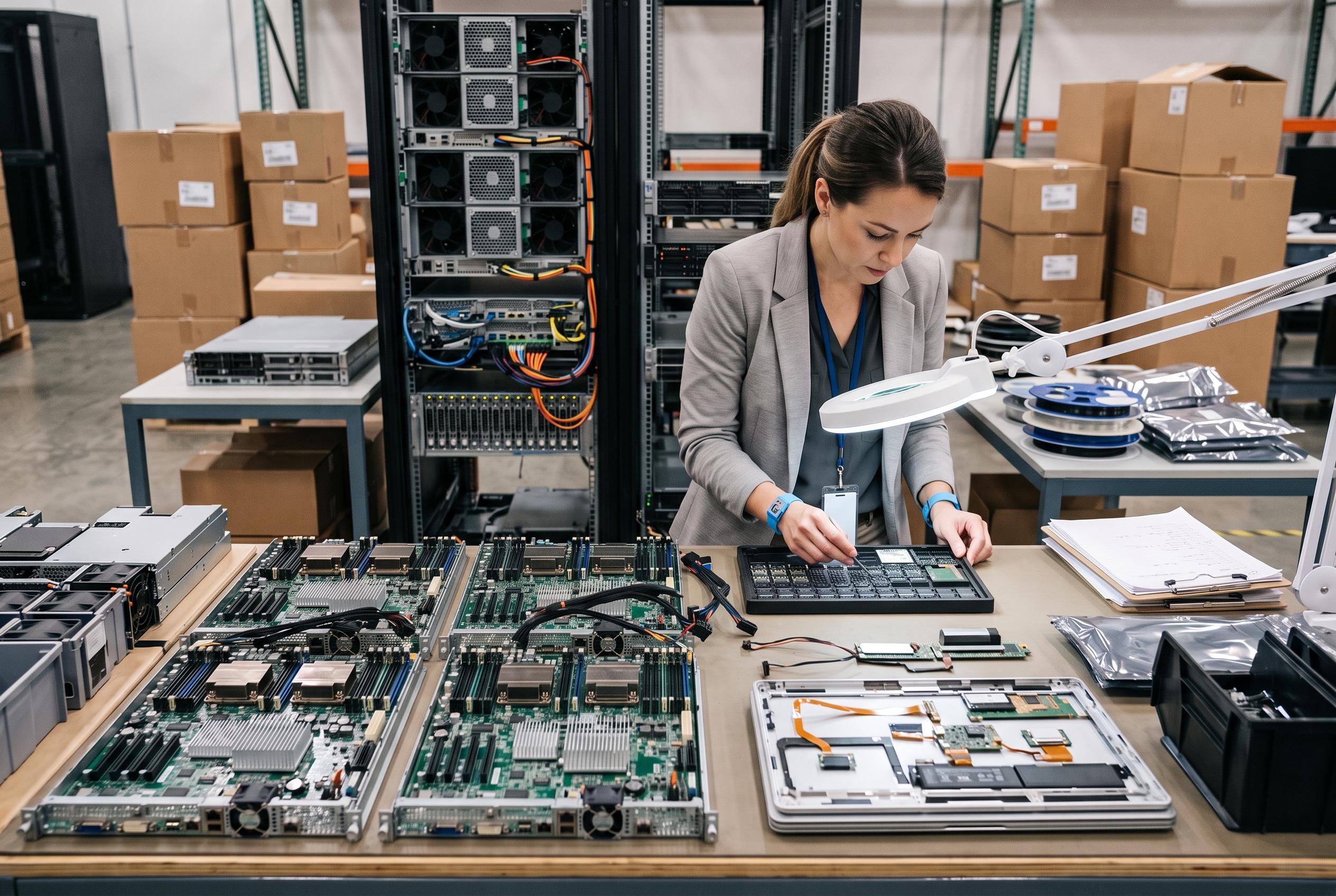

Rising costs for notebook components have led Quanta Computer to take a more assertive stance with HP, as the Taiwanese manufacturer pivots towards serving its booming AI server market and shifts away from traditional PC supply chains.
Rising notebook component costs have sharpened tensions between Quanta Computer and one of its biggest laptop customers, HP, as the Taiwanese contract manufacturer seeks to defend margins in a market where its business is increasingly driven by servers rather than PCs. Market sources said Quanta briefly halted production of HP laptops in September after price talks broke down, before output resumed following intervention from HP executives and agreement on an adjustment to costs. Quanta declined to comment on any individual customer dispute.
The stand-off comes at a time when laptop makers are facing a much harsher cost environment. HP has separately acknowledged that RAM prices have surged, with memory now representing a far larger share of laptop build costs than in earlier quarters, and the company has said it expects to lift notebook prices to pass on at least some of the pressure. The broader PC supply chain is also contending with higher prices for CPU, printed circuit boards, passive components, batteries, power-management chips and wireless parts, while some of the most expensive items are still supplied by the brand owner rather than the factory. When manufacturers try to redesign around cheaper parts, they must also pay for fresh engineering work, validation and certification, which can add further cost and delay.
What makes Quanta’s move notable is that it would have been far more difficult in the company’s old notebook-centric era. According to recent company disclosures and industry analysis, servers accounted for more than 80% of Quanta’s sales in the second quarter, while notebooks fell to the low double digits. That shift has been driven by the rapid expansion of AI server shipments, which now make up the bulk of server revenue and continue to grow both in volume and average selling price. Some forecasts cited by analysts suggest the company’s server business will remain dominant, with AI infrastructure continuing to take share from consumer electronics and with demand for customised systems and liquid-cooling solutions reshaping the market.
Industry observers say that change in mix helps explain why Quanta could take a harder line with HP than it once would have done. In the notebook business, ODMs depend on large production runs to absorb fixed costs and usually have limited room to walk away from a major brand order. But in servers, especially AI systems sold to cloud customers, the balance of power has shifted towards the factory side as Taiwanese manufacturers such as Quanta, Foxconn, Wistron and Inventec capture a larger share of the market. At the same time, rising component costs in AI hardware, including GPUs, high-bandwidth memory and storage, are forcing ODMs to rethink their procurement models and, in some cases, move towards consignment arrangements in which customers supply key parts directly.
That leaves Quanta trying to protect notebook pricing even as PC demand softens and the long-term outlook for the category appears weaker than the current AI server cycle. Supply-chain sources said first-half pull-forward buying by brands is likely to be followed by a softer second half for notebooks, with weakness potentially lasting into 2027. For HP and other PC makers, the result is a narrower set of choices: absorb more of the inflation, raise retail prices or shift more orders to lower-cost Chinese ODMs that are willing to forgo fees such as NRE and tooling charges in order to win business.
Disclaimer: This content is intended for informational purposes only. Readers are advised to exercise their own judgement, conduct due diligence, or consult a qualified expert before acting on any information provided.