

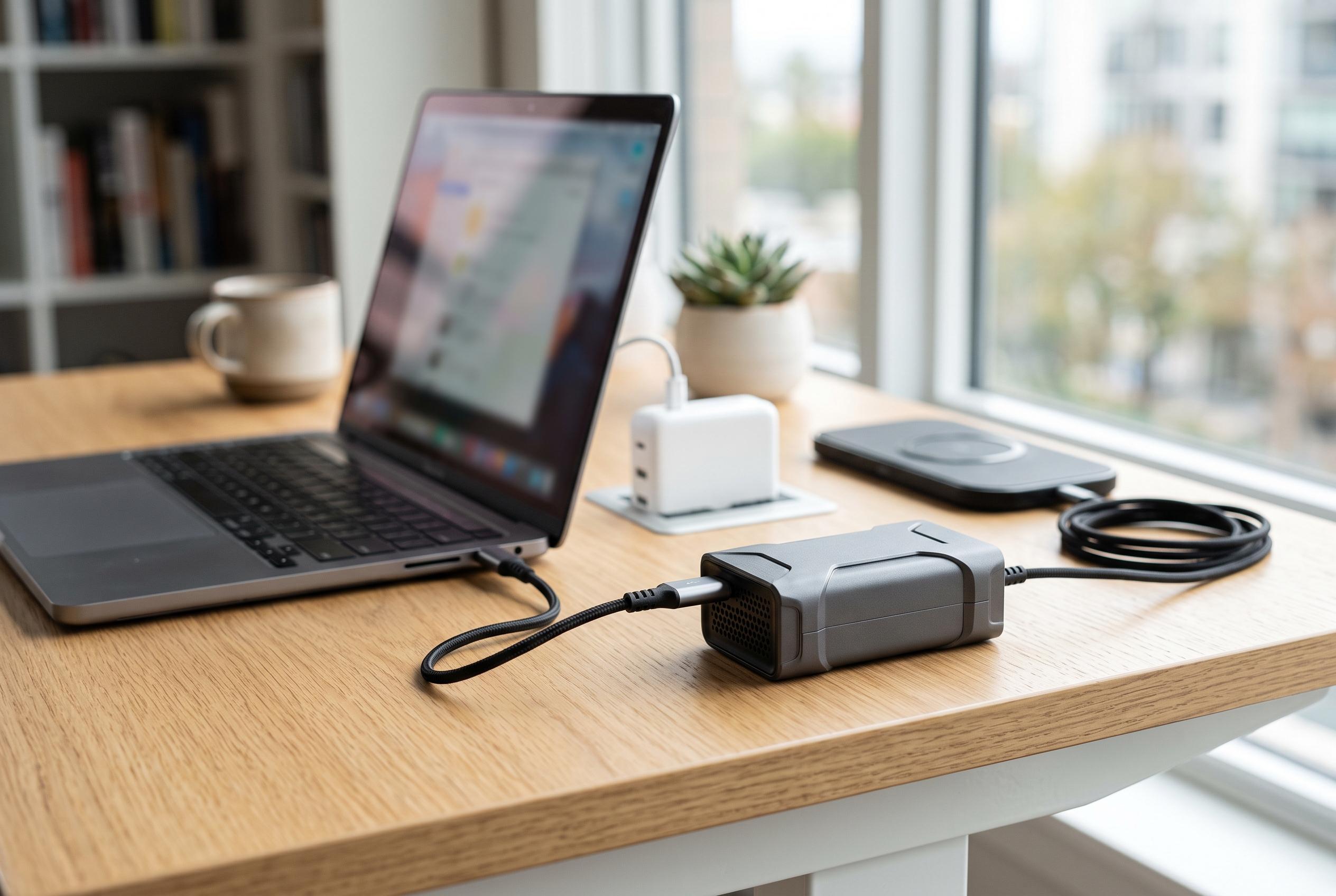

A recent comparative test reveals that while retractable USB-C chargers offer unmatched convenience, they vary significantly in heat management, stability, and long-term durability, leading consumers to weigh convenience against reliability.
Retractable USB-C chargers are starting to solve a familiar problem for laptop users: how to carry a single wall adaptor without ending up with a separate cable, a bundle of accessories and, eventually, worn insulation at the point where the cable is repeatedly bent. In a recent comparison of five 65W models with integrated retractable leads, the blogger tested whether the convenience came with hidden compromises in heat, output stability and physical durability.
The test was deliberately practical rather than laboratory-based. Because standard Linux tools did not expose the laptop’s true input power, the writer used a script that read charger data directly from the Framework laptop’s firmware. Each charger was run against a stressed CPU, with measurements taken at the start and after about an hour, alongside temperature readings from both a thermal camera and an infrared thermometer. The result was a field test focused on sustained delivery, not just peak specifications.
The Ugreen Nexode X605 emerged as the most conservative option. It was the heaviest and bulkiest of the group, but it also proved the most controlled thermally, topping out at 56C and holding a steady 55W to the laptop in the blogger’s test. That broadly aligns with other reviews, which describe the charger as a compact cube with a built-in cable, three charging outputs and a strong emphasis on safety features and durability claims. TechRadar found the retractable lead delivered up to 60W on its own, while Macworld said the integrated cable extends to about 70cm and the whole unit weighs roughly 195g.
By contrast, the Mcdodo FreeGo and the unbranded YKEJCLD model showed how compact chargers can become thermally constrained. The Mcdodo started near 54W but fell to 41W after an hour, suggesting throttling, although its maximum temperature remained lower at around 53C. The YKEJCLD was the lightest and smallest charger in the comparison, and it maintained 57W, but it also ran very hot at 69C. Both of those models shared a design weakness common to some retractable chargers: the cable bends sharply as it locks back into the housing, which could prove to be a long-term stress point.
The Topadre and Baseus models sat closer to the middle of the pack, but for different reasons. The Topadre was among the smallest chargers tested and had the longest cable, and it held a full 60W throughout the test. That came at a cost in heat, however, with a measured peak of 64C and a casing that became hot to the touch. The Baseus Enercore was larger and heavier, with a thicker cable and a Euro plug positioned to spare adjacent sockets in a power strip, but it failed to sustain full output, slipping from 58W to 47W while remaining relatively cool at 47C. That trade-off may matter to buyers who prioritise neatness and outlet access over raw charging consistency. Android Central’s review of Stuffcool’s Zeno 65W charger suggests the category is still broadening, with some brands choosing shorter cables, dual USB-C layouts or PPS support to improve compatibility rather than chasing maximum compactness.
Taken together, the results point to a market that is useful but not yet settled. The blogger did not declare a single winner, instead favouring the Topadre for its combination of size and cable length, while still warning that long-term thermal stress remains a concern. The Ugreen looked safest from a quality standpoint, but it was also the least elegant and the heaviest. For buyers, the practical question is no longer whether retractable cable chargers are convenient; it is which compromise matters least, whether that is bulk, heat, cable geometry or sustained power delivery.
Disclaimer: This content is intended for informational purposes only. Readers are advised to exercise their own judgement, conduct due diligence, or consult a qualified expert before acting on any information provided.



