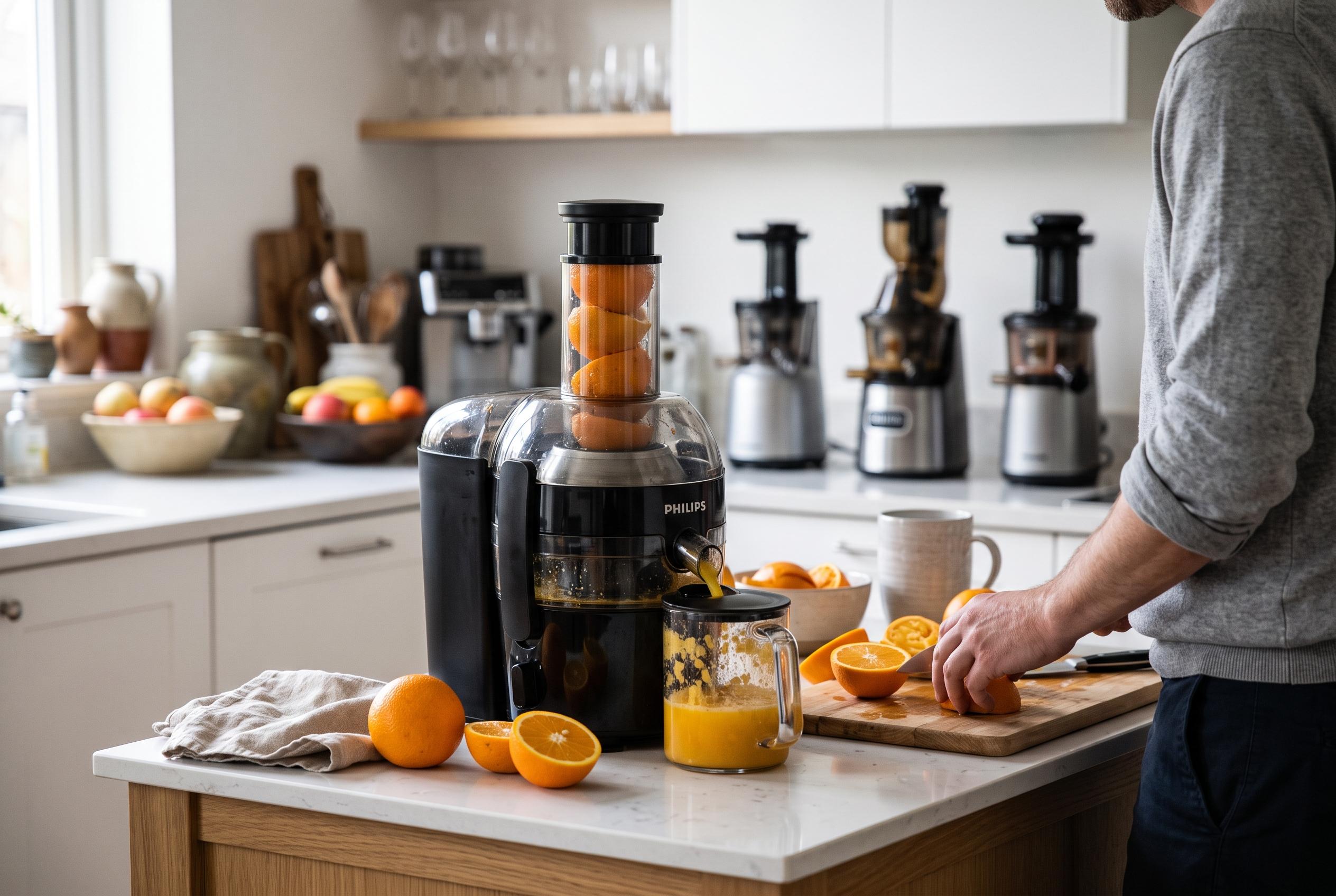

The Philips HR1921/20 took top spot for juice yield and convenience, while the WMF Kult X was named the best-value option and the Braun Multiquick J700 the quietest.
CHIP’s latest test of eight centrifugal juicers suggests that the category is more varied than its simple operating principle implies. All of the machines work in broadly the same way, yet they differ sharply in juice yield, noise, flavour and ease of cleaning. Priced between about €30 and €170, the models were assessed on practical use with oranges and carrots, giving a clear picture of what buyers can expect from fast, everyday juicing. According to CHIP, the Philips HR1921/20 came out on top, while the WMF Kult X took second place and also served as the publication’s price tip.
The Philips HR1921/20 impressed first and foremost with output. CHIP said the 1,100-watt machine, which reaches up to 14,000 revolutions per minute, delivered the best orange yield in the test and performed strongly with carrots as well. The juicer also benefits from a broad 80mm feed tube, which reduces preparation time, and Philips’ QuickClean system, designed to make rinsing out the machine after use significantly easier. CHIP also noted that the Philips was one of the quieter machines in the group, although it did tend to drip a little after juicing.
The WMF Kult X finished close behind and won praise for a different set of strengths. CHIP highlighted its clean design, straightforward operation and notably full, vivid-tasting juices. WMF says the appliance uses a 500-watt motor, a 74mm feed tube, dishwasher-safe parts and a 1.2-litre juice container with a 1.8-litre pulp container. In CHIP’s testing, those practical features were matched by respectable output from both oranges and carrots, although the machine was also among the loudest in the field. WMF also markets the model with a removable citrus attachment, underlining its versatility beyond standard centrifugal juicing.
A further model that stood out was the Nutrilovers Quick-Juicer, which CHIP placed in the upper half of the table and described as a lifestyle-oriented option. The package includes extras such as a recipe book and a glass bottle with an insulating sleeve, while the packaging is designed to reduce plastic waste. CHIP found the juicer capable of producing solid results with both oranges and carrots, though it judged the feed tube a little awkward at times and the noise level higher than ideal. The brand, run by the Munich-based SW Commerce GmbH, appears to be positioning the product as much around presentation and accessories as around raw performance.
The Braun Multiquick J700 occupied the middle of the ranking but was notable for a different reason: it was the quietest juicer in CHIP’s test. Despite its 1,000-watt motor, the machine measured lower noise levels than many rivals, and CHIP also liked its large 1.2-litre container and safety interlock, which prevents operation unless the lid is properly closed. Juice yield was solid rather than exceptional, and the unit was criticised for some drips after use and for a slightly delicate feel to the plastic parts. Braun’s engineering, however, was still enough to make it a credible choice for households that want less noise in the kitchen.
At the more specialised end, CHIP singled out the Nutribullet NBJ100G for hard produce, while the Severin ES 3570 and Pearl NC3631-944 were framed as more limited but cheaper alternatives. The Nutribullet produced particularly good results with carrots and avoided the post-juicing dripping seen on several competitors, helped by a closing flap at the spout. By contrast, the Severin offered only modest extraction and produced a thinner juice with noticeably more pulp, while the Pearl model was judged suitable only for soft fruit. CHIP’s least convincing result came from the Juilist 600 W juicer, which delivered acceptable output on paper but was disqualified in practice by a burning smell from the motor and a generally poor finish.
The broader lesson from CHIP’s test is that centrifugal juicers remain appealing because they are quick, simple and usually easier to clean than many slower alternatives. But the trade-off is clear: speed can come at the cost of noise, warmth and some oxidation, which may affect flavour and shelf life. CHIP’s advice is to choose carefully according to use case. Households wanting convenience and speed may prefer a centrifugal machine, whereas anyone seeking a gentler extraction method may be better served by a slow juicer. For buyers focused on daily orange juice, carrot juice or both, the test shows that the best choice depends as much on noise, cleaning and build quality as on motor power alone.
Disclaimer: This content is intended for informational purposes only. Readers are advised to exercise their own judgement, conduct due diligence, or consult a qualified expert before acting on any information provided.