

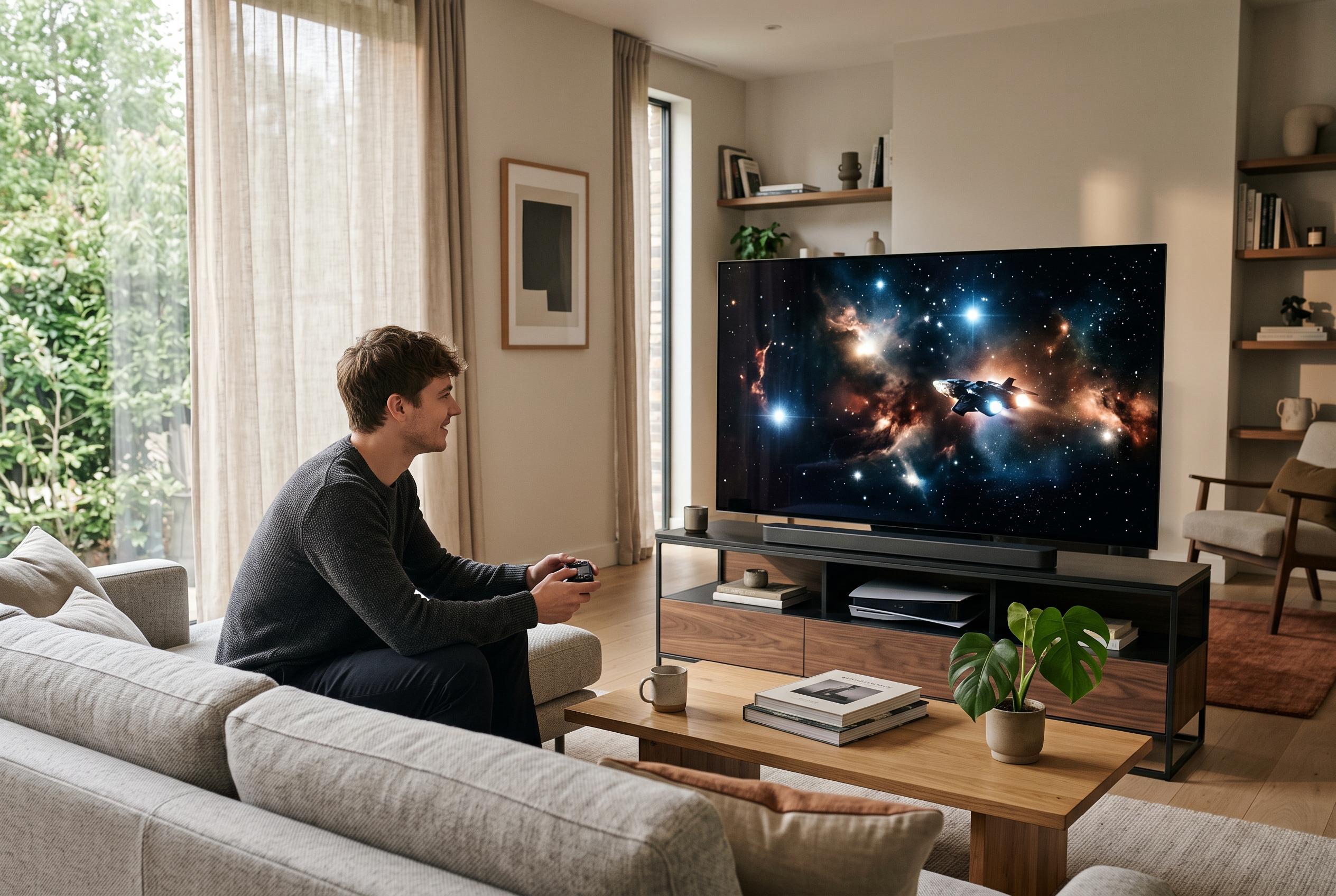

The R95H brings Samsung’s new Micro RGB backlight, 165Hz gaming and impressive black levels to the premium TV market, but reviews find its picture and sound fall short of OLED rivals at the same price.
Samsung’s first mainstream RGB Mini LED television arrives with an imposing specification sheet and an equally ambitious price tag, but the early evidence suggests that the technology is not yet enough to upend the premium TV market. What Hi-Fi? says the R95H is the company’s flagship Micro RGB set for 2026, positioned as the backlit counterpart to Samsung’s OLED top model, the S99H. In practice, though, the review concludes that it is neither the strongest example of its own new display type nor a convincing alternative to similarly priced OLED rivals.
At launch, the 65-inch model carried a UK price of £3,299, with US and Australian pricing broadly in line. That places it directly against Samsung’s own S99H OLED, which was introduced at the same level in the UK and Australia, and alongside other premium RGB Mini LED sets such as Sony’s Bravia 9 II and Hisense’s UR9. The result is a tightly contested market in which Samsung appears to be offering customers a choice between two flagship paths rather than a single clear best-buy option. What Hi-Fi? notes that the R95H has already seen discounts in the UK, reinforcing the likelihood that street prices will matter far more than launch figures.
Design is one of the R95H’s stronger points. According to What Hi-Fi?, the set is only around 3cm thick, with a flat rear panel, slim bezels and a central pedestal that creates a floating-screen effect. Assembly is refreshingly straightforward, with the stand clipping into place without tools. Samsung’s familiar remote package is less impressive, however. The review criticises the reuse of the company’s long-running handset design at this level, even if the inclusion of USB-C charging and solar charging remains welcome. RTINGS also notes that the set runs Samsung’s 2026 Tizen software and includes four HDMI 2.1 ports, underlining that the R95H is aimed squarely at buyers wanting a do-everything premium television.
The most significant selling point is, of course, the new Micro RGB backlight. Samsung says the LEDs are less than 100 microns across, allowing a denser arrangement of red, green and blue light sources behind the panel. In theory, that should improve colour control and local dimming. RTINGS describes the technology as Samsung’s attempt to extend the colour capabilities of standard Mini LED, while What Hi-Fi? reports that its 65-inch sample had 1,344 dimming zones, fewer than the Sony Bravia 9 II it compared it with. The set also supports HDR10, HDR10+ and HDR10+ Gaming, but not Dolby Vision, which remains a notable omission in a premium TV market where HDR format support is often a deciding factor. Gaming support is broad, with 4K at up to 165Hz, variable refresh rate and auto low-latency mode all available across the four HDMI 2.1 inputs.
The problem, according to the review, is that the R95H’s specification strength does not translate into a best-in-class picture. What Hi-Fi? found that black levels were impressive for a backlit TV, with restrained blooming and decent shadow detail, while colour balance was judged more subtle and, in some scenes, more natural than the brighter presentation of Samsung’s OLED. But in the review’s preferred picture modes, the set lacked the depth, brightness precision and dimensionality of the S99H. Scenes from Oppenheimer, The Matrix and Civil War were all used to show that the OLED delivered greater impact, better three-dimensionality and more convincing highlights. TechRadar and Forbes reached broadly similar conclusions, saying the R95H has useful brightness and strong detail but still falls short of the best OLEDs for overall image quality.
Sound is another weak spot. What Hi-Fi? says the R95H can produce a wide and spacious presentation in less demanding material, aided by its 70W 4.2.2-channel speaker system, but bass-heavy scenes quickly expose distortion, recessed midrange and a lack of composure. The set is also judged too quiet overall, even at full volume. Samsung’s Q-Symphony feature can combine the TV speakers with a compatible soundbar, although the review urges caution, suggesting that the result is not always superior to using the soundbar alone. Taken together, the R95H looks like a technically advanced television that proves Samsung’s new panel technology can work, but also one that arrives before the company has fully closed the gap to the best OLED sets or even the strongest RGB Mini LED rival from Sony.
Disclaimer: This content is intended for informational purposes only. Readers are advised to exercise their own judgement, conduct due diligence, or consult a qualified expert before acting on any information provided.



