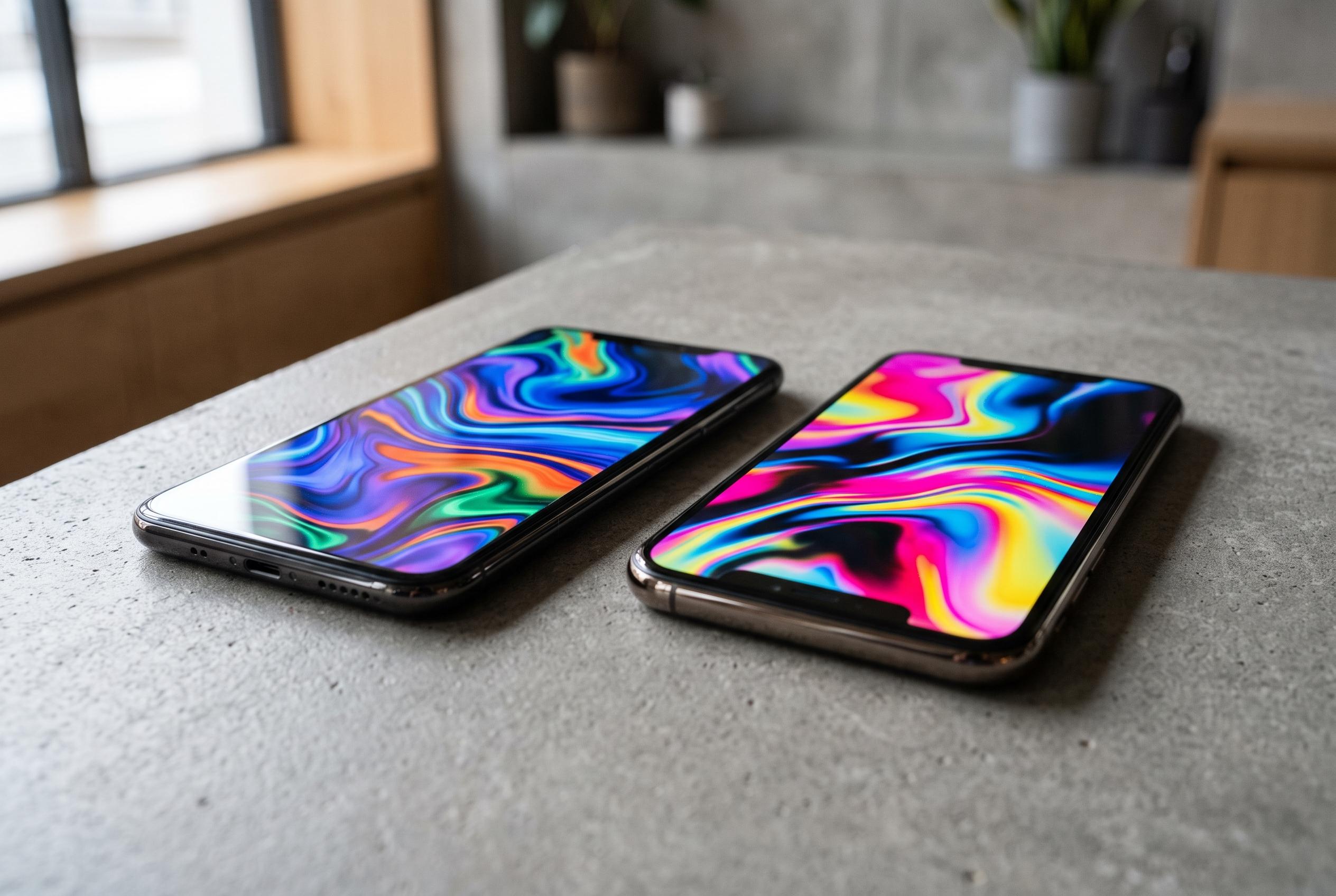

A direct comparison suggests Samsung’s flagship screen is sharper, more configurable and more feature-rich than Apple’s, despite both phones drawing on the same OLED supply chain.
A persistent claim in smartphone circles is that Apple somehow receives a superior class of OLED panel from Samsung Display, even when both companies are buying from the same industrial chain. The case for that idea is hard to prove, and the more useful test is a direct comparison of what the two firms actually ship in their flagship phones. On that basis, the display in Samsung’s Galaxy S26 Ultra appears more configurable and, in several respects, more technically ambitious than the panel in the iPhone 18 Pro Max.
On paper, the two screens are broadly similar in size, refresh rate and panel type, but not in specification depth. Independent comparison sites list both as 6.9-inch LTPO OLED panels with 120Hz refresh, yet Samsung’s display carries the higher resolution at 1440 x 3120 and a sharper pixel density of around 500ppi, versus 1320 x 2868 and about 460ppi on the iPhone. Review data also points to stronger feature depth on the Samsung side, including adjustable resolution, colour temperature controls and a privacy mode that limits side-angle viewing.
Brightness is more nuanced. Some comparison tables place the iPhone’s peak brightness at 3,000 nits, with the Galaxy at about 2,600 nits, while the Russian-language review cited in the lead article claims a higher manual brightness ceiling and a more usable adaptive mode on Samsung’s handset. In practice, that means Apple may win the headline number, but Samsung appears to retain the stronger real-world balance when the screen is being used at different brightness levels and in more varied lighting conditions.
The bigger difference is in implementation rather than raw panel class. The lead review argues that Samsung still calibrates its phones more aggressively at the factory, which it says reduces visible variation from one unit to another. Apple, by contrast, is said there to rely on a less customised approach for the panels it buys, resulting in differences in white balance and overall tone across devices. That claim is difficult to verify independently, but it aligns with the reviewer’s broader point that identical component sourcing does not guarantee identical tuning.
Samsung also uses the display as the foundation for a wider set of phone functions. The S26 Ultra includes an under-panel fingerprint reader, a privacy viewing mode and support for the S Pen, all of which depend on design choices that go beyond basic brightness or resolution. The iPhone 18 Pro Max, according to the comparison sources, lacks those extras and remains the more restrained product. That does not make it a poor screen; it does mean Samsung’s panel is being used in a more feature-rich way, with more user control and more hardware built around it.
The broader conclusion is less about brand mythology than about product philosophy. Samsung’s flagship display is the more elaborate component, with more settings, higher pixel density and more supporting features. Apple’s screen is competitive on core quality, and in some published comparisons it leads on peak brightness, but it is also more closed and less adjustable. For readers trying to judge whether iPhone panels are fundamentally superior because Apple buys them from Samsung, the evidence here points in the opposite direction: the panel may come from the same industrial family, yet the finished experience is still shaped by calibration, software and the number of features the manufacturer is willing to expose to the user.
Disclaimer: This content is intended for informational purposes only. Readers are advised to exercise their own judgement, conduct due diligence, or consult a qualified expert before acting on any information provided.