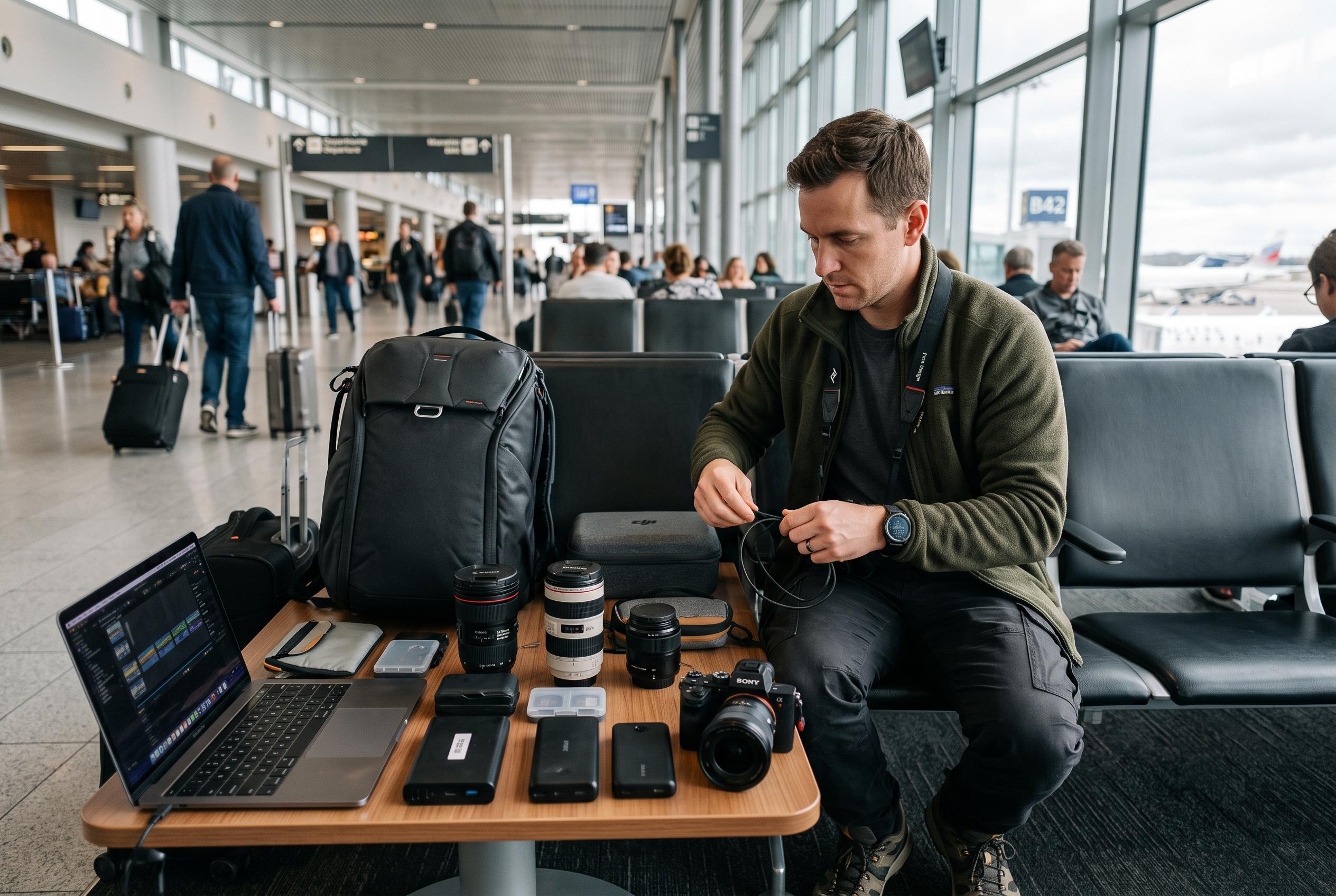

From hidden AirTags to certified power banks, a photographer’s travel routine shows why protecting essential kit means planning for the rules at every airport on the journey.
Travel with camera gear is often lost or damaged in small moments rather than dramatic ones. A checked bag misses a belt, a charger is packed in the wrong case, or a battery is pulled at security, and a routine journey can quickly become a problem for anyone carrying files, lenses and a laptop.
For Laura BC, the first line of defence is an AirTag. She says she places one in her checked suitcase and another inside her camera bag, hidden rather than attached on the outside. That approach helped her recover a missing bag after it was taken off the carousel and left to one side of the airport. Apple’s tracking tag works through the Find My network, and guides from MacRumors note that it is widely used for luggage because its low-power battery keeps it within aviation limits while still allowing location updates.
Her second rule is that anything hard to replace should travel in the cabin. That includes chargers, which many travellers still leave in checked luggage for convenience. In major cities, replacing a lost laptop charger is usually simple; on smaller islands or in less well-equipped transit hubs, it can mean days without power. Laura BC says she keeps almost all of her kit with her and checks only her travel tripod, using a Brevitē backpack that can hold a Sony a7R V, a Sony a7C II, two lenses, a drone and batteries while remaining relatively discreet. She says that low-profile design matters as much as storage when travelling alone with expensive equipment.
Power banks have become a more complicated part of the packing list. Laura BC says she learned, while preparing for a trip to China, that power banks there need the CCC mark, the country’s compulsory certification. She later saw that rule enforced during a transfer in Shanghai, where uncertified units were removed from passengers one by one. Travel guidance from Chinese aviation sources says domestic flights in China require the 3C certification mark, and that power banks without it can be confiscated. Those rules sit alongside broader airline restrictions: spare lithium batteries are barred from checked baggage, capacity limits are often expressed in watt-hours, and some carriers also restrict how a power bank may be used in flight.
Recent airline policies underline why travellers need to check the rules for every leg of a journey, not just the departure airport. The Federal Aviation Administration already prohibits spare lithium batteries in checked bags, while in 2025 China’s aviation authorities tightened enforcement on uncertified power banks. Southwest began requiring passengers to keep power banks visible while in use, and Emirates said it would not allow their use onboard from 1 October. For anyone carrying camera batteries, drone cells and a phone that doubles as a map, boarding pass and payment method, the practical lesson is straightforward: the rules of the transfer airport matter as much as those at the origin.
The rest of Laura BC’s list is less about compliance and more about workflow. She argues against relying on an airport SIM card and instead lands with mobile data already active. Her adapter can charge several devices at once, which makes long layovers more useful for editing. She pairs a 4TB SSD for working files with a separate hard drive for a second copy, backing up each day rather than waiting until the end of a trip. And for long-haul flights, she prefers a better pair of Bose QuietComfort headphones, plus an accessory that makes airline-issued earbuds less punishing to use.
Disclaimer: This content is intended for informational purposes only. Readers are advised to exercise their own judgement, conduct due diligence, or consult a qualified expert before acting on any information provided.