


Heat, cold and moisture can damage portable chargers or create safety risks. Here is how to store, charge and retire a power bank safely in changing weather.
Power banks should be stored indoors in a cool, dry, shaded place and kept away from direct sunlight, heaters and other heat sources. The most important rule is not to treat every device the same: the correct storage and charging limits are model-specific, so the owner’s manual remains the deciding reference. Industry guidance from Xiaomi, Anker and the U.S. fire authorities all points in the same direction: avoid heat, avoid moisture and do not assume that one universal temperature range fits every portable charger.
That matters because a power bank is a compact lithium-ion system with battery cells, control electronics and protective circuitry packed into a small case. Heat accelerates battery ageing and can worsen an existing fault; moisture can corrode contacts; and impact damage can create hidden internal problems. Anker’s safety guidance sets a storage and operating range of 0°C to 35°C, while Xiaomi’s support page for the Mi 50W Power Bank 20000mAh recommends a cool, dry environment between 5°C and 35°C, away from sunlight and heat sources.
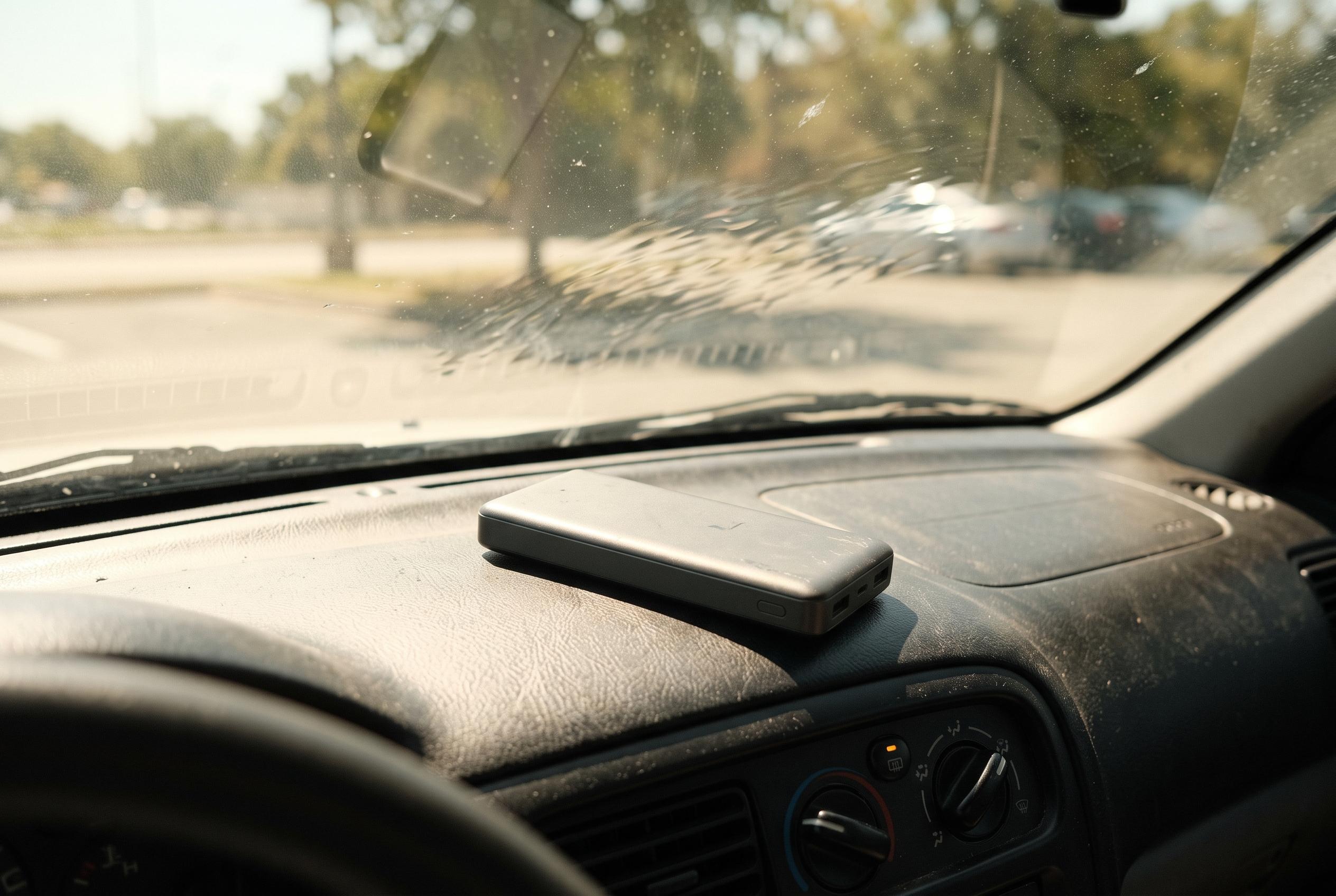
Hot weather calls for particular caution. A parked car is a poor place for a power bank because cabin temperatures can rise well above the ambient air, especially in direct sun. If a bank feels hot, it should be disconnected and left to cool naturally at room temperature on a non-flammable surface. It should not be put in a freezer, chilled with ice or forced to cool with direct airflow from a hair dryer or similar device. The U.S. Fire Administration, citing National Fire Protection Association guidance, says lithium-ion batteries should be stored at room temperature when possible and should not be charged below 0°C or above 40°C. Anker’s guide uses an even narrower charging and storage band of 0°C to 35°C.
Cold weather presents a different problem. A power bank taken from a freezing backpack, garage or vehicle may lose output, shut down under load or refuse to charge until it warms. That does not necessarily mean permanent failure, but it does mean the unit should be brought indoors and allowed to return naturally to the temperature range specified by its maker before use or charging. Moisture control is important during that transition, because condensation can form when a cold device meets warm air. Do not try to speed the process by placing the bank on a radiator or beside another heat source.
Long-term storage is also model-specific. Anker recommends keeping a power bank at roughly 60% charge and checking or recharging it every three months, while Xiaomi advises periodic charge and discharge cycles over longer storage periods to preserve battery health. Other guides suggest similar maintenance habits, usually in the 50% to 70% range, but those figures are not interchangeable with each other. The safest approach is to follow the exact charge level and inspection interval in the product documentation, keep the unit dry and unplugged, and retire any battery that swells, leaks, smells chemical, vents gas or shows persistent overheating.
Physical protection helps, but only within limits. A pouch or sleeve can stop keys and coins from touching the terminals and can reduce scratches or impact damage, yet it does not make an overheated car safe or override the manufacturer’s temperature limits. If a power bank is damaged, recalled or showing abnormal behaviour, it should be taken out of service immediately and disposed of through the manufacturer’s instructions or the relevant hazardous-waste route rather than household rubbish.
Disclaimer: This content is intended for informational purposes only. Readers are advised to exercise their own judgement, conduct due diligence, or consult a qualified expert before acting on any information provided.



