

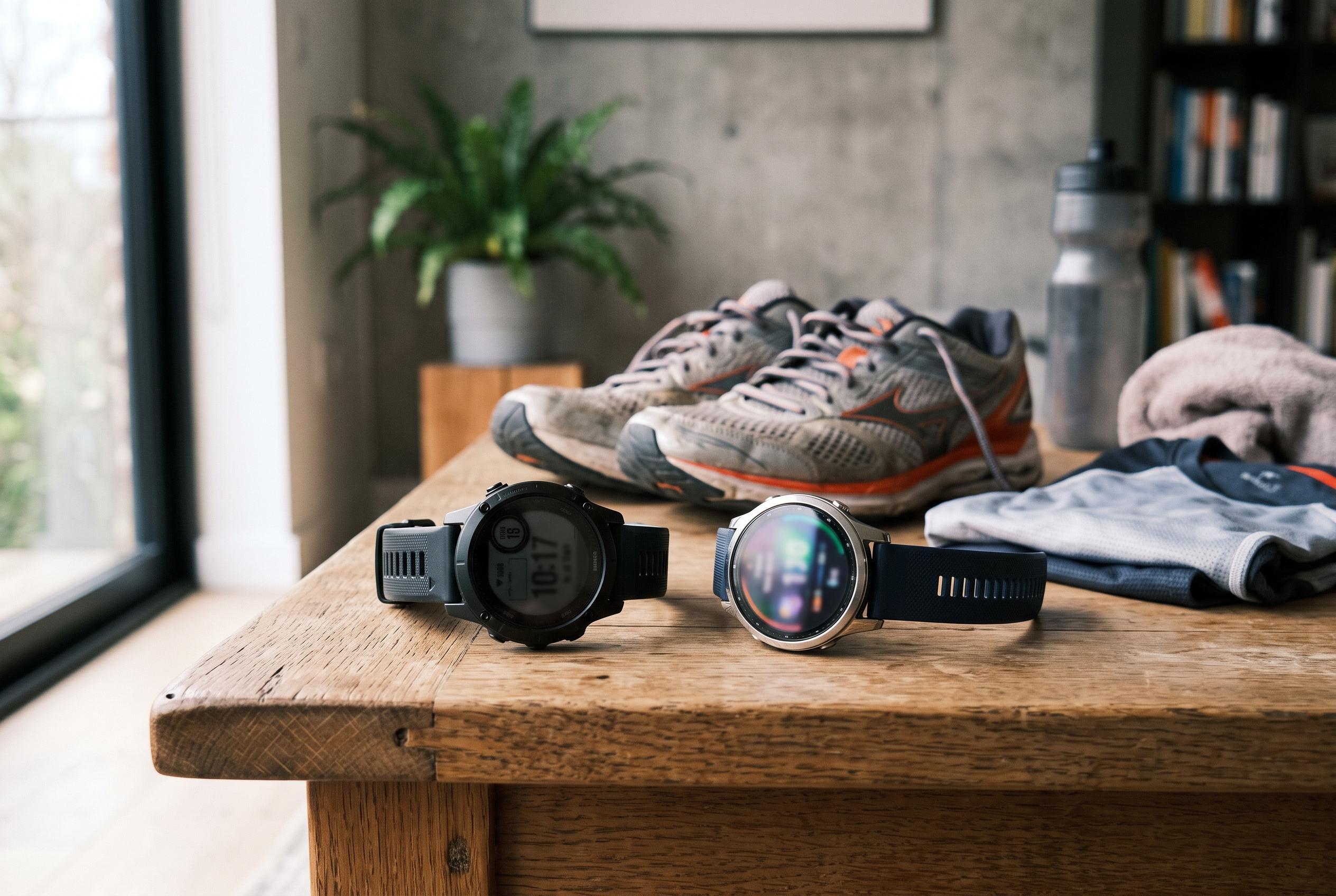

Garmin’s entry-level running watches share the essentials, but the Forerunner 55 prioritises simplicity and battery life while the Forerunner 165 adds an AMOLED display, richer training data and broader health features.
For runners choosing an entry-level Garmin watch, the Forerunner 55 and Forerunner 165 answer slightly different needs. The 55 is the more straightforward option, built around core running tools and long battery estimates, while the 165 adds a brighter AMOLED display, touch controls and a wider spread of health and training functions. Wareable’s comparison and other buyer guides draw the same broad line: the 55 is the simpler running companion, whereas the 165 is the more feature-rich upgrade.
Both watches are capable of taking a beginner through the first stages of structured training. Garmin equips each model with built-in GPS, wrist-based heart-rate tracking and guided workout support. The 55 includes Garmin Coach plans for 5K, 10K and half-marathon goals, as well as PacePro pacing guidance, cadence alerts and recovery time estimates. According to Garmin-focused comparison guides, the 165 extends that package with additional training detail such as running power, running dynamics, Training Effect and course support, which may be useful once a runner begins asking more specific questions about effort and progression.
The clearest hardware divide is the display. The Forerunner 165 uses a 1.2-inch AMOLED panel with touchscreen input, while the 55 relies on a smaller 1.04-inch transflective MIP screen and physical buttons. Garmin’s own positioning and independent summaries point to the same practical trade-off: the 165 is easier on the eye and more smartphone-like to navigate, but the 55 is often preferable in wet conditions, in cold weather or during interval sessions when buttons can be more dependable than swiping. The 165 is also slightly heavier, although the difference is marginal.
Battery life tilts the other way. Garmin quotes up to two weeks in smartwatch mode and up to 20 hours in GPS mode for the Forerunner 55, compared with up to 11 days and 19 hours respectively for the standard Forerunner 165. That makes the older model appealing for people who want to charge less often or expect longer outdoor sessions. As with any manufacturer estimate, real-world battery performance depends on settings, notifications, sensor use and satellite mode. The 165 does offer a battery-saver mode and additional display options, but the 55 remains the stronger pick on paper for endurance between charges.
Health and lifestyle features also separate the pair. Summaries of Garmin’s specifications note that the 165 includes sleep score, sleep insights, nap detection, Pulse Ox readings, Garmin Pay and a morning report, alongside support for more than 25 activity profiles. The 55 is more limited in that respect, but it still covers daily activity tracking, stress monitoring, relaxation reminders, Body Battery and Garmin Connect’s menstrual-cycle and pregnancy tracking tools. For many first-time runners, those functions may be enough; for users who want a watch to serve as a broader health companion, the 165 has the clearer advantage.
Music is another point that can trip up buyers. Garmin distinguishes the standard Forerunner 165 from the Music version, and only the latter supports phone-free listening with onboard storage. That matters for runners who want to leave their handset behind. For anyone who will carry a phone anyway, the standard 165 and the 55 both remain viable run-tracking choices, with the decision then coming down to the display, the extra training data and the appetite for more everyday smartwatch features. In practical terms, the 55 is the better no-frills buy, while the 165 is the more future-proof option if the price gap is modest and the added functions are likely to be used.
Disclaimer: This content is intended for informational purposes only. Readers are advised to exercise their own judgement, conduct due diligence, or consult a qualified expert before acting on any information provided.



