

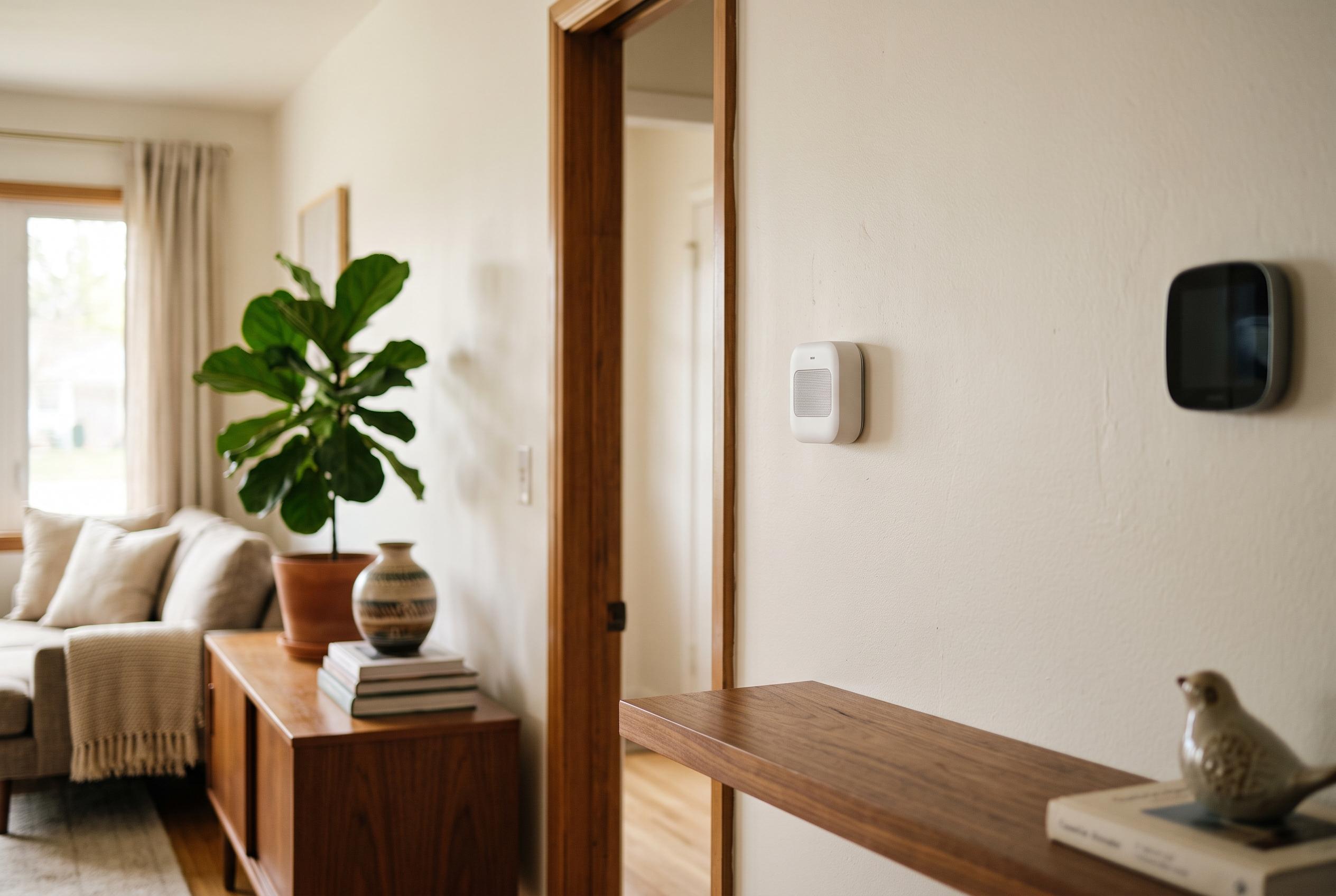

The latest Z-Wave sensors combine temperature readings with humidity, dew point, leak, motion and freeze detection, giving hub-based smart homes more useful room-level data.
Z-Wave temperature and humidity sensors remain a practical choice for homes where climate control depends on room-level data rather than a single thermostat reading. According to the guide, the most useful devices in this category do more than report temperature: some add humidity, dew point, leak detection, motion sensing or even window status, giving automation systems enough context to trigger fans, dehumidifiers, heating changes or freeze protection. The key distinction is that these products do not connect directly to Wi-Fi. They need a compatible Z-Wave hub, and their usefulness depends heavily on where they are mounted and how often they are set to report.
Among dedicated climate sensors, the Aeotec aërQ stands out for homes where moisture risk matters as much as heat. SmarthomeCompared says the device measures temperature, humidity and dew point, with S2 security, SmartStart pairing and a compact coin-cell design suited to discreet indoor placement. That makes it especially relevant in basements, closets and bathrooms, where dew point can be a better warning sign than temperature alone. By contrast, the Zooz ZSE44 is presented as the more general-purpose option for users who want a small, focused sensor for everyday room monitoring. SmarthomeU describes it as a compact temperature and humidity device with broad compatibility across major Z-Wave hubs, making it suitable for spreading around a house without much visual clutter.
For rooms that need more than climate data, the Aeotec MultiSensor 7 and TriSensor 8 show how Z-Wave devices are increasingly doubling up on functions. The MultiSensor 7 combines temperature, humidity, light, UV, motion and vibration, and the guide notes that USB power is a major advantage because it allows more frequent reporting and also lets the unit act as a mesh repeater. The TriSensor 8 is narrower in scope, but still useful where motion, light and temperature are the main requirements. SmarthomeCompared says it uses the 800 Series chip with S2, SmartStart and Long Range, while also offering temperature readings with claimed accuracy of ±1°C. In practical terms, that means it is better suited to lighting and occupancy logic than to humidity-driven automations.
Leak protection is another area where climate sensing becomes more valuable. Z-WaveProducts says the Aeotec Water Sensor 7 Pro combines flood detection with temperature and humidity monitoring, and includes a 36-inch probe for placing the sensing point exactly where water is most likely to appear. That makes it useful in basements, utility cupboards and around appliances, where one device can cover both incident detection and ambient dampness. The guide also highlights newer hybrid devices such as Aeotec’s Water Sensor 8 and Door Window Sensor 8, which extend the same idea further by adding climate data to leak or contact sensing. This is a sensible development: in many homes, the most actionable climate alerts come from devices already placed near windows, floors or plumbing.
Not every reader needs a temperature graph. In some cases, a threshold alarm is enough. The Ecolink flood and freeze sensor is included for exactly that reason, since its value lies in warning at a specific low temperature rather than logging continuous readings. Likewise, the guide’s outdoor and bathroom-focused picks reflect the fact that placement matters as much as specification. Outdoor sensors need weather resistance and good shading to avoid false heat readings, while bathroom sensors need to detect humidity spikes quickly without being placed in direct spray. The most suitable device is therefore not always the one with the largest feature list, but the one whose sensing profile matches the room and the automation you actually want.
The broader pattern across these products is that Z-Wave still works best as a local, hub-driven system. That is especially true for mixed environments with Home Assistant, Hubitat, SmartThings or HomeSeer, where users want climate data to feed rules even when the wider internet is unavailable. Battery-powered devices save energy by reporting only at intervals or after a meaningful change, while USB or mains-powered models trade convenience for faster updates and, in some cases, stronger mesh performance. For buyers comparing options, the most important question is not simply whether a sensor measures temperature, but whether it also provides the extra signal the room needs: humidity, dew point, leak detection, motion or freeze warning.
Disclaimer: This content is intended for informational purposes only. Readers are advised to exercise their own judgement, conduct due diligence, or consult a qualified expert before acting on any information provided.



