

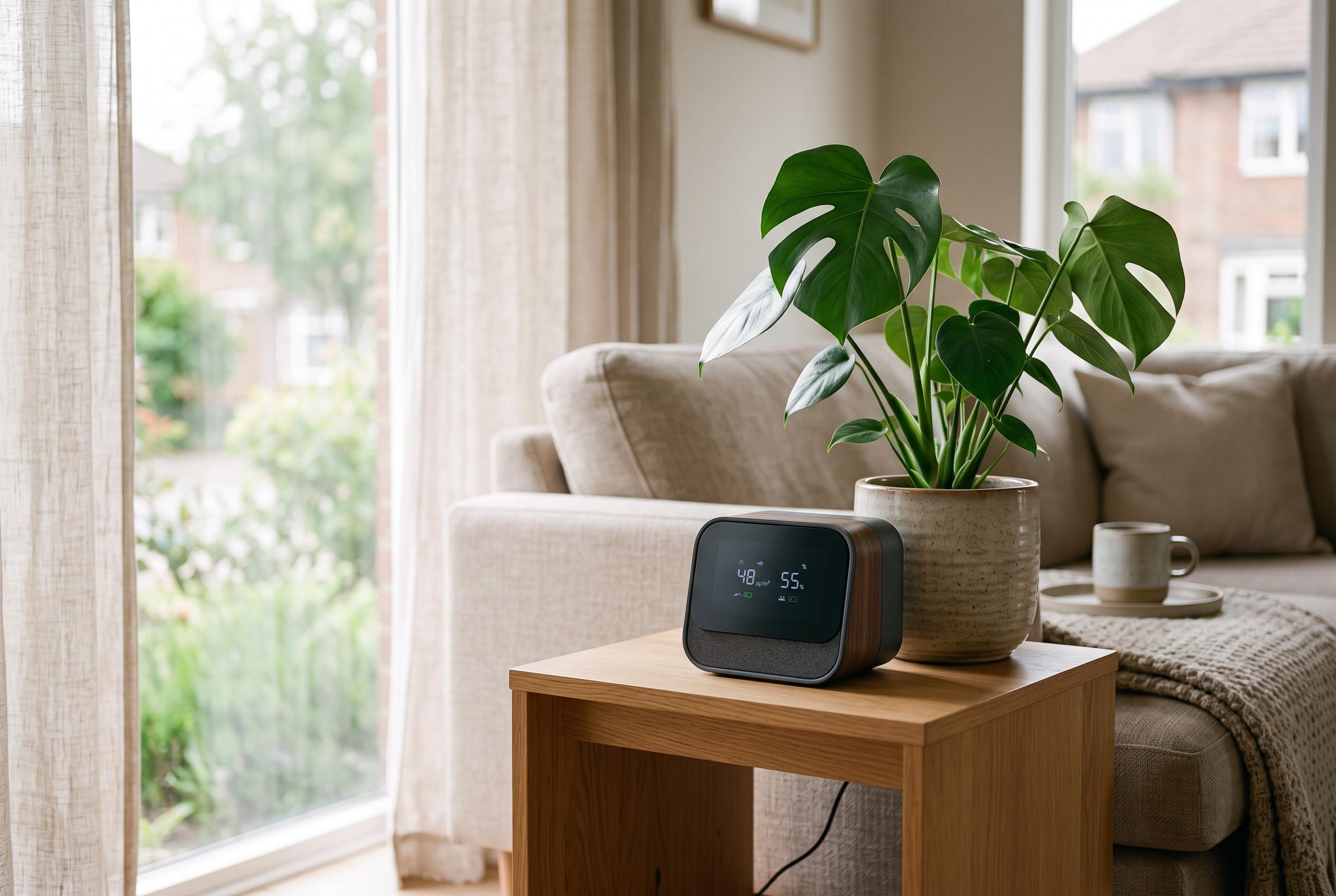

Ring’s compact Air Quality Monitor delivers accurate PM2.5 alerts and Alexa automation at a low price, but its lack of volatile organic compound detection limits what it can reveal about indoor pollution.
The Ring Air Quality Monitor is a simple, low-cost device aimed at households that want early warning of poor indoor air without paying for a more elaborate system. Priced at $69.99, it tracks fine particulate matter, carbon monoxide, temperature and humidity, and is positioned as a straightforward companion for the Ring ecosystem. It does not measure volatile organic compounds, which means it leaves out one category of indoor pollution that some rivals, including Amazon’s own Smart Air Quality Monitor, do cover.
That omission matters because indoor air can deteriorate quickly. The CDC says PM2.5 consists of fine particles small enough to travel deep into the lungs, while the World Health Organisation and the Environmental Protection Agency both note that cooking, heating, smoke and aerosol products can push those levels up indoors. Those pollutants are associated with asthma flare-ups and other respiratory problems, which is why a monitor that detects spikes early can be useful even if it does not purify the air itself.
In design terms, Ring has kept things compact and restrained. The unit is screenless, about the same size as Amazon’s competing monitor, and uses a plain white casing with a front intake grille and a top-mounted LED to signal status. Setup is handled through the Ring app, where users scan a QR code, select a home and complete a brief connection process before the monitor begins sending alerts. The device relies on Amazon Sidewalk rather than Wi-Fi, and it integrates with Alexa, but not with Google Home or Apple HomeKit.
In testing, the monitor appeared to behave as promised. PCMag reported that its PM2.5 readings closely matched those from a Govee air quality monitor and a Blueair air purifier placed in the same room, while alerts arrived when particulate levels, heat or humidity crossed configured thresholds. Because the monitor only detects problems rather than fixing them, its practical value comes from automation: the reviewer used an Alexa routine to switch on a Blueair purifier when the Ring device detected poor air quality, turning the monitor into an effective trigger for a broader smart-home response.
Disclaimer: This content is intended for informational purposes only. Readers are advised to exercise their own judgement, conduct due diligence, or consult a qualified expert before acting on any information provided.



