

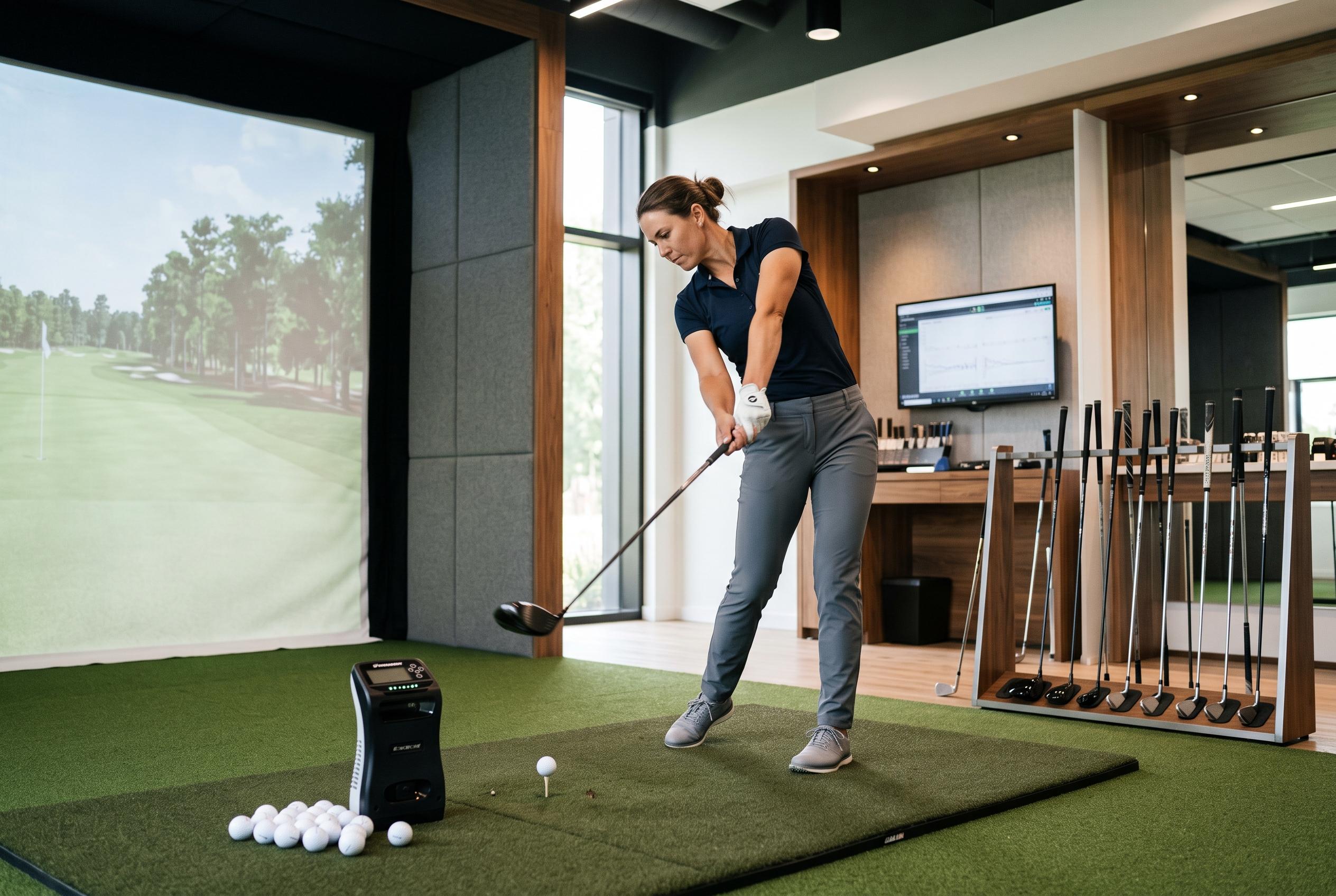

Comparative testing shows ball speed is broadly reliable across devices, but spin and club data can vary sharply with sensor design, ball type and indoor or outdoor conditions.
The question of the “most accurate” launch monitor is less straightforward than many buying guides suggest. The central issue is not only whether a unit is close to the true ball flight on average, but also whether it repeats reliably from shot to shot. The lead article says indoor comparisons usually measure one device against another reference unit, rather than against the ball itself, and that distinction matters because a monitor can be consistent yet still carry a small bias. Across the 2025 and 2026 tests cited in the related material, the pattern is clear: ball speed is usually the steadiest metric, while spin and some club measurements are where devices diverge most. According to MyGolfSpy, that was especially obvious in its December 2025 indoor test, where spin varied more widely than ball speed, and the publication’s earlier indoor rankings are not directly comparable with that later data. All Seasons Design Build and other review sites make the same broad point: radar systems such as Trackman are strongest outdoors, while camera-based units are generally better suited to indoor use where ball flight is truncated.
That split explains why some devices are held up as benchmarks in one setting but not another. The related summaries consistently place the Trackman 4 at the top for outdoor accuracy, while the Foresight GCQuad is described as the strongest camera-based option indoors. All Seasons Design Build also names the Uneekor EYE XO2 as a high-value indoor choice, reflecting a broader view that accuracy alone is not the only buying criterion. For many golfers, the practical question is whether the unit measures the specific numbers they use for practice, fitting or gapping. Parpercision notes that the GCQuad is widely trusted by professionals and fitters, while Golf Simulator Nerd points to the GC3, SkyTrak+ and Rapsodo MLM2PRO as strong home-use options, even if they are not all positioned at the same premium level. The message across the reviews is that accuracy must be judged alongside the intended environment and the type of data a player actually needs.
The latest comparative testing also suggests that some more affordable units can produce surprisingly strong results, at least on ball speed. In MyGolfSpy’s December 2025 indoor test of 12 launch monitors, the publication said ball speed was the most stable metric it measured, and it singled out the Foresight GC3, Garmin R50 and Rapsodo MLM2PRO among the most accurate indoor performers. The same reporting shows why these results should be interpreted carefully: the charted differences for launch angle, spin, carry and ball speed were not identical, and one of the printed tables did not fully match the chart. Even so, the broad conclusion was consistent. Lower-cost models may be close enough on some core numbers to support practice, but spin and club data remain more variable, particularly when a monitor must infer rather than directly capture the shot.
The technology inside the unit is often the deciding factor. The lead article’s breakdown shows that some systems measure spin directly, while others calculate it from observed data or require marked balls to improve the read. That distinction is central to interpreting claims from Garmin, FlightScope, Rapsodo, Foresight and others. Garmin’s Approach R10, for example, depends on RCT balls for stronger spin readings, while FlightScope says its radar-based units need RCT balls or aluminium dots for accurate spin measurement. Rapsodo’s MLM2PRO uses RPT balls for its spin data, and the lead article notes that camera-based devices such as the Foresight GC3 and GCQuad, along with several overhead systems, are generally better positioned to capture spin without relying as heavily on estimation. In practice, that means two monitors can both be “accurate” and still disagree because one is measuring more directly while the other is modelling part of the result.
Owners’ reports in the related material reinforce that point. Complaints about inaccurate readings often trace back to the room, not the brand. Radar units are sensitive to depth and ball flight; glare, low sun, mounting height and cold balls can all skew results; and some camera systems struggle with shiny club faces or need very specific setup conditions. One recurring theme is that units with strong reputations can still produce poor readings when used in the wrong environment or with the wrong balls. The lead article also notes that club data is less settled than ball data, and that some manufacturers are explicit about which figures are measured and which are estimated. That is important for anyone using a launch monitor for fitting, because club path, face angle and angle of attack are often less stable than carry or ball speed.
The most useful way to choose a launch monitor, then, is not to ask which unit is universally “best”, but which one is most accurate for the numbers that matter in your space. MyGolfSpy’s indoor results, the outdoor rankings cited elsewhere, and the makers’ own technical claims all point towards the same practical conclusion: ball speed is usually dependable across a wide range of devices, while spin, club delivery and carry are more dependent on sensor design, ball type and setup discipline. For a home simulator or garage bay, that means the right answer may be a camera-based unit that works consistently indoors; for outdoor fitting, it may still be a radar system such as Trackman 4. Accuracy is therefore not a single ranking. It is a combination of measurement method, environment and the specific metrics a golfer intends to trust.
Disclaimer: This content is intended for informational purposes only. Readers are advised to exercise their own judgement, conduct due diligence, or consult a qualified expert before acting on any information provided.



