

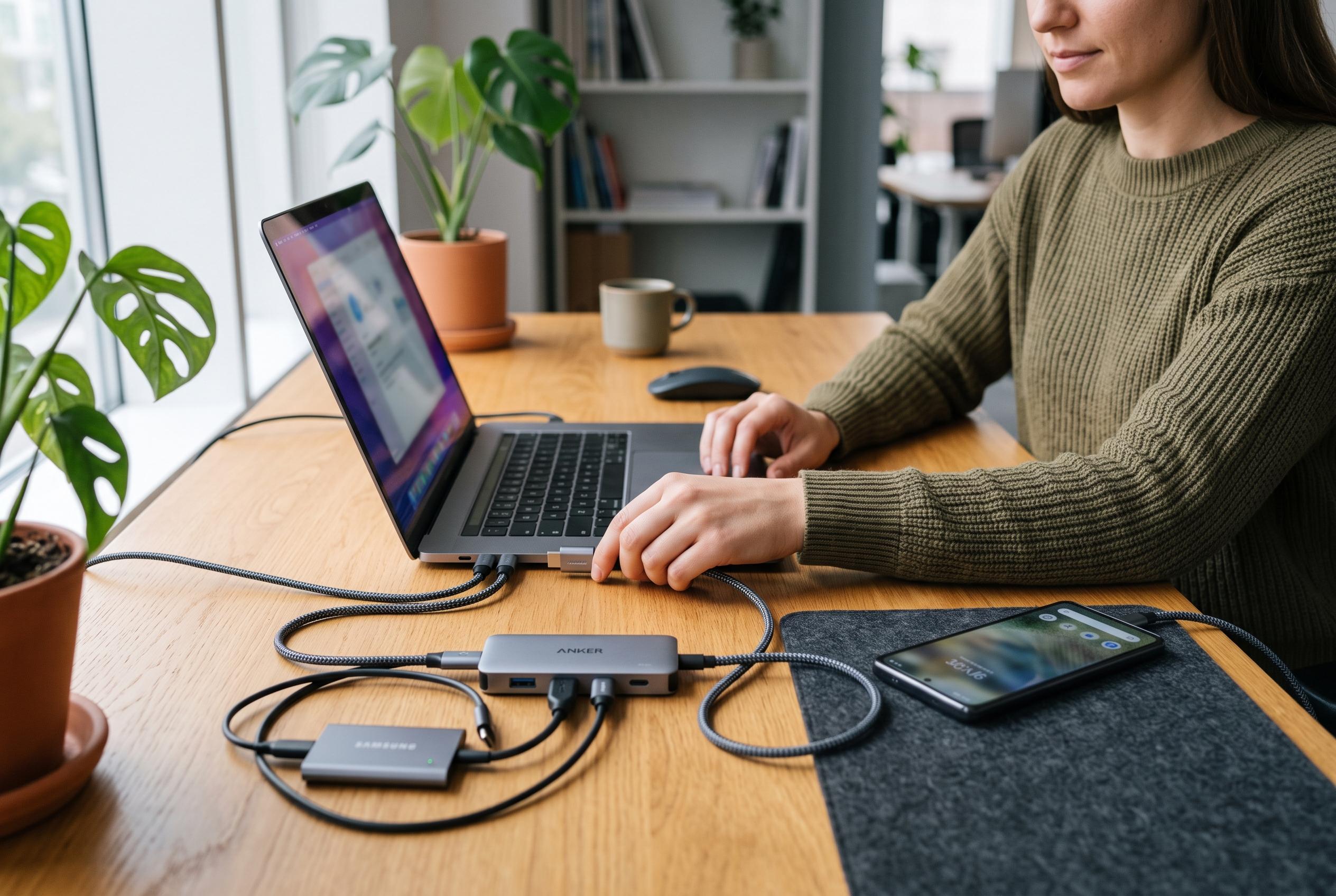

USB-C cables may share the same connector but differ sharply in charging power, data speeds and safety. Here is what to check before buying one for a phone, laptop or dock.
USB-C has gone a long way towards simplifying modern tech life, but the port’s apparent uniformity can be misleading. Cables that look identical on the outside can behave very differently once they are in use, with some suited only to modest charging and others able to support faster power delivery, higher-speed data transfer, or both. That is why a cable that is perfectly adequate for a phone may be a poor choice for a laptop, a portable drive or a docked display.
The main differences lie inside the cable, not in the connector itself. Industry guides explain that charging performance depends on the cable’s design, including its wire gauge and whether it carries an e-marker chip for power negotiation. Without those features, a cable can bottleneck charging well below the capability of the charger, while a well-specified cable can support much higher wattages. In practical terms, the cable is often the limiting factor, not the wall adaptor.
Data transfer adds another layer of complexity. As Anker notes in its own guidance, not every USB-C cable is built for file transfer, even though most can move power. Some are charge-only cables, while others are designed to carry data at much higher speeds. That distinction matters when moving large files, connecting external storage or using accessories that depend on a stable, fast connection. The connector shape alone tells you little about what the cable can actually do.
That is why published buying guides increasingly stress the markings on the cable and its packaging. Rather than assuming all USB-C leads are interchangeable, consumers are urged to check the stated power rating and the data standard separately. USB-C cables may be labelled for 60W or 240W charging, and higher-spec models should also state their data rate. The practical advice is straightforward: match the cable to the task, rather than buying on appearance alone.
Against that backdrop, Slashgear’s comparison of major USB-C cable brands is best understood as a value-and-capability exercise rather than a simple popularity contest. The site assessed range, price, available lengths and safety credentials to separate stronger offerings from weaker ones. Even so, its conclusion was deliberately measured: the lowest-ranked branded options still sit well above the anonymous, unverified cables that flood online marketplaces. For buyers, the useful lesson is not that every expensive cable is superior, but that reputable brands usually provide clearer specifications, better consistency and less risk of an underperforming or unsafe lead.
Disclaimer: This content is intended for informational purposes only. Readers are advised to exercise their own judgement, conduct due diligence, or consult a qualified expert before acting on any information provided.



