

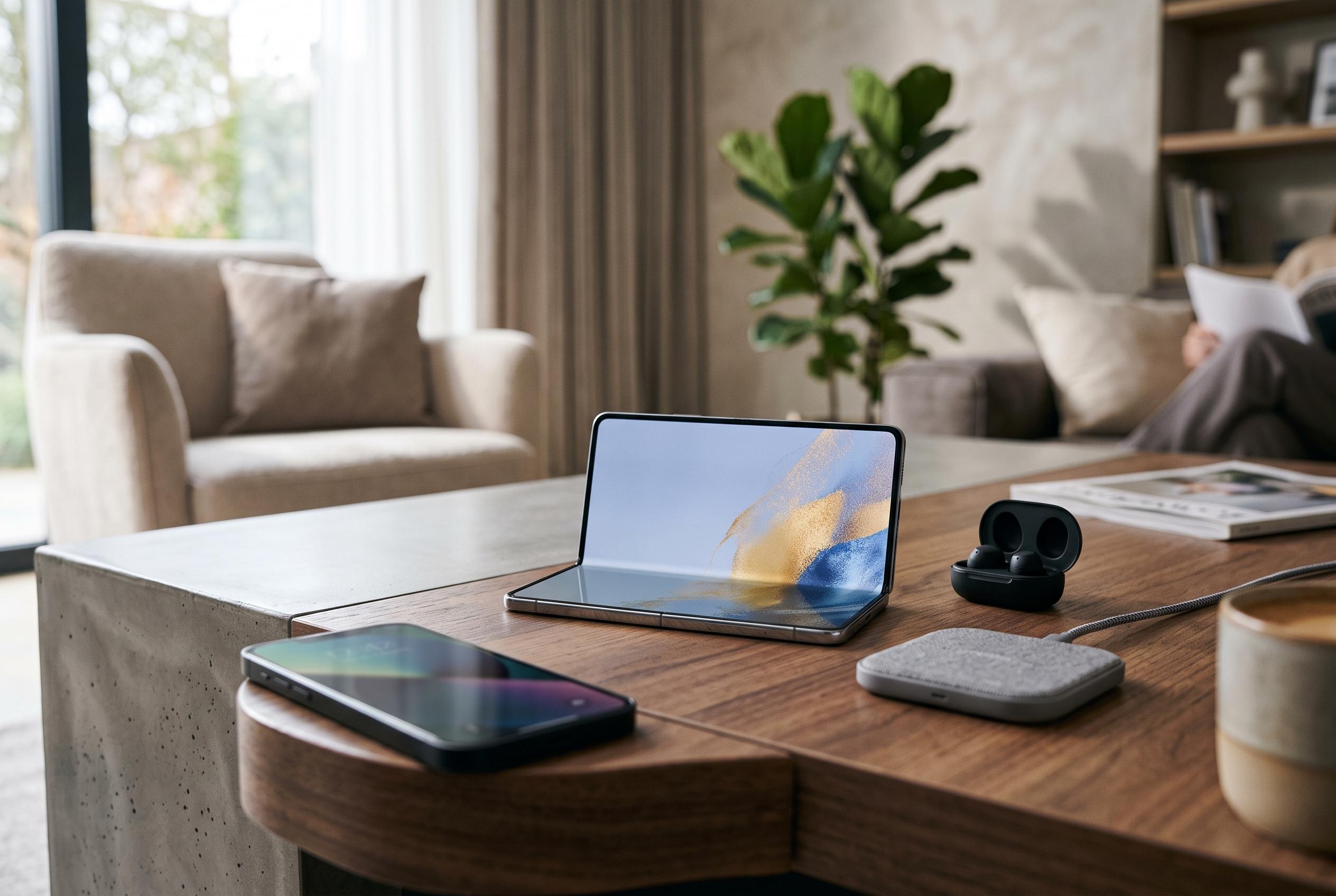

Apple’s first serious foldable offers a larger dual-screen design, but lacks the Pro models’ telephoto camera, Face ID and Action button while commanding a far higher price.
Apple’s new foldable iPhone Duo is being pitched as a premium alternative to the iPhone 18 Pro, but the trade-offs are substantial. According to MacRumours and MacObserver, the two phones share Apple’s A20 Pro chip, yet they are aimed at very different buyers. The 18 Pro remains the conventional flagship, while the Duo marks Apple’s first serious attempt at a foldable handset, with a very different design philosophy and a far higher asking price.
The most obvious attraction of the Duo is its dual-screen layout. MacRumours says the foldable model has a 7.6-inch inner OLED display paired with a 5.4-inch outer screen, giving it a clear edge for split-screen use and on-the-go multitasking. Tom’s Guide also notes that the hinge allows the phone to sit at different angles, which makes it practical for video calls and media playback without a stand. By contrast, the iPhone 18 Pro keeps the familiar slab design, with a 6.3-inch screen, while the Pro Max stretches to 6.9 inches. According to the Danish report, the Duo is also heavier and thicker in everyday use than the Pro Max, despite the latter being the larger non-folding phone.
Camera capability is where the gap becomes harder to ignore. The Danish report says the Duo is limited to a dual-camera system without a dedicated telephoto lens, while the 18 Pro and 18 Pro Max gain a 48-megapixel main camera, variable aperture and a separate 48-megapixel telephoto module. MacObserver and Tom’s Guide similarly describe the Duo’s camera setup as simpler, with a fixed aperture and no telephoto unit. That means the Pro models offer more flexibility for portraits, zoom shots and low-light work, as well as support for advanced capture modes such as ProRAW, Apple Log 2 and ProRes video recording.
Apple has also made different choices around authentication and controls. The Pro models keep Face ID and the Action button, whereas Tom’s Guide reports that the Duo switches to Touch ID in the side button and does not include the customisable Action button. That may appeal to users who prefer fingerprint unlock, but it also underlines how many familiar flagship features Apple has left out of the foldable model. The Duo’s flexibility is offset by a more experimental feature set, and that is before the practical matter of price is considered.
On battery life, the comparison is mixed but still tilts towards the Pro line for consistency. The Danish article says the Duo can reach up to 44 hours of video playback on the outer display, but that figure falls to 31 hours when the large inner screen is used. It adds that the iPhone 18 Pro Max is rated for up to 45 hours of video playback, while the standard 18 Pro is rated lower at up to 24 hours of typical use. Charging is also a little quicker on the Pro models, according to the same report, with a 50 per cent charge in 15 minutes using a compatible 60-watt charger, compared with 20 minutes for the Duo.
Pricing is the clearest divider. MacRumours says the iPhone 18 Pro starts at $1,199, while the Duo begins at $1,999, and the Danish pricing places the foldable at 17,999 kroner for the entry version and 29,999 kroner for the top configuration. That makes the Duo one of Apple’s most expensive consumer phones by a wide margin. For most buyers, the 18 Pro or 18 Pro Max is likely to make more sense because it offers stronger cameras, Face ID, better battery behaviour and a more established design. The Duo is better understood as a specialist device for users who genuinely need a large foldable screen, not as the obvious upgrade for everyone else.
Disclaimer: This content is intended for informational purposes only. Readers are advised to exercise their own judgement, conduct due diligence, or consult a qualified expert before acting on any information provided.



