

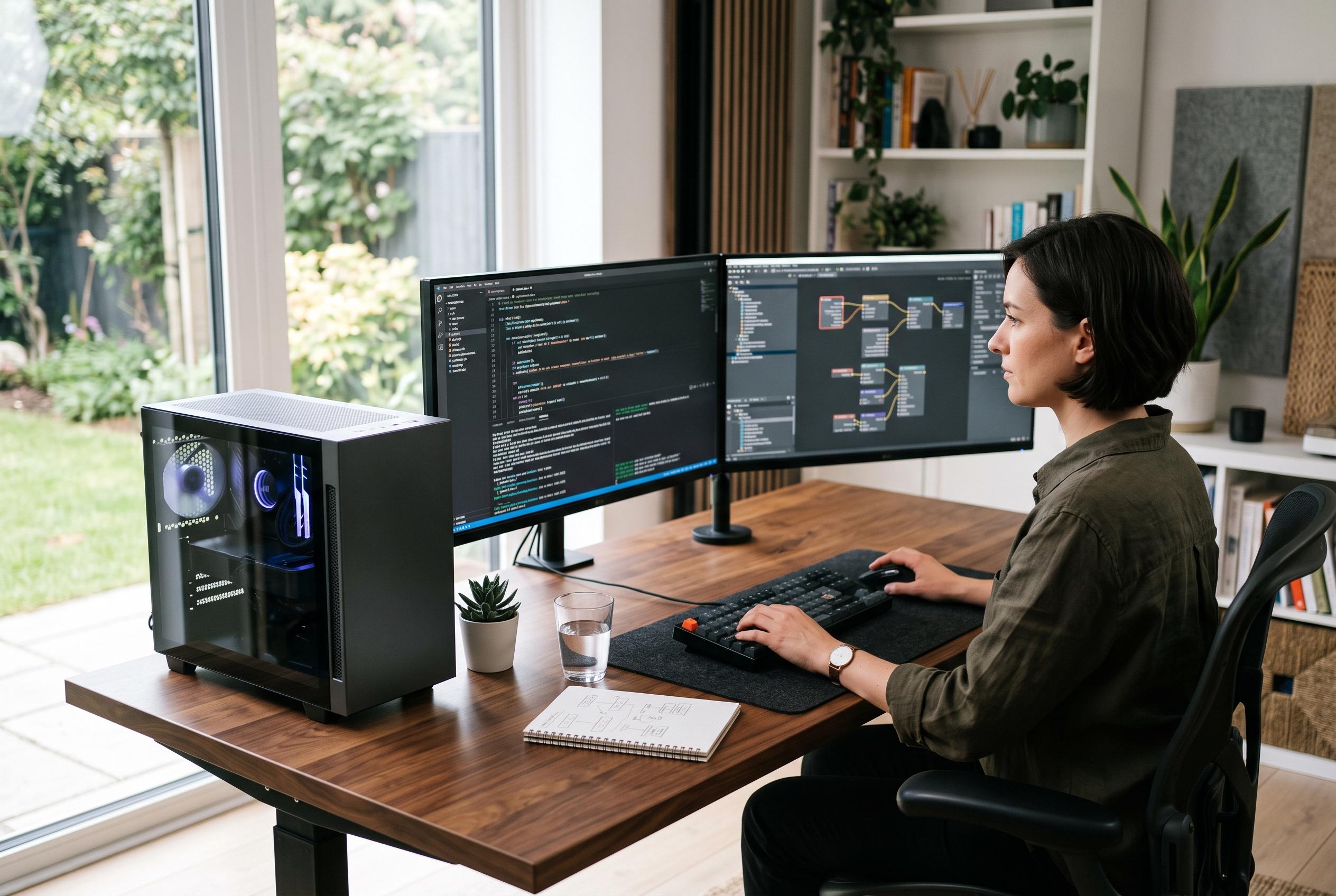

Nvidia’s compact ARM-based system combines a 20-core Grace CPU, Blackwell graphics and up to 128GB of unified memory to run demanding AI models, coding agents and creative workloads locally.
Nvidia’s RTX Spark is emerging as a sign of where Windows PCs may be headed next: machines designed not only for general computing and gaming, but for running large AI models locally on the device itself. In a hands-on test reported by Thanh Niên, the platform was positioned as a compact laptop-class system that combines an ARM-based processor with a Blackwell GPU, aiming to reduce reliance on cloud services for demanding AI work.
According to Nvidia’s own product information, RTX Spark pairs a Blackwell RTX graphics processor with a 20-core Grace CPU and up to 128 GB of unified memory. The company says the architecture is intended to give users around one petaflop of AI performance, while supporting tools such as CUDA, TensorRT and NVFP4 so developers can build, test and deploy AI models and agents directly on a PC. Nvidia also presents the platform as suitable for gaming and creative work, with ray tracing, DLSS and Reflex included in the design.
The test machine described by Thanh Niên used 64 GB of LPDDR5X memory shared between CPU and GPU, with bandwidth cited at up to 300 GB/s. That common memory pool is important because it allows AI workloads to stay on the device rather than being split between local storage and remote servers. The system ran Windows 11 ARM64 and was able to use both native ARM software and x86 or x64 applications through Microsoft’s Prism emulation layer, while CUDA accelerated compatible AI tasks.
Performance figures from the publication suggest the platform is capable of handling substantial local workloads. In AgentPerf Local, which simulates multi-step AI tasks such as analysing requirements and writing code, the system completed 168 runs across eight tasks using Qwen3.8 27B. Thanh Niên said switching from an MTP setup to DFlash raised text generation speed from 20.69 tokens a second to 36.22 tokens a second, cutting total processing time by about 31.5 per cent.
Other tests showed the machine handling both agent-style tasks and content creation. In MLPerf Client 2.0.1, Qwen3 8B completed an AI agent task involving tools in an average of 56.8 seconds. Using FLUX.2 Klein 4B, the system produced images at a rate of 37.69 images a minute, or roughly 1.59 seconds per image. In ComfyUI, another local generative AI environment, FLUX.2 Klein 4B took an average of 14.05 seconds to create an image, FLUX.2 Dev took 40.46 seconds, and the LTX 2.5 video model completed a task in about 68.51 seconds. Thanh Niên noted that those numbers are not directly comparable because the models and settings differ.
Perhaps the most notable demonstration was the use of Hermes, an AI agent capable of using tools, writing code and interacting with the computer itself. Running Qwen3.8 27B locally, Hermes was given a Vietnamese prompt to develop QuickWebP, a Windows utility for batch image resizing and conversion. After roughly two hours and nine minutes, it produced a working application, despite encountering Python library and environment issues along the way. The system also processed 329 JPG images in 246 seconds, and handled a smaller batch of 20 images in 8.8 seconds for JPG output and 12.3 seconds for WebP conversion.
RTX Spark is not just about AI. Thanh Niên’s graphics tests indicate that the Blackwell GPU remains strong enough for modern gaming and GPU-intensive work. In 3DMark, the system scored 9,230 in Port Royal, 3,004 in Speed Way and 3,184 in Steel Nomad, figures that the publication said were close to Nvidia’s own reference results. In Cyberpunk 2077 at 2K resolution with ray tracing set to Low, DLSS on Auto and Multi Frame Generation at 3X, the machine averaged 136.55 frames per second, with a minimum of 117.56 fps.
Taken together, the results point to a broader shift in laptop design. Rather than treating AI as a cloud-first feature, Nvidia’s RTX Spark is built to run large models, code-generation tools and image or video workflows on the PC itself. For users who need low-latency AI work, local processing and a more self-contained workflow, the platform suggests that this category of Windows machine is moving quickly from concept towards practical use.
Disclaimer: This content is intended for informational purposes only. Readers are advised to exercise their own judgement, conduct due diligence, or consult a qualified expert before acting on any information provided.



