

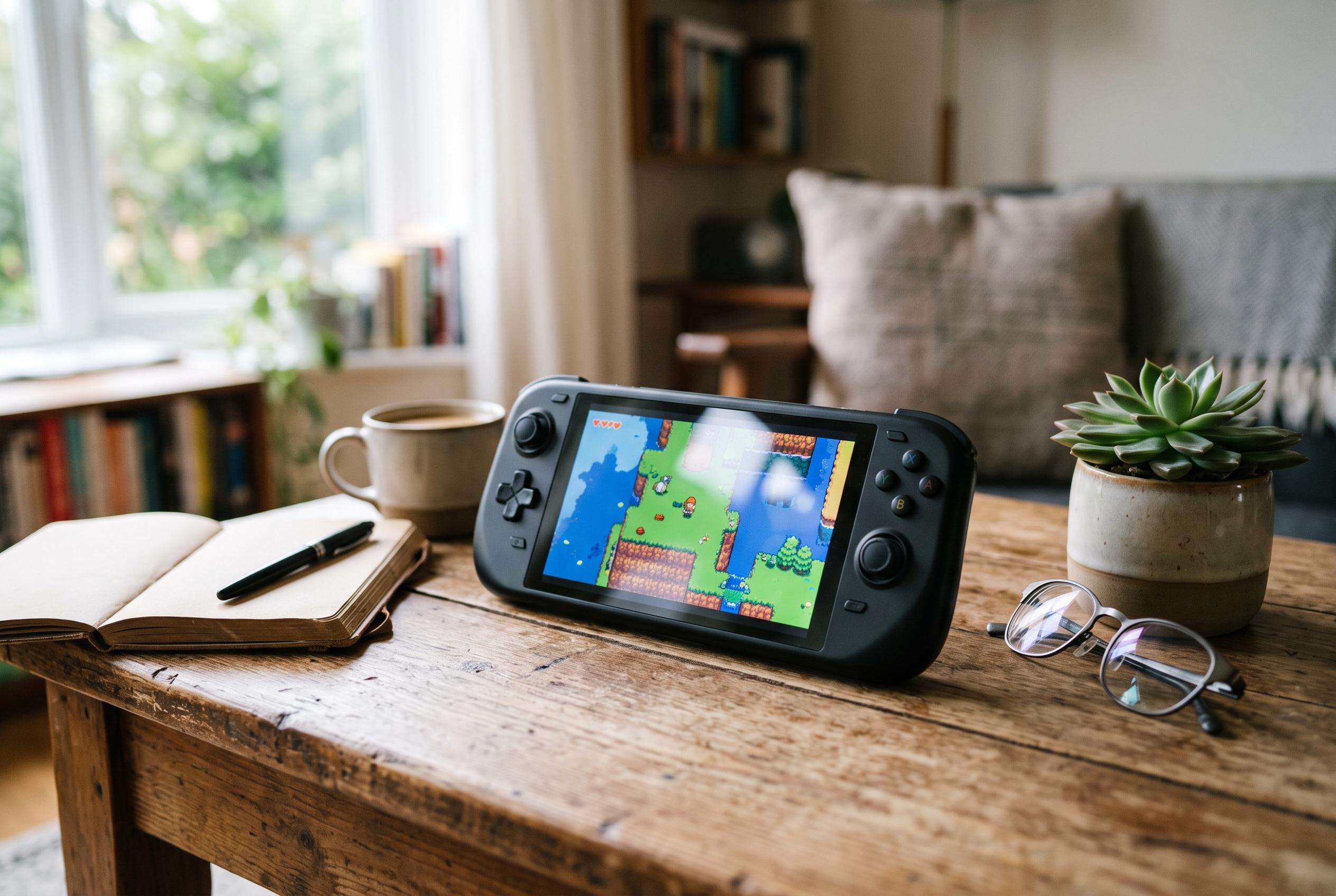

From clamshells and dual-screen machines to pocket-sized Linux consoles, affordable handhelds now offer sharper displays, broader emulation and more ambitious designs than ever.
The sub-$100 handheld market has become far more capable than it was only a few years ago. Devices now range from slim Linux machines to Android-based curiosities, with screens sized for pixel-perfect retro play and enough processing headroom for systems such as the PlayStation 1, Nintendo 64 and, in some cases, selected Dreamcast or PSP titles. Time Extension’s review of the TRIMUI Brick Pro, together with Handheld Picker’s coverage of ANBERNIC’s budget clamshell and other low-cost models, shows how much this segment has matured without losing its appeal to newcomers.
Among the strongest examples is the TRIMUI Brick Pro, a larger vertical handheld built around a 3.95-inch IPS display with a 4:3 aspect ratio and a 1024 × 768 resolution. According to Time Extension, it uses an Allwinner A133P processor, 1GB of memory, two joysticks, illuminated controls and removable shoulder buttons, all running on a Linux front end designed to keep the experience straightforward. Its appeal lies in that balance: it looks refined, feels considered and remains capable enough for Nintendo 64 and some Dreamcast emulation.
ANBERNIC’s RG SP takes a different approach by leaning hard into nostalgia. Handheld Picker describes it as a clamshell handheld inspired by the Game Boy Advance SP, with a 3.4-inch IPS 720p screen, an Allwinner H700 chip, 1GB of RAM and a 3,300mAh battery. The Linux interface is aimed at ease of use, while the lack of analogue sticks makes its strengths clear: quick access, pocketability and solid performance for systems up to PlayStation 1.
At the other end of the physical design spectrum is the RG DS Plus, ANBERNIC’s dual-screen effort aimed squarely at Nintendo DS fans. The device is priced at $95 and uses two 4.3-inch IPS panels with 1,024 × 768 resolution, plus touchscreen support and a hidden stylus for stylus-driven games. Its custom DS emulator and Linux base are intended to deliver better compatibility for the platform than a generic handheld emulator would manage, while still leaving room for other systems such as GBA, Dreamcast and PSP.
AYANEO’s KONKR Pocket Block pushes further into premium compact design. Its 3.33-inch 4:3 LCD has a 960 × 720 resolution, which is well suited to clean integer scaling on older games, while the body uses cyber-inspired styling and a compact layout that makes it feel more like a design object than a conventional emulator box. It runs Android with AYASpace, but that software layer is better suited to larger devices; on this machine, a lighter front end is likely to be the more practical choice. Even so, the hardware gives the user more than enough scope for GBA, Game Gear and selected PSP or Nintendo 64 software.
For buyers who want something sturdier, the TRIMUI Brick Hammer is the more mature version of the Brick concept. It keeps the same minimal philosophy but adds a metal shell, removable shoulder buttons and front and rear lighting, while remaining below the $100 mark. The device is still a Linux handheld rather than an Android machine, which helps keep the interface simple and responsive. Time Extension’s reporting on the related Brick Pro makes clear why the platform works: these compact TRIMUI devices are focused on practical retro play rather than headline-grabbing specifications.
If value is the priority, ANBERNIC’s RG 35 stands out for a different reason: price. At $37.99, it is presented as a stripped-back Linux handheld that still delivers PlayStation 1 emulation on a bright 3.5-inch IPS display, with two analogue sticks, decent controls and enough portability to make it easy to hand to children or keep as a low-risk travel device. The interface is plain, but the appeal is obvious. It is a functional route into handheld emulation for very little money.
The Miyoo Mini remains one of the defining devices in the pocket-sized handheld boom. Launched in 2021 and still available in limited batches, it helped popularise the ultra-compact Linux handheld format with a small screen, a simple front end and a form factor that makes it easy to carry everywhere. It is best suited to older, lighter systems rather than more demanding emulation, but that focus is precisely why it became so influential. In the same vein, the RG Rotate shows how far manufacturers are willing to experiment, using a sliding square-screen design that hides the controls until needed and runs Android with enough power for more ambitious software, even if its unusual form factor is more novel than universally practical.
Disclaimer: This content is intended for informational purposes only. Readers are advised to exercise their own judgement, conduct due diligence, or consult a qualified expert before acting on any information provided.



