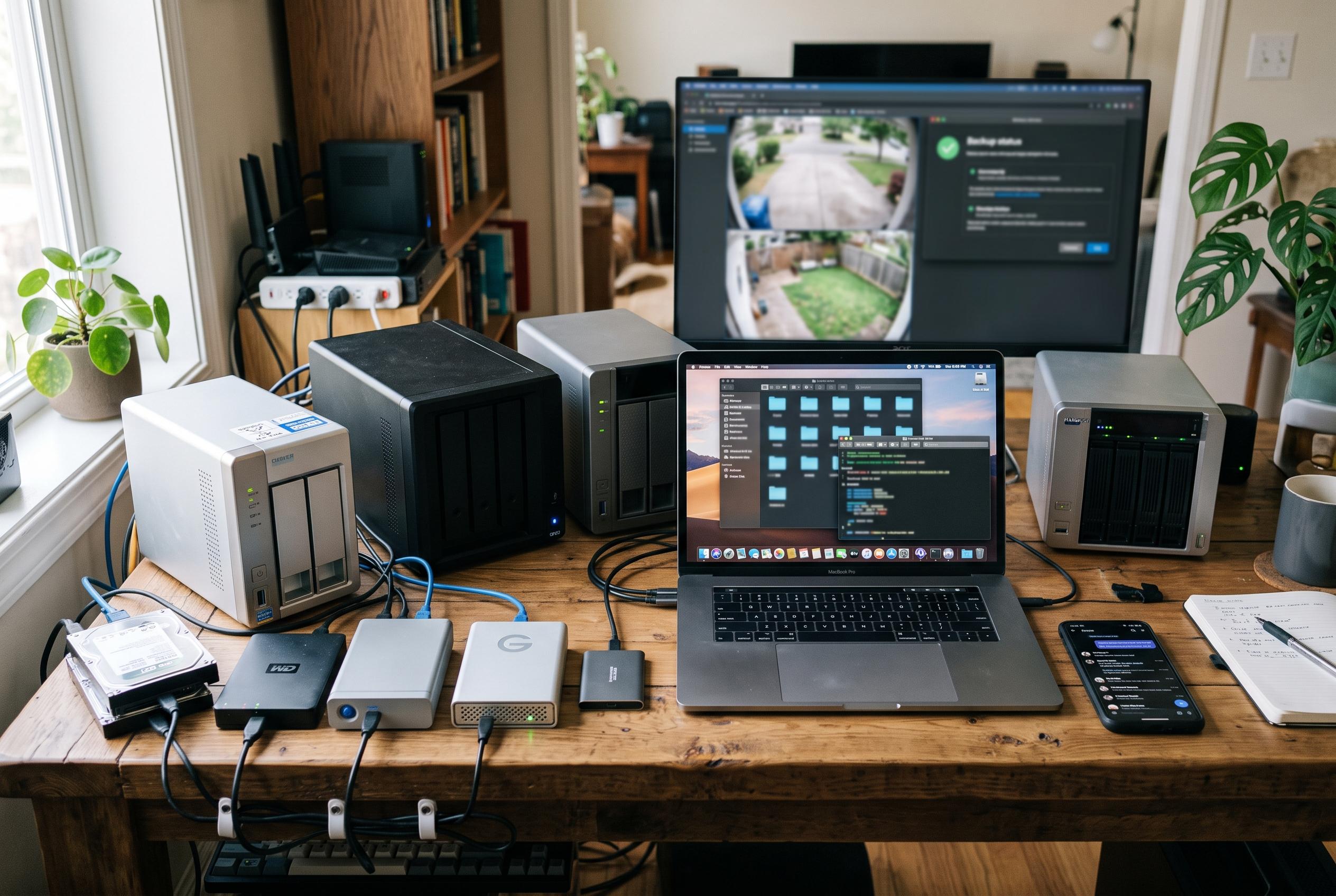

Synology, QNAP, Feiniu, UGREEN and ZSpace are built for different workloads, making the right choice less about brand rankings than support for chat history, ransomware protection, surveillance and demanding applications.
The question of which NAS operating system is “best” only makes sense once the buyer has identified the one capability that cannot be compromised. That is the central argument running through the lead article: the five major ecosystems often discussed by Chinese buyers, including Synology, QNAP, Feiniu, UGREEN and ZSpace, do not compete on a single universal scale. They separate by workload. Once the real constraint is defined, the apparent ranking changes with it.
That is especially clear with WeChat-related backup. QNAP says its WeChat Assistant Mini Program can back up photos, videos and files from a mobile device to a QNAP NAS, with data organised into timestamped folders and stored on the user’s own server. Synology’s documentation for Drive on Android says the service can back up photos and, in the China version, WeChat-related photos, videos and documents downloaded or opened in WeChat. But a separate user account published on Zhihu says Synology still does not provide a native way to back up and restore WeChat chat records themselves, pointing users instead to iCloud, the desktop client or third-party backup tools. In practice, that means the crucial question is not whether a system supports WeChat, but whether the buyer needs to preserve media files or the conversation history itself.
Snapshots are another example of a feature that depends on the underlying design, not just the software label on the box. QNAP’s documentation says snapshot and replication functions are available only on specific product families, with a minimum of 4GB of RAM required. The lead article makes the same broader point about Synology’s Snapshot Replication: on some older or entry-level models, snapshot support is tied to Btrfs rather than available universally across the range. For buyers worried about ransomware or accidental deletion, that means the file system and the hardware class matter as much as the management interface.
Surveillance is a more decisive dividing line. The lead article argues that Feiniu is not a fit for users who want native camera support, because the system does not provide that function at the platform level and pushes users towards Docker-based workarounds instead. That is a meaningful distinction because it is not merely a matter of convenience. If video surveillance is a requirement, the operating system either supports it in a first-class way or it does not. In that sense, the feature is a filter, not a preference.
Hardware limits can also expose themselves only after the machine has been put to work. The lead article notes that some entry-level NAS units, especially ARM-based models, may struggle when photo libraries, AI indexing, 4K transcoding and containers are run together. That is consistent with the wider pattern in NAS planning: software features are only one part of the equation, and actual throughput depends on architecture, memory and storage design. A system may advertise a capability, yet still be unable to complete the task in a reasonable time on a weak chassis.
Seen this way, the practical answer is not to ask which brand’s system is objectively superior, but to decide which constraint is non-negotiable. If the need is chat preservation, snapshot protection, camera integration or heavy AI workloads, the shortlist will be different each time. QNAP’s published backup tools, Synology’s selective WeChat support and the limitations described in user reports all point in the same direction: these platforms are optimised for different jobs, not the same one. The final choice is therefore less about ideology than about workload fit.
Disclaimer: This content is intended for informational purposes only. Readers are advised to exercise their own judgement, conduct due diligence, or consult a qualified expert before acting on any information provided.