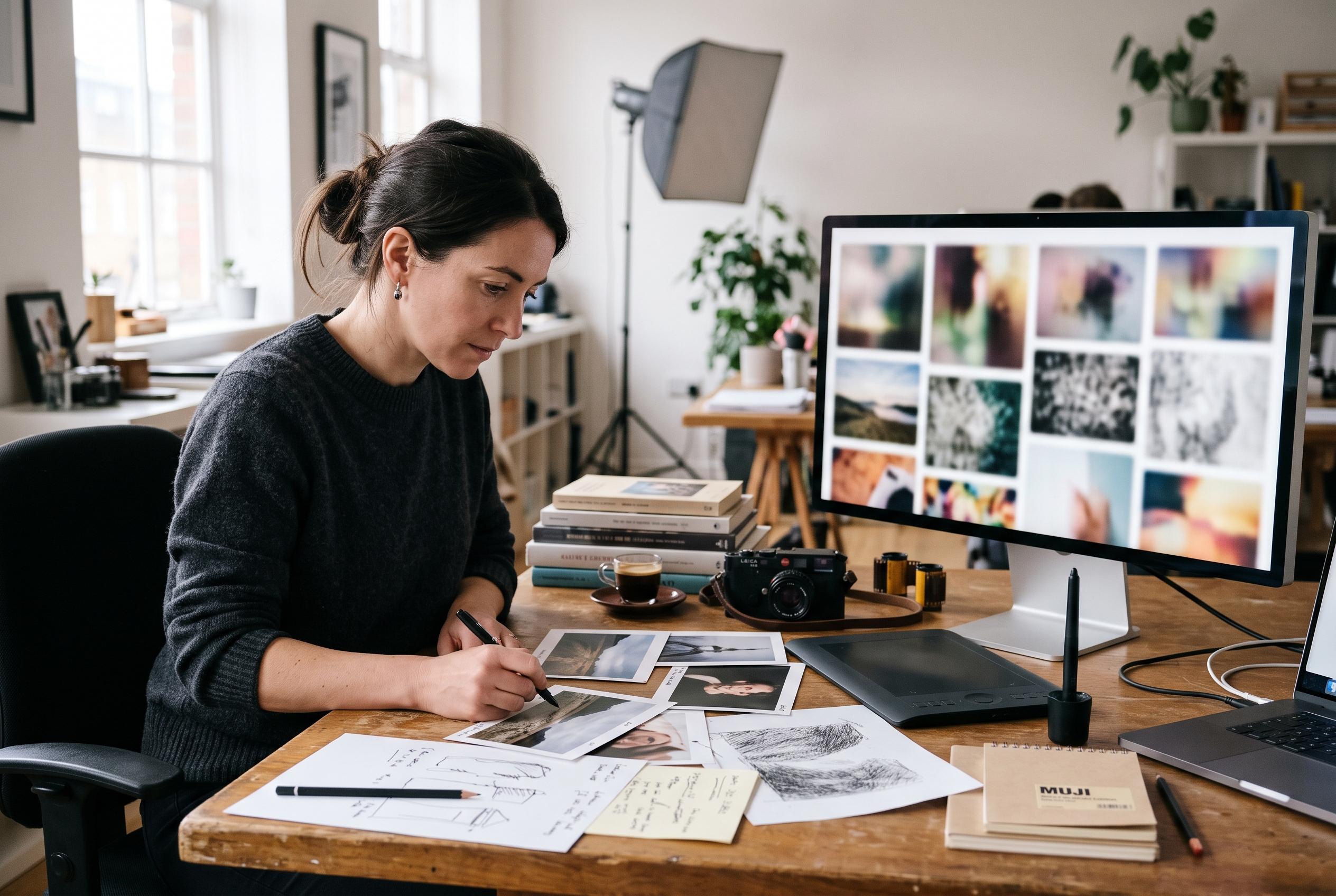

Generative tools are making imagined visuals faster and cheaper to produce, but real people, products and events still demand licensed or commissioned photography , while copyright and disclosure rules complicate the choice.
AI image generators are now a practical substitute for stock photography in many routine publishing and marketing tasks, but only up to a point. For blog headers, social graphics, background illustrations and concept-led advertising, they can be faster, cheaper and more flexible than searching a library of pre-shot images. According to the supplied report, the strongest use case is any visual brief that is imaginary rather than documentary, because the prompt gives the creator control over composition, style, lighting and mood rather than forcing a compromise with whatever a stock archive happens to contain.
That advantage matters most when teams need volume or variety. Industry commentary in the related summaries suggests that brands are increasingly turning to generative tools to produce multiple versions of the same asset, test creative directions quickly and avoid the generic look that can come from overused stock imagery. The same logic applies to abstract subjects such as data protection or digital services, where a generated illustration can look more distinctive than a familiar, overused stock metaphor. The limitation is consistency: if prompts are handled too mechanically, the results can begin to look interchangeable, which is why style and camera treatment still need deliberate variation.
Stock photography remains stronger whenever accuracy is non-negotiable. A generated image cannot credibly show a real product, actual packaging, a specific interface or an event that truly happened. It also falls short when a campaign depends on genuine people and verifiable situations, such as testimonials, team pages or case studies. In those contexts, authenticity is not just an aesthetic preference but a matter of trust. The report’s basic test is a useful one: if the image makes a claim about a brand, its customers or a real-world moment, it should usually be licensed or commissioned rather than generated.
Cost is another reason teams are experimenting. The supplied comparison says entry-level stock plans can work out at roughly three dollars an image, while free or low-cost AI tools can lower the upfront barrier still further. At the same time, the economics are not identical. A stock subscription buys a licence to use a photograph that other customers may also licence, whereas a generated image is typically unique to the prompt but may come with unclear ownership and contract terms. That distinction matters more than the headline price, particularly for organisations that need predictable rights and a paper trail.
The legal position is also more complicated than many users expect. In the United States, the Copyright Office has maintained that a work created purely by AI is not eligible for copyright protection, because human authorship is still required. The related summaries note that the Supreme Court declined to intervene in the Thaler dispute in March 2026, leaving that principle intact. The practical consequence is straightforward: an unedited generated image may offer little protection against reuse by others, while a version that includes substantial human editing, layout or design choices may be easier to defend. For brand assets, that often means treating AI output as raw material rather than a finished deliverable.
Disclosure rules add another layer. The report says the European Union’s AI Act now requires certain generated content to be marked in machine-readable form, and that deepfakes must be disclosed. Ad platforms also maintain their own labelling policies, which can change quickly. For that reason, the most defensible workflow is hybrid rather than ideological: generate what is imagined, licence or shoot what must be true, keep provenance records, and review the platform and regional rules before publication. As the supplied material makes clear, the teams getting the best results are not choosing between AI and stock as a matter of principle; they are matching each image source to the job it must do.
Disclaimer: This content is intended for informational purposes only. Readers are advised to exercise their own judgement, conduct due diligence, or consult a qualified expert before acting on any information provided.