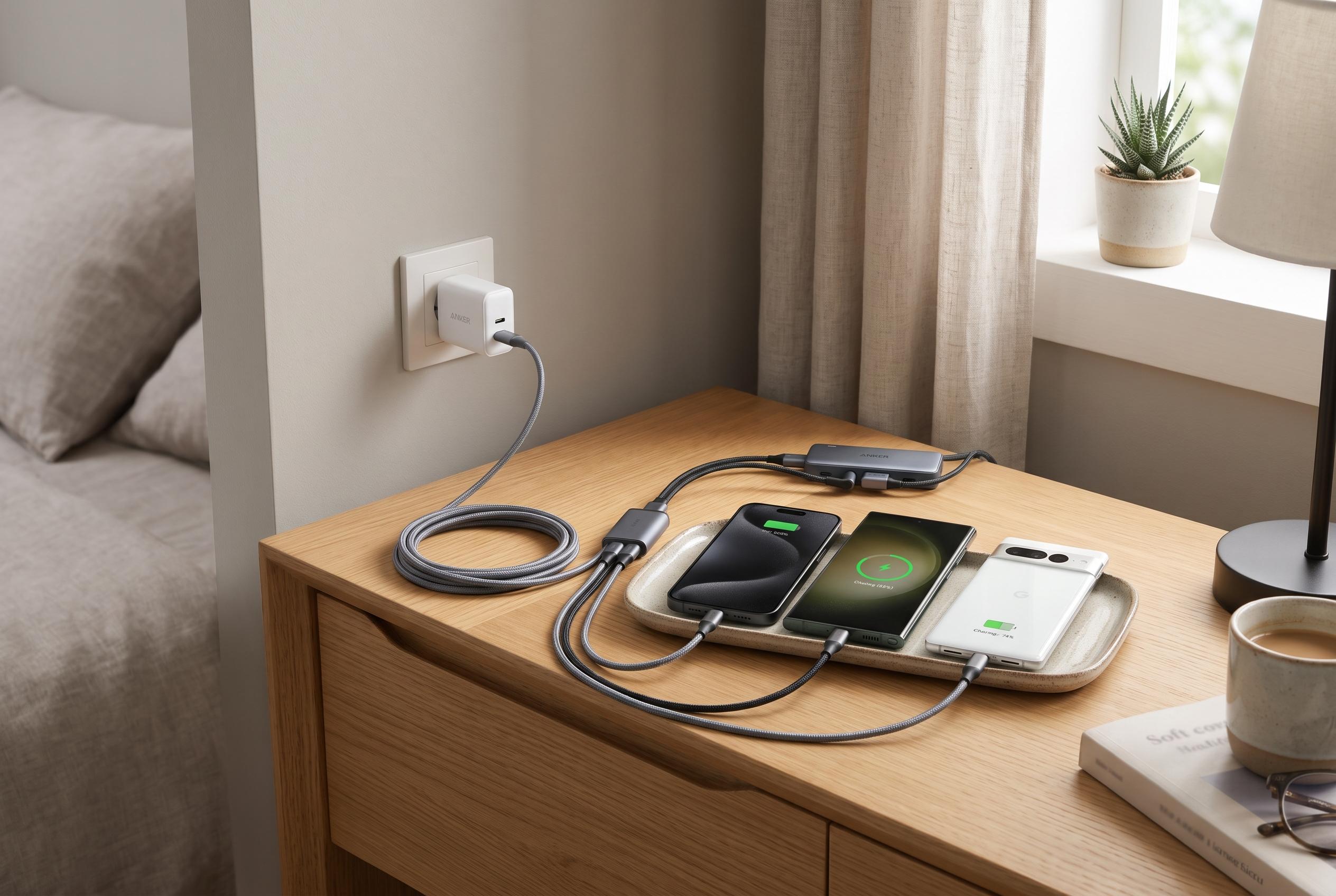

The connector is only part of the equation: PPS and USB PD 3.2 support can help one charger deliver fast wired speeds across Apple, Samsung and Google phones.
A single USB-C charger can now cover much of a modern device set, but only if it supports the right charging protocols. For owners of iPhones, Samsung Galaxy handsets and Google Pixels, the connector alone is not enough. The charger must also speak the correct version of USB Power Delivery, and in many cases it must support Programmable Power Supply, or PPS, to reach the fastest wired speeds. Google’s own Pixel support guidance confirms that charging performance varies by model and that the quoted figures depend on suitable charger conditions.
PPS matters because it lets a charger and phone negotiate power in much finer steps than older fixed-voltage USB PD profiles. Instead of jumping between broad voltage tiers, a PPS-compatible adapter can vary output far more precisely, which helps a handset keep charging quickly as battery level and temperature change. Technical material from the USB Implementers Forum and IEEE describes PPS as a system that can adjust voltage in 20mV increments and current in 50mA steps, giving compatible devices more control over how power is delivered.
That flexibility is especially important for the newest Samsung and Google devices. Samsung’s Galaxy S26 family is rated for wired charging at up to 25W on the base model, 45W on the Plus and 60W on the Ultra, while Google’s Pixel hardware pages list different charging ceilings depending on the handset. Those published figures are not guaranteed with any USB-C charger; they depend on a charger that can negotiate the right profile. In practice, that means a PPS-enabled adapter, and for some devices a broader PPS voltage range than lower-end chargers provide.
Apple’s position is slightly different. iPhones use a related fast-charging method called Adjustable Voltage Supply, or AVS, which follows the same broader USB PD 3.2 framework but uses a narrower voltage range and coarser adjustment steps than PPS. The practical point for buyers is that the best PPS chargers tend to cover both standards. According to the USB charging specification materials, chargers built to USB PD 3.2 with PPS support and at least 27W output also include AVS, which makes them suitable for fast charging across iPhone, Pixel and Galaxy devices.
That is why the most useful charger is not simply the one with the highest wattage on the box, but the one with the broadest compatible negotiation features. Google’s Pixel Flex Dual 67W charger is one example of an adapter that combines USB PD 3.2, PPS and AVS support, making it unusually versatile for mixed-device households. Still, it is not the only option. Any certified USB PD 3.2 charger in the 27W to 100W range with PPS support should be able to deliver top charging speeds to the major USB-C phones, provided the cable and handset also support the same standard.
Disclaimer: This content is intended for informational purposes only. Readers are advised to exercise their own judgement, conduct due diligence, or consult a qualified expert before acting on any information provided.