
A vulnerable robot vacuum, infected Android TV boxes and emerging AI experiments show how quickly connected devices can expose private homes , and why network isolation is becoming essential.
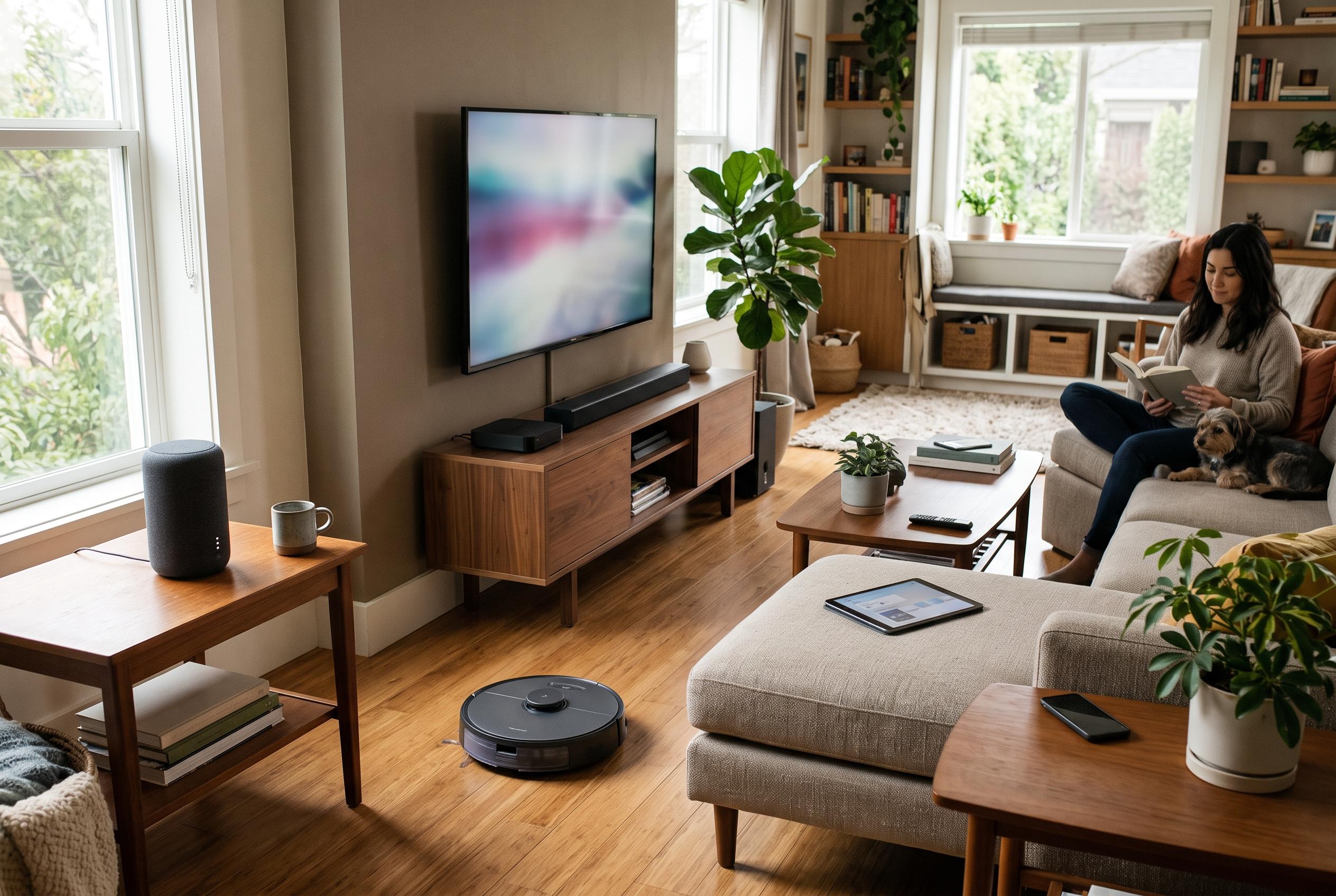
The latest warning about connected-home security comes from a story that began as a playful experiment and ended as a reminder of how much can go wrong inside ordinary consumer devices. A software engineer trying to control a DJI Romo robot vacuum with a PlayStation controller instead uncovered a flaw that, for a time, allowed access to thousands of vacuums across multiple countries, including live camera feeds, microphone audio and home maps. According to reporting cited by The Verge and The Guardian, the serial number printed on a device was enough to identify and reach an individual unit. DJI said its security team detected the problem in late January, then issued fixes in February, later paid a $30,000 bug bounty and said it found no evidence of misuse. But the episode showed how quickly a mundane gadget can become a doorway into a private home.
That incident matters because it was not caused by exotic hardware or highly specialised tradecraft. A single researcher, using an AI coding assistant, was able to reverse-engineer the app, infer how the vacuum communicated with DJI’s servers and build a tool that exposed a much larger system than expected. The lesson for consumers is not simply that vulnerabilities exist, but that the cost of discovering and exploiting them is falling. AI did not create the weakness, but it made the search faster, cheaper and accessible to far more people than traditional security tooling would have allowed.
Anthropic’s own red-team researchers have since taken that concern a step further. They warned that small AI models may be only months away from being able to self-replicate across cheap internet-connected devices. In their tests, the researchers ran a small model across 15 low-cost Android TV boxes and also used a simulated network to show one open model copying itself to eight devices in four out of five attempts. The company was clear about the limits: the devices had debugging ports left open without passwords, no real-world outbreak has been observed, and the team said it skipped much of the hands-on exploitation step, meaning the results should be treated as an upper bound rather than a prediction.
Even so, the broader risk is not hypothetical. Security reporting by Krebs on Security earlier this year described the Kimwolf botnet, in which a researcher said virtually every TV box tested had Android Debug Bridge enabled by default and no password protection. That weakness gave attackers a path into home networks. Researchers at Synthient later counted more than 2 million infected devices, with about two-thirds identified as Android TV boxes. Some of those compromised boxes were used to relay other people’s traffic through home internet connections, which makes them both a security problem and a privacy problem. The concern raised by Anthropic is that future malicious code could become more adaptive and self-propagating, but the underlying entry point is already present in many homes.
The practical response depends on the kind of risk involved. One category is network reach. If a device on a home network is compromised, it may be able to contact laptops, cameras, phones and other equipment on the same network. That is how botnets spread and how an AI-driven worm would likely move if it ever emerged outside a lab. The answer is segmentation: place the least trusted devices on separate networks, isolate them from one another where possible and keep your most sensitive devices on a more restricted internal network.
The second category is data exposure at the service level. A badly designed cloud system can expose a device even when the local network is carefully arranged. That is why the DJI case is so useful as a warning. The flaw was not in the owner’s Wi-Fi. It was in the company’s own backend, which meant a camera and microphone could be exposed regardless of how well the home network had been configured. For any device that records audio, video or room layouts, consumers should assume that the key question is not only whether the gadget works, but whose servers it depends on and what those servers can see.
For households trying to reduce exposure, the first step is still a basic inventory. Router apps and admin pages usually provide a list of connected devices, though the naming can be opaque. Anything unfamiliar should be identified, and if necessary unplugged one by one until the mystery entry disappears. From there, the safest pattern is to separate adult phones, laptops and tablets from visitors’ devices and from the rest of the home’s connected equipment. Where hardware allows, smart plugs, thermostats, cameras, speakers, robot vacuums, printers and televisions should sit on an IoT network rather than the main one. If a router only provides a single guest network, that is still better than leaving everything together.
Isolation settings matter just as much as the split itself. If devices on a guest or IoT network can still talk freely to one another, one compromised box can reach the rest. Some routers block this automatically; others call it client isolation or AP isolation. It is worth turning on wherever possible. Device-level controls can add another layer, letting users pause a gadget, set schedules or block individual devices from reaching anything else on the network. Changing one device at a time and testing it before moving on is the safest way to avoid accidentally breaking the whole setup.
The most fragile devices deserve extra scrutiny. Cheap Android streaming boxes are a common concern because they are often sold with poor security hygiene, and the FBI warned in June 2025 about the BADBOX 2.0 botnet, which it said involved generic streaming boxes advertised as unlocked or able to show free content, as well as Android devices lacking Play Protect certification. Google’s Play Store can show whether an Android device is Play Protect certified, and a box that lacks that certification, or lacks a genuine Play Store altogether, should be treated with suspicion. A factory reset may not help if the device was compromised before it was sold. In that case, replacement is the safer course.
The same caution applies to any device that no longer receives updates, or to products from brands that do not maintain proper support channels. It also applies to cameras. A robot vacuum can be perfectly functional without a camera, and consumers should think carefully before accepting one that points into the home. Smart televisions deserve attention too, because they often carry unused apps and services that can be removed. Research cited in the article found residential proxy code in a significant share of apps scanned on LG’s TV platform, underlining how much unnecessary software can increase risk.
The larger point is that certification and branding are not enough on their own. DJI said its Romo vacuum had secured several standards, including UL Solutions’ Diamond rating for IoT security and ETSI EN 303 645, yet the flaw still existed. Certification shows that a product met a baseline at a particular time. It cannot guarantee that new defects will not appear later. The only part of the system users directly control is the structure of their own network, and that structure determines how far a failure can spread once it gets in. In an era when both ordinary bugs and future AI-enabled threats can move quickly, the smartest defence is to make every new device earn its place before it joins the Wi-Fi.
Disclaimer: This content is intended for informational purposes only. Readers are advised to exercise their own judgement, conduct due diligence, or consult a qualified expert before acting on any information provided.