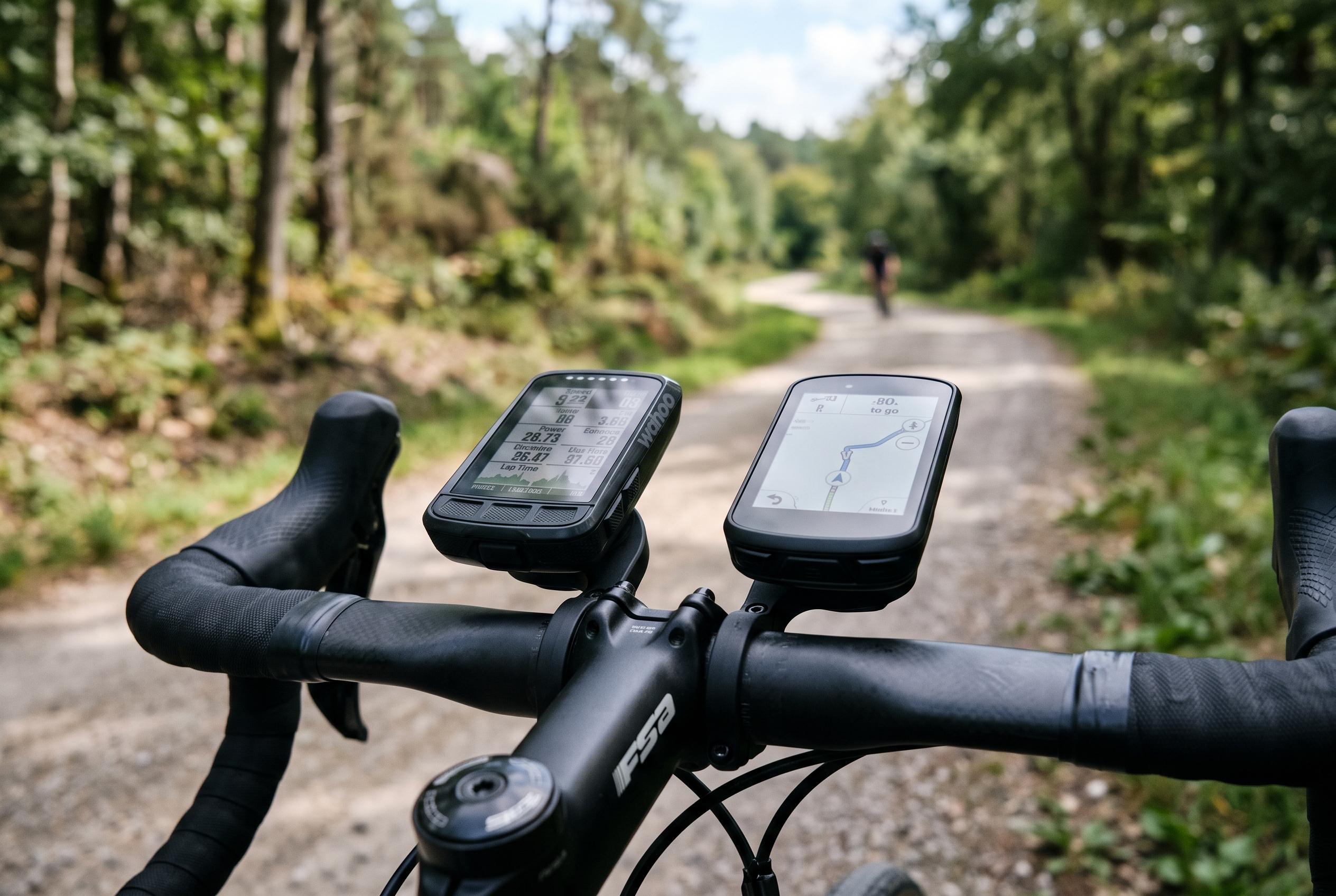

The Garmin Edge 1050 offers deeper training tools and ecosystem integration, while Wahoo’s ELEMNT ACE prioritises readable navigation, a simpler interface and longer claimed battery life.
Garmin and Wahoo have taken distinctly different routes to the top end of the GPS bike computer market. The Edge 1050 is built around training depth, navigation tools and integration with Garmin’s wider cycling ecosystem, while the ELEMNT ACE leans on a bigger display, a more stripped-back interface and Wahoo’s new airspeed sensor. For riders deciding between them in late 2026, the question is no longer which unit can record a ride, but which extra functions will actually earn their place on the handlebars.
On paper, the two devices are close enough to make design choices matter more than raw specification. The Wahoo has a 3.8-inch touchscreen, compared with the Garmin’s 3.5-inch display, and independent reviews have generally praised the ACE for its clear mapping and easy-to-read layout. BikeRadar judged the Wahoo’s maps and interface slightly ahead, while T3 noted that the larger screen comes with practical compromises, including greater bulk and more difficulty reading in strong sunlight.
That tension runs through the navigation experience. Both computers offer turn-by-turn directions, route imports and recalculation when a rider leaves the planned line. Yet the way they present information is different. The ACE favours a cleaner map view with prominent route guidance, which can make it easier to follow at speed. The Edge 1050 offers a broader set of navigation and training options, but that flexibility also brings more menus and setup choices. For riders who want a computer that is quick to read and simple to operate, Wahoo’s approach may feel more immediate.
The Garmin’s strongest case is for riders who already live inside its ecosystem. The Edge 1050 adds structured workouts, performance analysis, climbing data, group-ride functions and support for a wide range of connected accessories. It also includes Garmin Pay and an integrated bell, features that are useful but unlikely to be decisive on their own. Wahoo is less expansive, but not basic: the ACE supports heart-rate monitors, power meters, electronic shifting information and structured workouts, alongside a Ready-To-Ride dashboard intended to reduce pre-ride setup time.
Wahoo’s airspeed sensor is the ACE’s most distinctive feature, but it should be understood carefully. The company positions it as a way to surface wind-related ride data, which may interest riders looking at drafting, exposed sections or general aerodynamics. However, reviews have stressed that it does not amount to a full aerodynamic measurement system. Its usefulness will depend on how consistently a rider uses the data, how the device is mounted and whether the information proves meaningful beyond initial curiosity. In other words, it is an interesting extra rather than a reason to buy the computer on its own.
Battery life and physical size are also part of the trade-off. Wahoo claims up to 30 hours from the ACE, while Garmin quotes up to 20 hours in demanding use and up to 60 hours in battery saver mode. Those figures are not directly comparable, and independent usage tests will vary with screen brightness, sensor load and navigation settings. Even so, both units are ample for a long club ride, a sportive or a typical day in the saddle. The ACE’s larger chassis, however, makes it heavier and potentially more awkward on some integrated cockpits, while T3 also flagged possible brightness limitations in full sun.
Price may ultimately be the deciding factor. In UK retail listings checked for the original comparison, the Wahoo ACE appeared at £449.99 on Wahoo’s own store, while the Garmin Edge 1050 was listed from £599.99 at Tredz. That gap makes the Wahoo easier to justify if the priority is map readability and a straightforward ride workflow. Garmin’s higher price is easier to defend for riders who will genuinely use the richer training tools, deeper customisation and broader connected ecosystem. For many cyclists, a mid-range unit would still be enough. But if the choice is between these two flagships, the split is fairly clear: Garmin is the more complete training computer, while Wahoo makes the stronger case for navigation-first riding and a less complicated daily experience.
Disclaimer: This content is intended for informational purposes only. Readers are advised to exercise their own judgement, conduct due diligence, or consult a qualified expert before acting on any information provided.