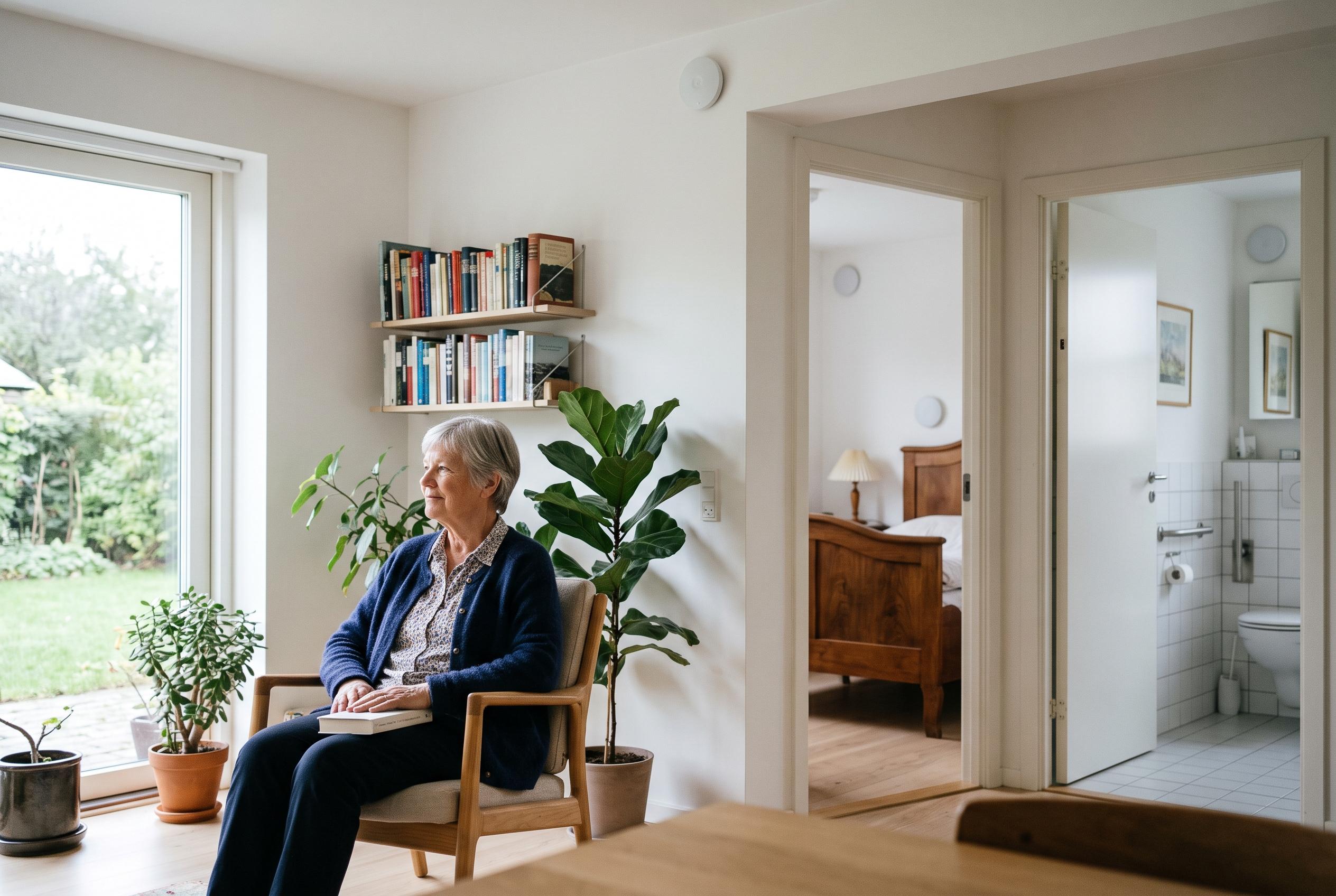

A bathroom fall detector, bedroom sleep radar and living-area presence sensor can work as one local system, combining alerts gradually while avoiding cameras and reducing false alarms.
A practical ageing-in-place system is not built around a single radar, but around a set of devices that each answer a different question in the home. The architecture described here treats the bathroom, bedroom and shared living areas as distinct monitoring zones, then routes all alerts through one broker and one response path. That matters because a fall in a bathroom, a prolonged absence from bed, and quiet immobility in a hallway are not the same event, even if each may require attention from a carer. The devices are presented as a safety and wellness layer, not a medical system, and they are not a replacement for human supervision, a call service or emergency assistance.
The strongest case for combining three 60GHz radars is that one sensor rarely tells the whole story. In a bathroom, the fall detector is the critical device because video is often unacceptable and a call pendant may be out of reach. In a bedroom, a sleep radar can establish whether someone is in bed, whether breathing appears normal and whether an overnight pattern has changed. In a hallway or living room, a presence sensor can show whether anybody is moving, still or approaching a room. The point is not to measure everything at once, but to match the sensor to the question that room actually raises.
For system design, the most important rule is consistency. Each radar should connect to one broker, use its own credentials and keep a unique client identifier so that one unit does not repeatedly disconnect another. The article recommends a clear topic structure that separates the fall, sleep and presence models, with device IDs that also encode the room. That makes it easier to build automations later, because the home controller can group events by location rather than by raw device type. Products that support MQTT and Home Assistant integration, including comparable 60GHz mmWave modules from other vendors, follow the same basic principle: the local network becomes the control plane, and the automation platform becomes the place where the logic lives.
The response chain should also be staged, not immediate. A fall event in the bathroom may justify an alert at once, but the timing threshold should be long enough to ignore a brief stumble from which the person recovers. A second layer can combine dwell time from the fall radar with occupancy data from the presence sensor, so that someone who remains motionless in a room beyond a defined limit triggers a check rather than a hard alarm. Overnight, a sleep radar reporting out-of-bed status while the presence system sees no occupancy anywhere may be more meaningful than either signal alone. Several nights of poor sleep, reduced rest or repeated anomalies are better treated as a care conversation than as an emergency.
That graduated model matters because radar produces noisy data by design. The article argues for a soft signal, a network-level confirmation and then an external contact step through the homeowner’s own service, rather than through the sensor itself. It also notes that an acknowledgement button is essential, because carers need a way to clear false alarms and avoid alert fatigue. This is where consumer-grade mmWave hardware has become more useful: vendors now advertise local processing, privacy-preserving detection, breathing estimation and direct smart-home integration, but the practical value still depends on how carefully the alerts are routed and reviewed.
Privacy is one of the main reasons mmWave radar has become attractive in bedrooms and bathrooms. The sensor output is limited to distance, motion, occupancy and related state changes, rather than video or audio, and a self-hosted broker keeps the data on the local network unless the owner chooses otherwise. Even so, the deployment still has to be engineered properly. Placement is decisive: bathroom units work best when mounted to cover the open floor rather than the door, bedroom sensors need the right height and angle to preserve breathing detection, and shared-room devices should avoid fans, moving curtains, air-conditioning motors and other sources of interference. The article also stresses a final limitation that matters for any buyer evaluating this class of product: these systems do not reliably count multiple people, sleep scores are inferred rather than directly measured, and tuning in the actual home is more valuable than trusting a default setting.
Disclaimer: This content is intended for informational purposes only. Readers are advised to exercise their own judgement, conduct due diligence, or consult a qualified expert before acting on any information provided.