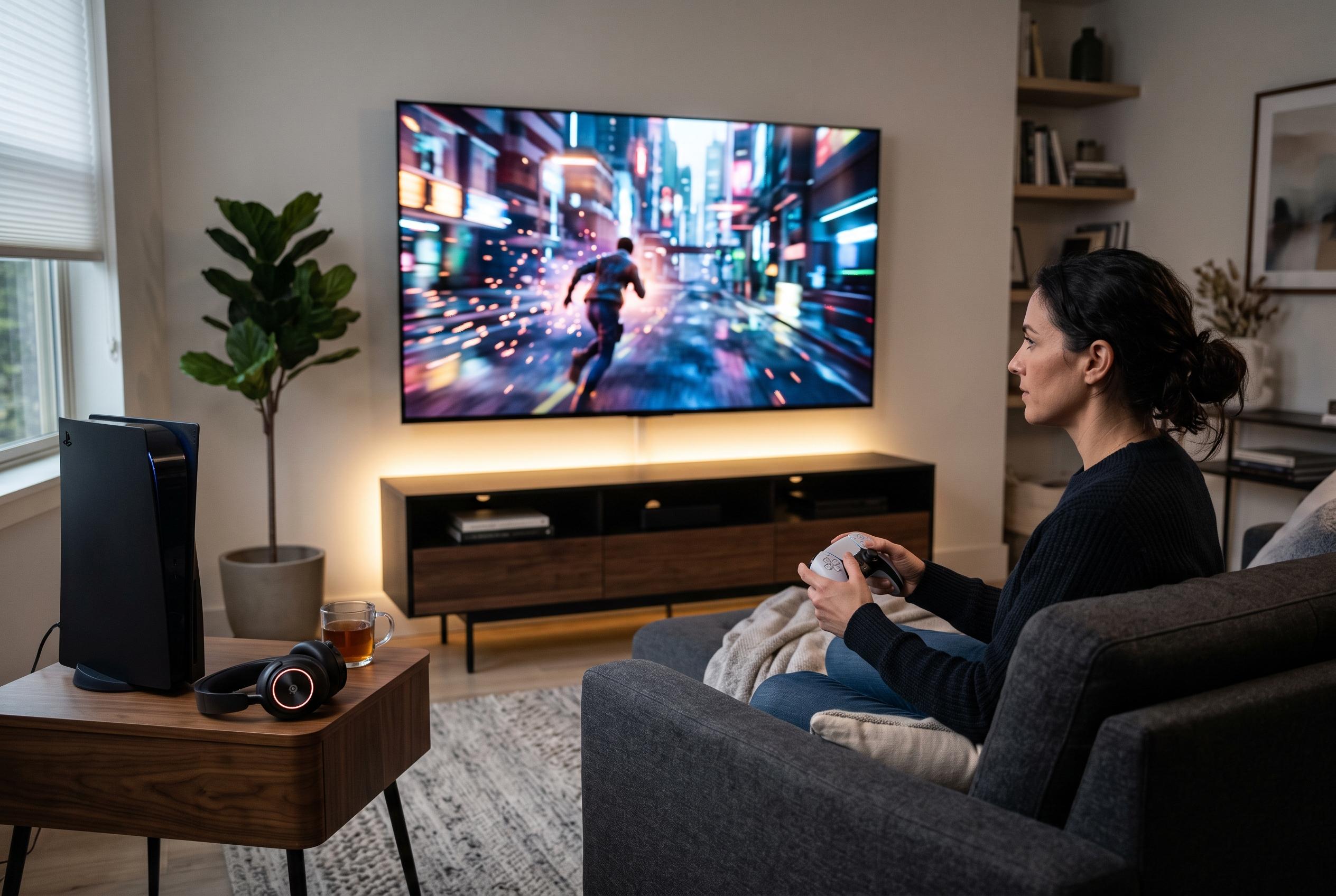

Auto Low-Latency Mode, VRR and adaptive-sync support have made modern televisions serious gaming displays, although monitors still lead on responsiveness.
Modern televisions have become far better for gaming than they were a few years ago. Features once associated mainly with dedicated monitors are now common on many sets, especially over HDMI. Among the most relevant are Auto Low-Latency Mode, Variable Refresh Rate, Nvidia G-Sync and AMD FreeSync, all of which are intended to reduce delay and keep motion smoother. For players using a console or a PC from the sofa, that shift has narrowed the gap between a TV and a purpose-built gaming display.
Auto Low-Latency Mode is one of the simplest of those features, but also one of the most useful. Sony says it automatically changes between a picture setting designed for high image quality and one tuned for lower delay when it detects an HDMI-connected source such as a games console. The feature can also work through compatible soundbars without interrupting the gaming experience. In practice, that means the set can move into game mode when a title launches and return to its usual viewing mode afterwards.
Variable Refresh Rate addresses a different problem. Games rarely run at a perfectly stable frame rate, so a fixed 60Hz or 120Hz screen can struggle to keep motion entirely smooth. By adjusting refresh on the fly to match the source, VRR can reduce judder and screen tearing. Similar principles apply to Nvidia G-Sync and AMD FreeSync, which synchronise the display with the graphics output from a compatible PC. PCWorld notes that both technologies are based on adaptive-sync concepts, though G-Sync and FreeSync differ in implementation and availability.
Input lag is another critical measure for gamers. PCMag says the current lowest-latency TV in its testing is the Roku Pro Series OLED, at 8.8 milliseconds at 4K60, narrowly ahead of the Hisense U6SF Pro and taking the title from the Samsung S95H. That kind of responsiveness matters most in fast genres such as fighting games and action titles, where even small delays can affect timing and control. PCMag also notes that lag can vary sharply depending on picture mode, with non-game settings often introducing much more delay even on otherwise fast sets.
For current consoles, resolution and refresh support now matter as much as latency. The PlayStation 5, Xbox Series X and S, and Nintendo Switch 2 all support 4K output with HDR, and the latest Sony and Microsoft consoles can also reach up to 120 frames per second in supported games. That makes a 4K HDR television with at least 120Hz refresh, and ideally VRR support, a sensible target for many buyers. Yet a gaming monitor still has the edge if absolute responsiveness is the priority, as PCMag points out, because monitors are typically able to deliver even lower input lag and broader PC-friendly refresh support.
Disclaimer: This content is intended for informational purposes only. Readers are advised to exercise their own judgement, conduct due diligence, or consult a qualified expert before acting on any information provided.