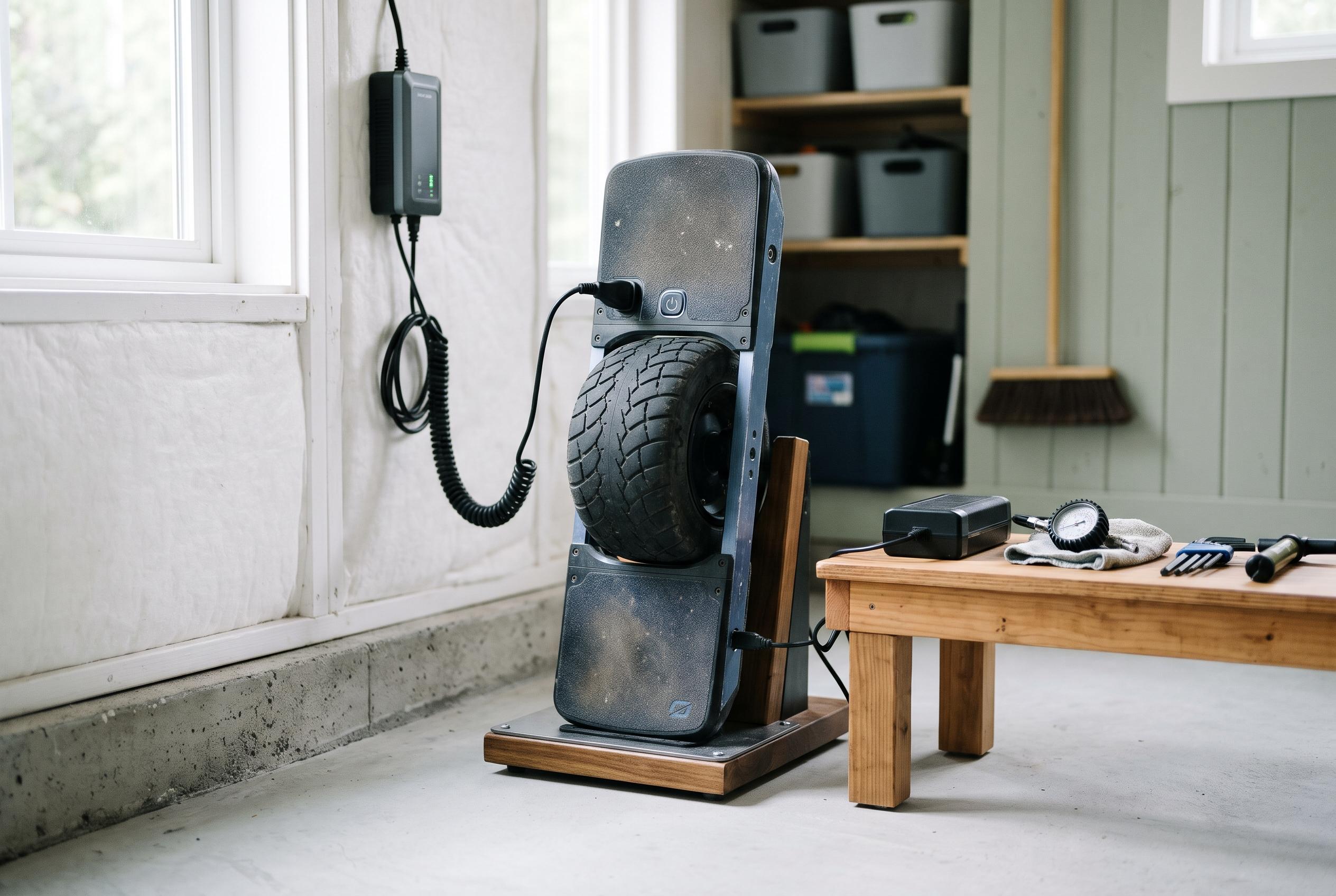

Storing an Onewheel fully charged, empty or in freezing conditions can accelerate battery wear. Future Motion’s guidance points to a safer routine for winter storage and occasional use.
Cold weather changes the way a lithium-ion battery behaves, but it does not rewrite the basic rules. The key habits remain the same: avoid long periods at a full charge, do not leave the pack empty, keep it away from heat, and charge it only when it has warmed up if it has been sitting in the cold. Future Motion’s own charging and storage guidance for Onewheel boards lines up closely with that advice, and the company says a battery that is damaged or no longer holds a charge should be taken out of service and referred to support.
For riders putting a board away for the season, the safest routine is straightforward. Future Motion recommends storing the battery at roughly 40% to 50% charge, checking it each month, and keeping the board in a dry place with mild temperatures rather than a garage or shed that swings cold at night. The company also warns against leaving the board at 0% or 100% for long periods, which is consistent with broader lithium-ion battery care advice that favours a mid-charge state during storage.
Temperature matters just as much as charge level. Future Motion says riders should let a cold board warm up before use, while Battery University’s technical guidance explains why charging below freezing is a problem: the chemistry can allow metallic lithium to plate onto the anode, causing permanent damage. It also notes that lithium-ion cells perform best when charged in a moderate temperature band, rather than in freezing air or in a hot enclosure.
Heat is the other major risk. Battery University’s data show that a battery stored at full charge in warm conditions loses capacity faster than one stored partially charged, and the difference becomes more severe as temperatures rise. Future Motion likewise advises riders not to expose the battery pack to extreme temperatures. In practical terms, that means avoiding closed cars, sun-baked garages and any situation where a board sits hot and full for hours at a time.
Riding habits affect longevity too. Heavy acceleration, steep climbs and repeated hard pulls draw more current from the pack than gentle cruising, which increases wear over time. Sandia National Laboratories has found that cycle life can vary widely depending on temperature, discharge rate and depth of discharge, even when cells are operated within specification. That does not mean a rider needs to be cautious to the point of frustration, only that repeated full-power use on a low battery will age the pack more quickly than moderate riding.
Charging habits are easier to control and often make the biggest difference. Future Motion says it is acceptable to leave a board on the charger for several days, but not for months, and it recommends charging at least once every two months to preserve warranty coverage. Battery University also notes that partial charging tends to be gentler on lithium-ion cells than routinely taking them to full voltage. For riders with a GT, Future Motion’s 90% charge setting is designed around that trade-off, reducing stress on the pack in exchange for slightly less range.
There is one exception to the general rule against full charges: balance and recalibration. Future Motion recommends charging to 100% when the range reading seems off, because a full charge helps the pack balance and the gauge recalibrate. The same guidance appears in its older charging information, which says leaving the charger connected overnight from time to time can help the cells balance. The point is not to store the board full, but to use a full charge occasionally as a maintenance step.
Moisture deserves equal caution. Future Motion says Onewheel boards are water-resistant, not waterproof, and asks riders to dry the board completely before charging after a wet ride. Its cleaning advice also stresses removing moisture and debris after exposure to salt or damp conditions, then allowing the board to dry thoroughly before reassembly. A board that has been wet or taken a hard impact should be inspected carefully, because physical damage can create longer-term battery problems even if the pack still appears to function normally.
The same care applies if the board has been left in the cold. Future Motion advises bringing it indoors and allowing it to warm before charging, rather than plugging it in immediately after exposure to low temperatures. Battery University explains that the battery management system can only do so much; it cannot prevent the slow chemical wear that comes from poor storage, repeated deep discharge or charging at the wrong temperature. The result may not be immediate failure, but it can show up later as shorter range, weaker performance or cells that become increasingly unbalanced.
For owners who only ride occasionally, the monthly check is not busywork. Battery University notes that lithium-ion cells self-discharge slowly, but not to zero, and Future Motion says the board should not be left unattended for months at a time. Checking the battery level every few weeks and topping it back to the recommended storage range is a simple way to avoid discovering, too late, that a board has drifted to an unhealthy state.
The broader lesson is that battery care is mostly about restraint. Mid-charge storage is better than full or empty, moderate temperatures are better than heat or freezing conditions, and a little periodic attention is better than leaving the pack alone for months. Future Motion’s own recommendations are consistent with that view, and they apply whether the board is used daily or only when the weather is perfect.
Disclaimer: This content is intended for informational purposes only. Readers are advised to exercise their own judgement, conduct due diligence, or consult a qualified expert before acting on any information provided.