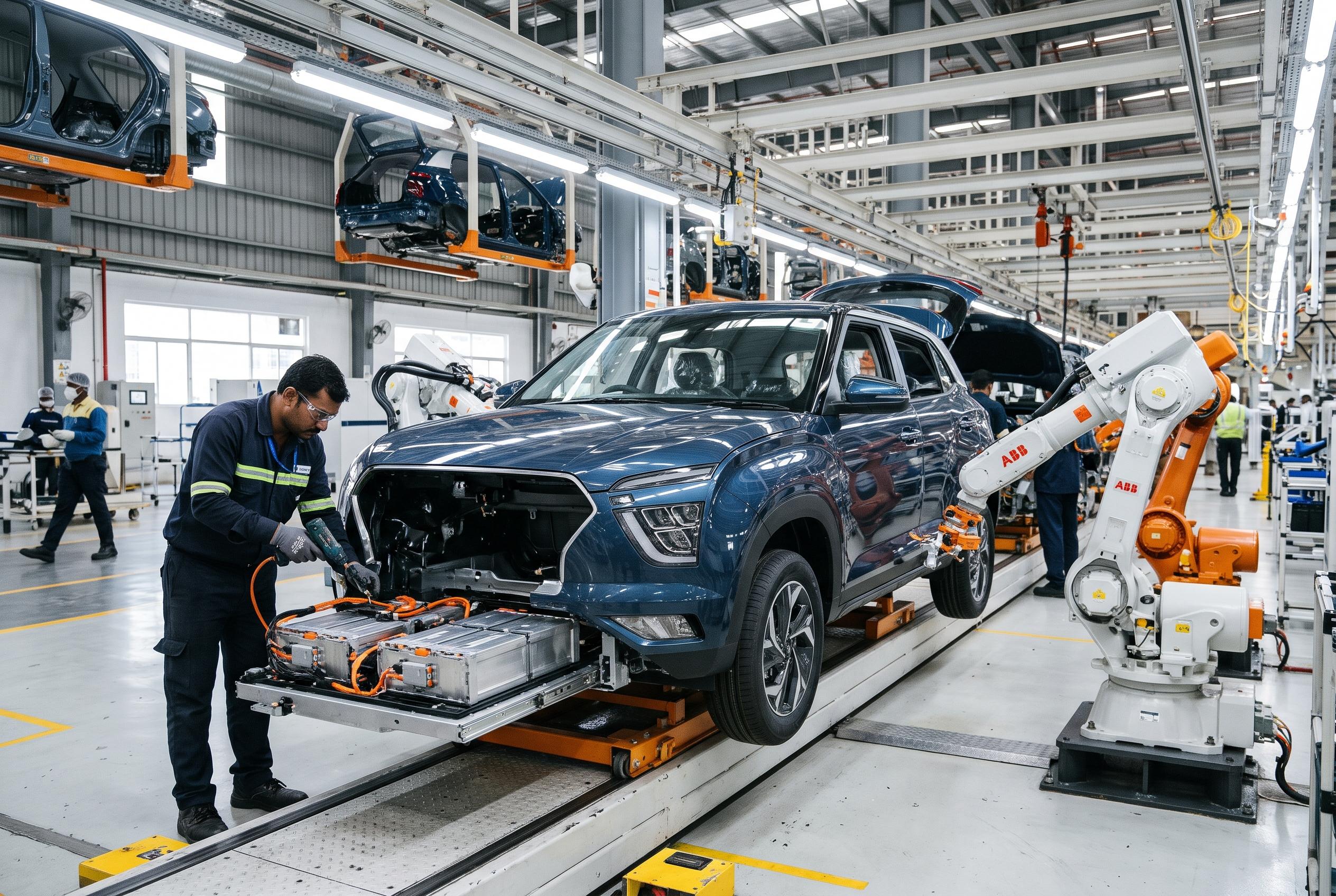

Hyundai is preparing to launch its entry-level electric SUV in India with Chinese Svolt cells before switching to locally supplied Exide batteries, using its established Sriperumbudur plant to accelerate production.
Hyundai’s planned entry-level electric SUV for India is shaping up as a carefully timed local play rather than a simple budget EV bet. Reports say the model, referred to as the HE1i, will be assembled at Hyundai’s Sriperumbudur plant in Tamil Nadu and will share its basic underpinnings with the overseas Inster EV. The move would place the car inside India’s production-linked incentive framework from the outset, giving Hyundai access to support tied to qualifying domestic sales, while also reinforcing the company’s long-term push to make Tamil Nadu a core EV manufacturing base. According to Hyundai Motor India’s recent plans, the Sriperumbudur site is being positioned as its flagship EV facility, backed by a large multi-year investment programme.
That localisation, however, does not automatically translate into a sharply lower showroom price. Battery costs, production volumes and Hyundai’s own pricing decisions will all shape the final figure, even if the car is made in India. The most revealing detail is the battery supply strategy. Autocar India reports that the first batch of vehicles will use cells from China’s Svolt, with Hyundai intending to switch later to cells supplied in India by Exide. The company appears to have judged that delaying the launch in pursuit of a fully local battery chain would have carried a greater commercial risk than starting with an imported cell package.
The Sriperumbudur plant gives Hyundai a strong base for that approach. The facility has been operating since the late 1990s and has long been central to the carmaker’s Indian and export business, with previous reporting showing it has already produced millions of vehicles for markets overseas. In June 2026, Hyundai formally described the site as its flagship EV manufacturing hub for India, underscoring the strategic weight the company now assigns to the location. That history matters: the plant is not a greenfield experiment, but an established industrial centre with scale, export experience and supply-chain depth.
Spy images published by The Times of India suggest the HE1i is already in testing, including at a fast-charging station in Vijayawada, which points to a launch timetable later in 2026. The same reporting indicates the SUV sits below the Creta Electric and is expected to use Hyundai’s E-GMP(K) architecture, with more than one battery option and Level 2 driver assistance features. If that proves accurate, the model would give Hyundai a locally built, lower-priced entry into India’s expanding EV market, while the company balances speed to market against the slower task of localising more of the car’s key components.
Disclaimer: This content is intended for informational purposes only. Readers are advised to exercise their own judgement, conduct due diligence, or consult a qualified expert before acting on any information provided.