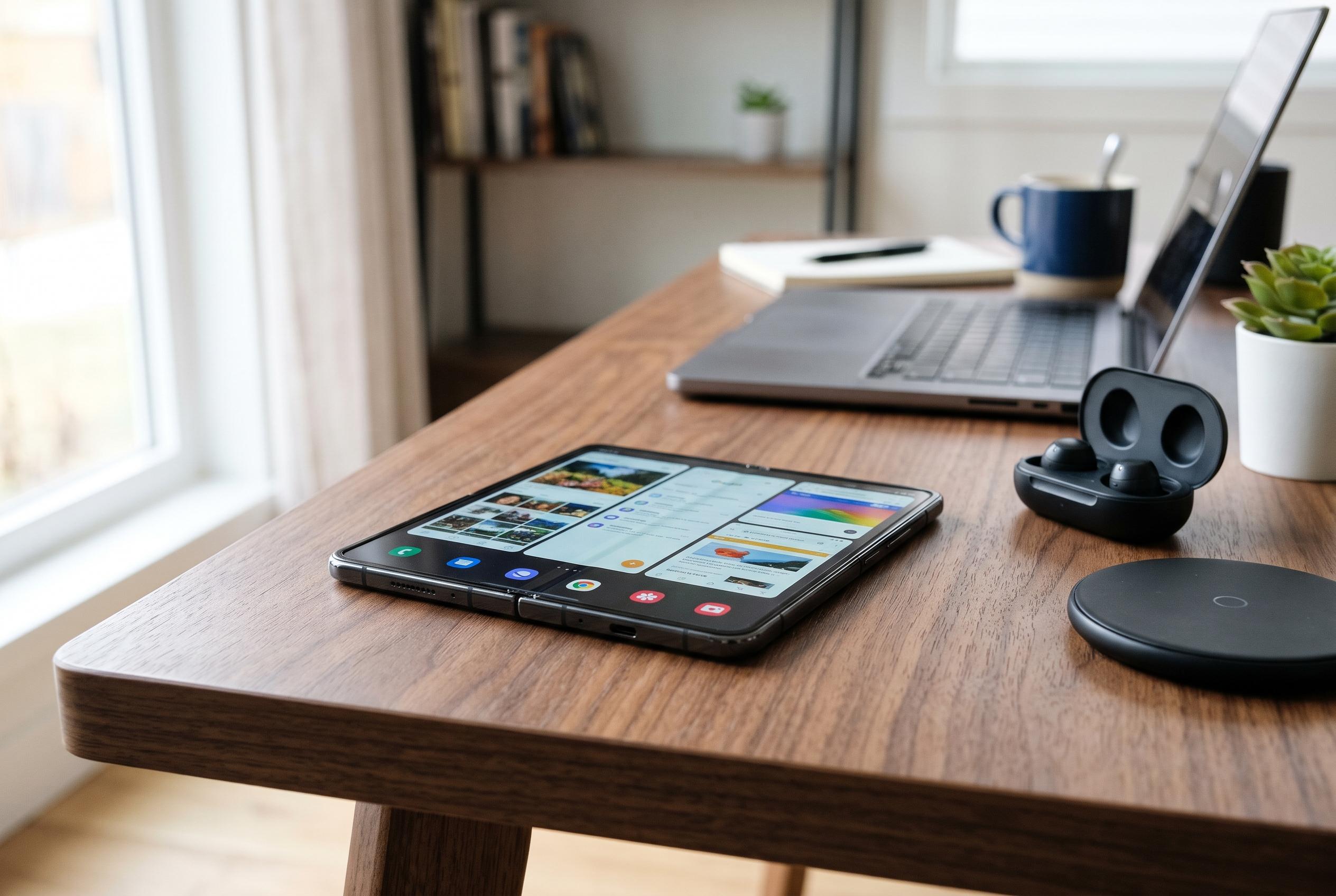

Apple’s first foldable combines a polished hinge, near-invisible crease and powerful multitasking with a steep price, weaker zoom photography and the loss of Face ID.
Apple’s first foldable arrives with the rare sense that the company has spent years learning from everyone else’s missteps. The iPhone Duo is not a tentative experiment dressed up as a flagship; it feels like a fully formed product that turns the foldable category into something more polished, more durable and more coherent than most rivals have managed. According to the review published by Absolute Geeks, that confidence is built on a titanium frame, a refined hinge, strong performance and displays that make the crease largely disappear, even if the price and the loss of Face ID remain hard compromises.
Design is the Duo’s clearest statement of intent. The device is compact when closed, more squat than the tall, narrow proportions common to book-style foldables, and it opens into an impressively thin slate. Absolute Geeks says the chassis uses titanium and recycled materials, while the hinge mechanism is both mechanically complex and unusually smooth, with enough resistance to feel deliberate rather than fragile. Tom’s Guide’s review similarly highlights the premium finish and the no-gap hinge, framing the Duo as a device that finally makes a foldable feel like a luxury object rather than a compromise.
The displays are the feature most likely to persuade sceptics. The inner panel is described as large, bright and unusually resistant to glare, with a matte finish that not only improves visibility but also makes the fold far harder to spot in normal use. Absolute Geeks reports that the crease is effectively invisible head-on, while Tom’s Guide says the nano-texture layer plays a major role in suppressing reflections and improving the experience. The outer display is also presented as a proper phone screen rather than a narrow utility panel, which means the device remains usable when shut as well as when opened.
Apple has also tuned the software around the new form factor. Tom’s Guide identifies several modes of use, including closed, fully open in both orientations, book mode, tabletop mode and tent-style positioning, each intended for different tasks such as reading, video calls and hands-free photography. Absolute Geeks argues that this is where the Duo becomes more than a larger iPhone, because split-screen use, app pinning and half-folded layouts turn it into a pocket productivity device. The caveat is that not every third-party app has caught up, so some software still opens awkwardly or with wasted space.
Performance appears to be among the Duo’s strongest assets. According to Absolute Geeks, the A20 Pro chip keeps the device responsive even when two demanding apps are active at once, and the same review says the phone remains smooth in gaming and other intensive tasks. Tom’s Guide also praises the chipset and multitasking behaviour, describing the device as one of the more capable foldables currently available. The battery story is more mixed, but still solid: Tom’s Guide’s testing showed respectable endurance for a foldable, with charging figures that are competitive rather than class-leading, while Absolute Geeks says the phone comfortably lasts a full day and can stretch further with lighter use.
The biggest hardware trade-off is the camera system. Absolute Geeks says the Duo’s dual 48-megapixel rear cameras are strong for everyday shooting, travel and social sharing, but still fall short of the company’s top slab-phone cameras, particularly where zoom is concerned. The absence of a telephoto lens is the most obvious limitation, and the review suggests that anyone who values serious photography should still look to the Pro model. On the other hand, the foldable format allows for preview tricks, flexible shooting angles and a concealed inner camera that keeps the main display uninterrupted.
Price remains the final hurdle, and it is a substantial one. Absolute Geeks says the Duo starts at AED 8,499, positioning it well above the iPhone 18 Pro Max and higher than competing foldables in its market, while Tom’s Guide notes a launch price of $1,999 in the United States. Even so, the argument for the Duo is that it does something a conventional premium phone cannot: it combines a flagship iPhone with a tablet-like inner screen in a body that is still practical to carry. For buyers already committed to iOS and willing to pay for that flexibility, the Duo looks like the most convincing foldable Apple has made, even if it is not the best choice for photographers or anyone who values Face ID above all else.
Disclaimer: This content is intended for informational purposes only. Readers are advised to exercise their own judgement, conduct due diligence, or consult a qualified expert before acting on any information provided.