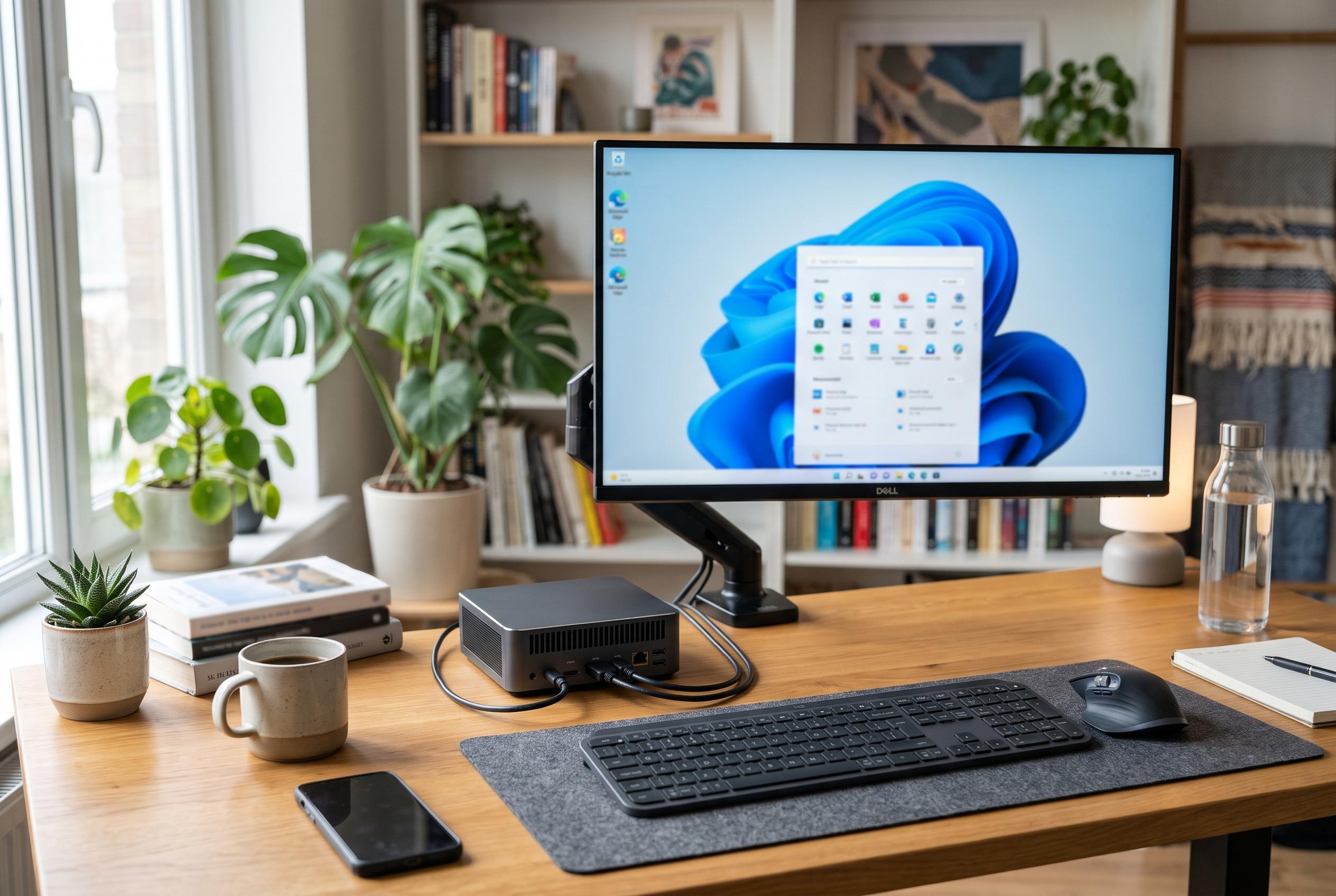

The Geekom IT13 Max offers strong performance, extensive connectivity and a clean Windows 11 setup, but its travel-ready credentials collapse once its display, peripherals and power supply are added.
Saeed Wazir’s switch from an Asus gaming laptop to Geekom’s IT13 Max mini-PC was meant to test a simple question: can a small desktop replace a portable notebook for everyday Windows 11 work? His answer was mixed. According to his account, the machine is entirely capable at a desk, but it is a much weaker proposition once the workday moves to a café, train or client site.
For stationary use, the IT13 Max appears well suited to the job. Wazir reused existing peripherals, including a monitor, mouse and keyboard, and found that his usual workflow carried across without friction. Independent testing supports that impression. PCWorld recorded a strong PCMark 10 result and said the system remained smooth in daily use, while noting that it has enough headroom for office work, light development, image editing and moderate virtual machine or video tasks. TechRadar and other reviewers similarly describe it as a capable office machine that handles Microsoft 365 applications with ease.
Gaming is more selective, but not absent. Wazir said the mini-PC coped with lighter titles and older games, while newer blockbusters were too demanding for its integrated graphics. That aligns with third-party reviews. Tom’s Hardware found that the IT13 Max can run modern games only at reduced settings and is better matched to esports and older releases. PCWorld and TechPowerUp also frame the Intel Arc graphics as strong for an integrated solution, but still far from a substitute for a discrete GPU.
The portability argument is where the idea starts to break down. Wazir found that once the mini-PC, power brick, portable display, keyboard, mouse and audio gear were packed together, the travel setup was not much lighter than a laptop system. More importantly, it lacked the qualities that make a laptop practical on the move: battery power, an integrated screen and built-in speakers. PCWorld confirms that the IT13 Max offers a wide spread of ports, including dual HDMI, dual USB4, dual 2.5Gbit Ethernet and a card reader, plus support for up to four displays. But that flexibility does not remove the need to carry and connect everything separately. If anything, it reinforces the point that a mini-PC is only small at the unit level, not necessarily at the workstation level.
There is one important caveat to the upgrade story. Wazir suggested that mini-PCs tend to be easy to expand, but the specific 24GB configuration of the IT13 Max is not upgradeable in the way some buyers might expect. PCWorld, PC-WELT and TechRadar all note that the LPDDR5 memory in that version is soldered. Geekom also sells a different memory variant with a more upgrade-friendly design, so buyers need to check the exact specification rather than assume all IT13 Max units are alike. Storage is more flexible, with reviewers noting additional M.2 support. Price is another relative point. Review units were priced at $799 in several reviews, which is competitive for a Core Ultra 9 mini-PC with this connectivity, but hardly cheap in absolute terms.
The conclusion is straightforward. The IT13 Max looks like a strong desk machine with excellent connectivity, respectable performance and a clean Windows installation. It is less convincing as a travel-first computer. For users who mostly work at one place and already own a display and peripherals, the mini-PC makes sense. For anyone who needs battery life, a screen that is always attached and a setup that can be opened anywhere, a laptop remains the better tool.
Disclaimer: This content is intended for informational purposes only. Readers are advised to exercise their own judgement, conduct due diligence, or consult a qualified expert before acting on any information provided.