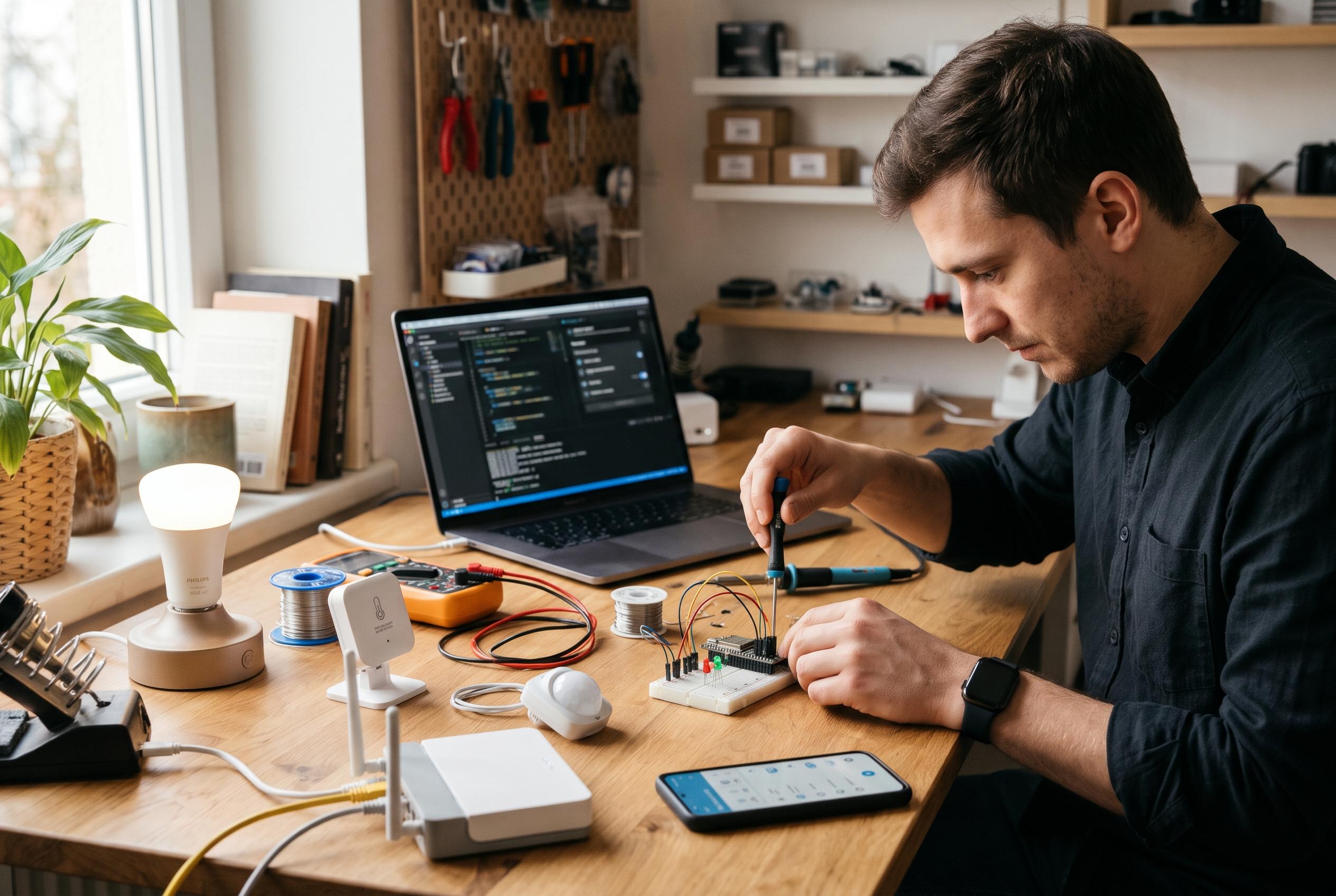

Espressif’s compact ESP32-C6 combines Wi-Fi 6, Bluetooth LE and 802.15.4, giving DIY developers a simpler route from Wi-Fi projects to Thread and Zigbee devices.
For anyone building smart-home projects on an ESP32, the ESP32-C6 has become a particularly practical choice because it folds several radios into one chip. Espressif describes it as its first Wi-Fi 6 SoC, combining 2.4GHz Wi-Fi, Bluetooth Low Energy and 802.15.4 support, which is the radio used by Thread and Zigbee. That combination removes the need to bolt on separate hardware when a project must move beyond a simple Wi-Fi connection.
That matters because many DIY sensor and automation builds begin on Wi-Fi, then later need to join a mesh network. In the past, that often meant choosing one board for the device itself and another piece of equipment for coordination or border routing. Espressif’s documentation says the ESP32-C6 is designed for Thread and Zigbee development within the ESP-IDF framework, while its Zigbee SDK v2.x supports Zigbee device development on the chip. In practice, that makes the C6 a single-board starting point for projects that might otherwise require extra infrastructure.
The attraction is not just radio support but coexistence. Espressif says the chip can share its 2.4GHz front end between Wi-Fi, Bluetooth and 802.15.4 through time-division multiplexing, allowing those radios to operate together, albeit with reduced airtime for each. The company also notes that a dual-SoC approach is preferable when a design needs continuous heavy use of more than one network at the same time. For many home-automation tasks, however, the C6’s integrated approach is enough to simplify the build.
That simplicity is one reason the board has appeal for Home Assistant users and other tinkerers. The chip supports GPIO, I2C, SPI, UART and other common interfaces, as well as a 12-bit ADC and a temperature sensor, so it can serve as a practical sensor or control node rather than merely a connectivity bridge. It is also a modest part in cost terms, which makes it easier to choose one board up front without committing to a more complicated hardware stack.
The main limitation is that the ESP32-C6 is not the most powerful ESP32 variant for compute-heavy work. Espressif’s specifications place it below boards such as the ESP32-S3 for more demanding tasks, and that is where the S3 still has an advantage. But for compact smart-home projects, especially those that may need to start on Wi-Fi and later move into Zigbee or Thread, the C6 offers unusual flexibility. It is a small chip that reduces guesswork, cuts extra hardware from the bill of materials and leaves more room for the project to grow.
Disclaimer: This content is intended for informational purposes only. Readers are advised to exercise their own judgement, conduct due diligence, or consult a qualified expert before acting on any information provided.