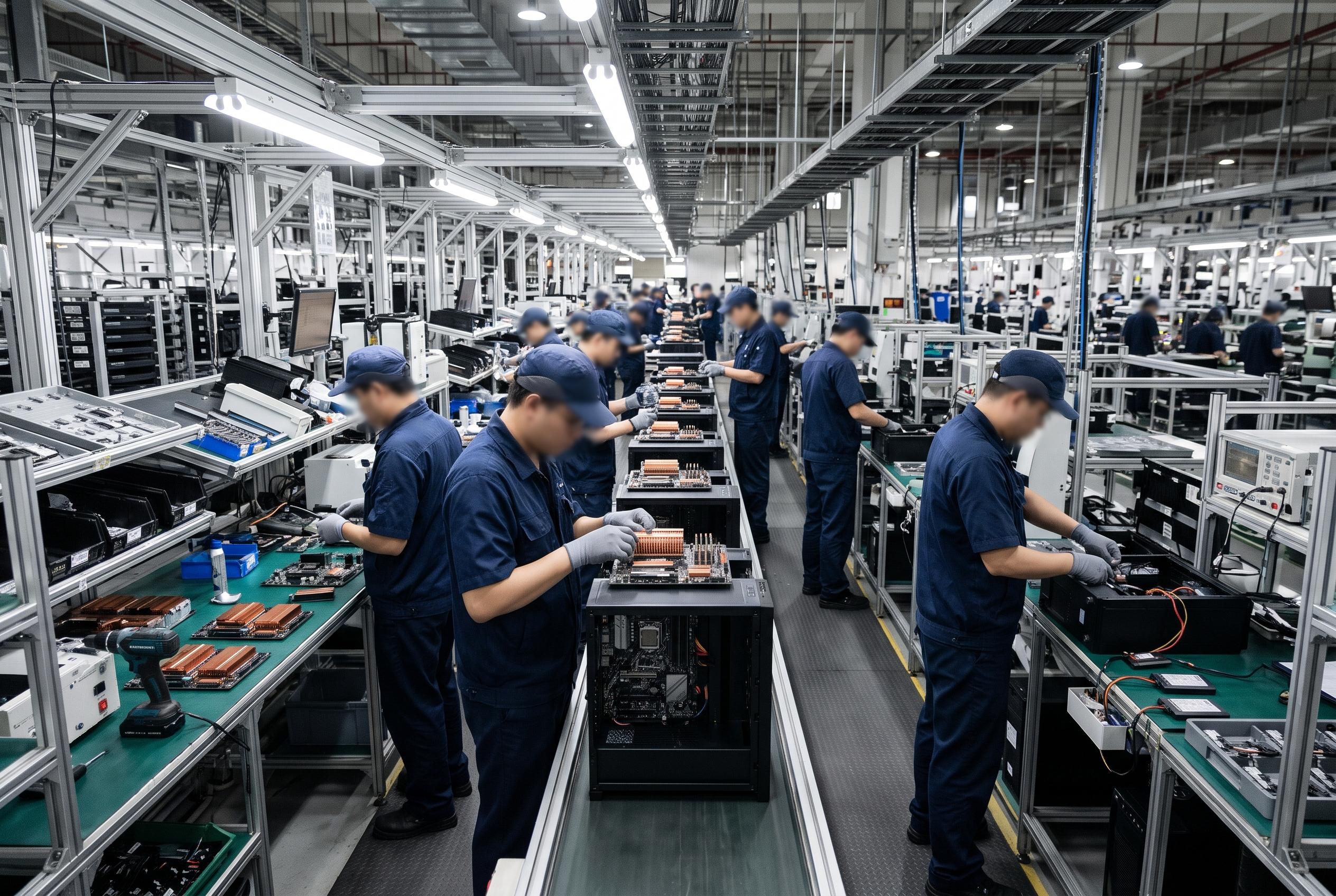

Rising memory and storage costs are prompting major PC makers to reconsider supply-chain diversification, with some production reportedly returning from South-east Asia to China.
HP, Asus and Acer are among the major PC makers now weighing a partial reversal of the manufacturing shift that once pushed production out of China, according to Nikkei Asia. Rising component costs, especially for memory and storage parts squeezed by demand from artificial intelligence infrastructure, are forcing the industry to reconsider where it assembles notebooks and desktop PCs.
Several people familiar with the matter told Nikkei Asia that some production is being moved back from Thailand and Vietnam to China, while the companies are also widening their use of newer Chinese contract manufacturers. The rationale is largely commercial: China still offers a dense supply chain, experienced factory labour and easier access to components, which can offset geopolitical risk when margins are being compressed by higher bills of materials.
The change is notable because it runs against the strategy many PC brands adopted over the past few years, when trade tensions and tariff exposure encouraged them to diversify away from China. Reuters has previously reported that suppliers were asked to expand capacity in South-east Asia, while Tom’s Hardware noted that HP had been working with contract manufacturers to shift a substantial share of laptop production towards Thailand, Mexico and, eventually, Vietnam. The current trend suggests that cost, rather than geopolitics alone, is again shaping the industry’s production map.
Nikkei Asia reported that the tighter component market has become severe enough to alter buying behaviour across the supply chain. One industry executive told the publication that the pressure is no longer limited to DRAM: prices for multiple parts have risen sharply, leaving PC makers with fewer options for absorbing the increase themselves. Another source said Chinese manufacturers are pitching themselves as a stronger fallback because they are better placed to secure domestically produced memory chips and manage procurement more efficiently.
That shift is also creating opportunities for a new generation of Chinese electronics manufacturers. Long-established Taiwanese assemblers such as Quanta, Compal, Inventec and Foxconn have dominated the PC contract manufacturing business for decades, but some of their attention has moved to AI server work, where demand and margins are higher. Nikkei Asia said firms such as Luxshare, Huaqin and Longcheer are using that opening to win new PC orders, including from global brands seeking lower-cost alternatives and more flexible sourcing.
The pressure on costs is being felt across the market. Omdia data cited by Nikkei Asia showed that global PC shipments fell 21% year on year in the July-to-September period, and that the decline could reach 24% in the fourth quarter if shortages persist. The research firm also said the bill of materials for mainstream PCs in the $500 to $699 range climbed from $435 in the first quarter of 2025 to $699 by the third quarter of 2026, while the parts cost of entry-level machines rose from $275 to $471 over the same period.
For manufacturers, the new calculus is straightforward. A supply chain built around resilience and geographic diversification is now being tested by an AI-driven scramble for memory and storage, and by the higher cost of keeping production outside China. As one gaming PC executive told Nikkei Asia, even a year-on-year surge in DRAM prices, alongside cost increases in CPUs, circuit boards and passive components, is forcing the sector to rethink where it builds and sources its machines.
Disclaimer: This content is intended for informational purposes only. Readers are advised to exercise their own judgement, conduct due diligence, or consult a qualified expert before acting on any information provided.