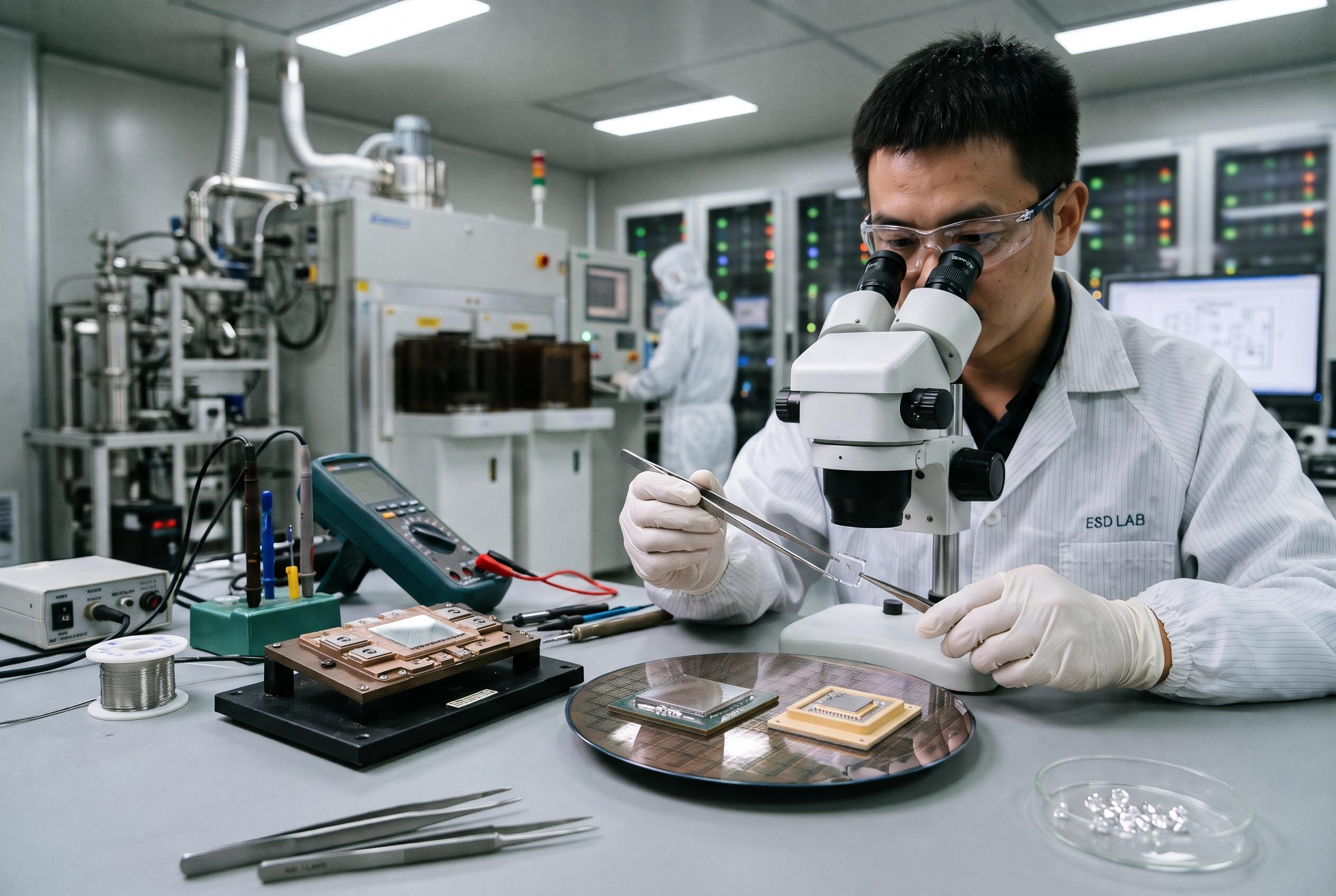

Facing falling prices and fierce competition in jewellery, Chinese producers are seeking new uses for diamonds in chips and data centres, though scaling up industrial demand remains uncertain.
Chinese producers of laboratory-grown diamonds are increasingly looking beyond the jewellery trade and towards uses in semiconductors, artificial intelligence and other advanced electronics, Reuters reported. The shift reflects intense competition, falling prices and a market that is becoming harder to defend on gems alone, even as China remains a major force in global production. Industry background from the Gemological Institute of America shows that China has built substantial capacity in lab-grown stones over recent years, giving manufacturers both the scale and the incentive to seek new outlets.
One of the clearest examples is Feng Canjun, an entrepreneur who told Reuters that about 70% of his factory’s two million carats of annual output currently goes into jewellery. He said he wants more than half of production to be devoted to industrial uses by 2030, while jewellery output would be capped at 30%. A separate industry report cited by Reuters says China’s overall lab-grown diamond production has expanded rapidly, underlining how quickly the sector has moved from niche status to industrial scale.
The appeal lies in the material itself. Diamond conducts heat exceptionally well, and that quality matters as chips and data centres run hotter under the strain of AI workloads. Fraunhofer USA’s Centre for Micro and Nano Technology says diamond also offers strong voltage tolerance and radiation resistance, making it attractive for wide-bandgap semiconductor research. Princeton Plasma Physics Laboratory has likewise described work on lab-grown diamond for computers, optics and sensors, while Rice University recently reported a patterned diamond growth method that reduced operating temperatures in test devices by 23 degrees Celsius.
Even so, commercial adoption remains uncertain. Reuters noted that producers and analysts see sizeable industrial opportunities, but also warned that supply-chain constraints and overcapacity could complicate the transition. For jewellery retailers, the development could eventually reshape pricing and positioning in a market already under pressure from cheaper lab-created stones. For technology makers, it points to a potential new class of thermal-management material, though one that still has to prove it can be produced reliably, at scale and at a cost that industry can justify.
Disclaimer: This content is intended for informational purposes only. Readers are advised to exercise their own judgement, conduct due diligence, or consult a qualified expert before acting on any information provided.