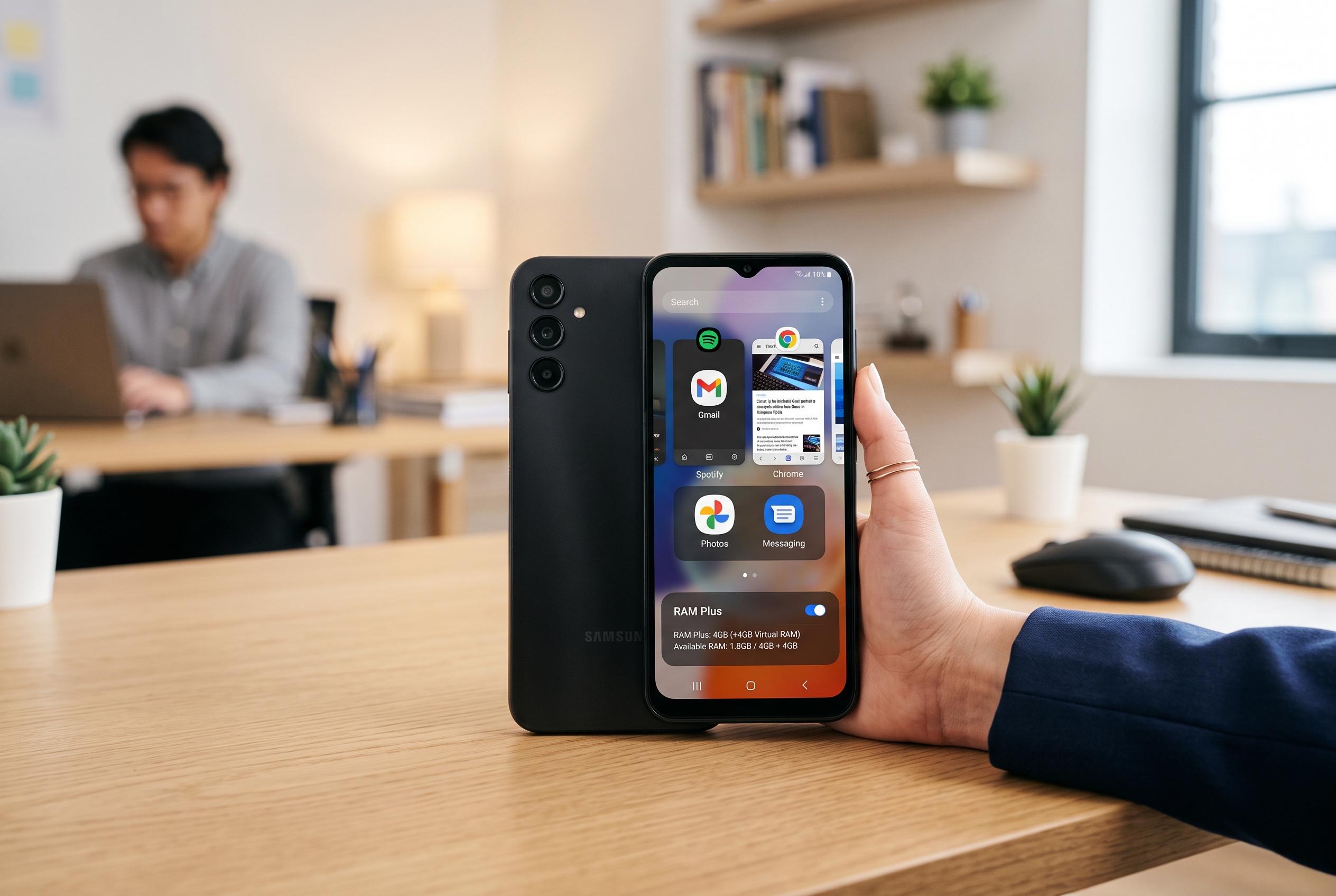

Samsung’s virtual memory feature, RAM Plus, offers modest multitasking improvements on budget Galaxy devices but delivers negligible benefits on higher-end models, highlighting its hardware-dependent effectiveness.
Samsung’s RAM Plus has long been one of those settings that sounds more useful than it feels at first glance. The feature, which Samsung says is meant to help phones handle more apps at once by leaning on virtual memory, became available on a wider range of Galaxy devices after first appearing on the Galaxy A52s 5G in 2021, according to coverage from SamMobile and Notebookcheck. In practice, it has also become one of the most debated options in One UI because its benefits depend heavily on the phone’s hardware.
Samsung describes RAM Plus as a way to improve multitasking by using part of the phone’s internal storage as extra memory, with the company saying the feature can reduce app reloads and improve responsiveness. Its support pages say users can find it under Battery and device care, then Memory, and can choose how much storage to set aside before restarting the handset. Samsung also says the feature is especially helpful on devices with limited physical RAM.
But the setting has also attracted scepticism. SamMobile has argued that RAM Plus does not work quite the way many people assume, saying it relies on zRam, a compression technology that keeps more data available in system memory rather than simply turning storage into a direct RAM substitute. That explanation matters because it helps clarify why switching the option off does not always produce the dramatic change users might expect, or free up storage in the way some descriptions suggest.
That ambiguity helps explain why a week-long test across several Galaxy phones produced mixed results. On the older Galaxy S21, turning RAM Plus off did not noticeably slow app launches or multitasking, and battery life stayed broadly the same. On a budget Galaxy device with 6GB of RAM, though, multitasking felt a little less smooth once the feature was disabled. Testing two additional Galaxy phones led to the same broad pattern: handsets with 8GB or 12GB of RAM did not seem to gain much, while devices with 6GB or less appeared to benefit more.
The practical takeaway is simple: RAM Plus is not a universal upgrade, even if Samsung enables it by default on Galaxy phones. For higher-end models with plenty of RAM, the setting may make little difference either way. For cheaper devices with tighter memory budgets, however, it can still provide a modest boost when several apps are open at once. On a future flagship with 12GB of RAM, the feature may be more optional than essential.
Disclaimer: This content is intended for informational purposes only. Readers are advised to exercise their own judgement, conduct due diligence, or consult a qualified expert before acting on any information provided.