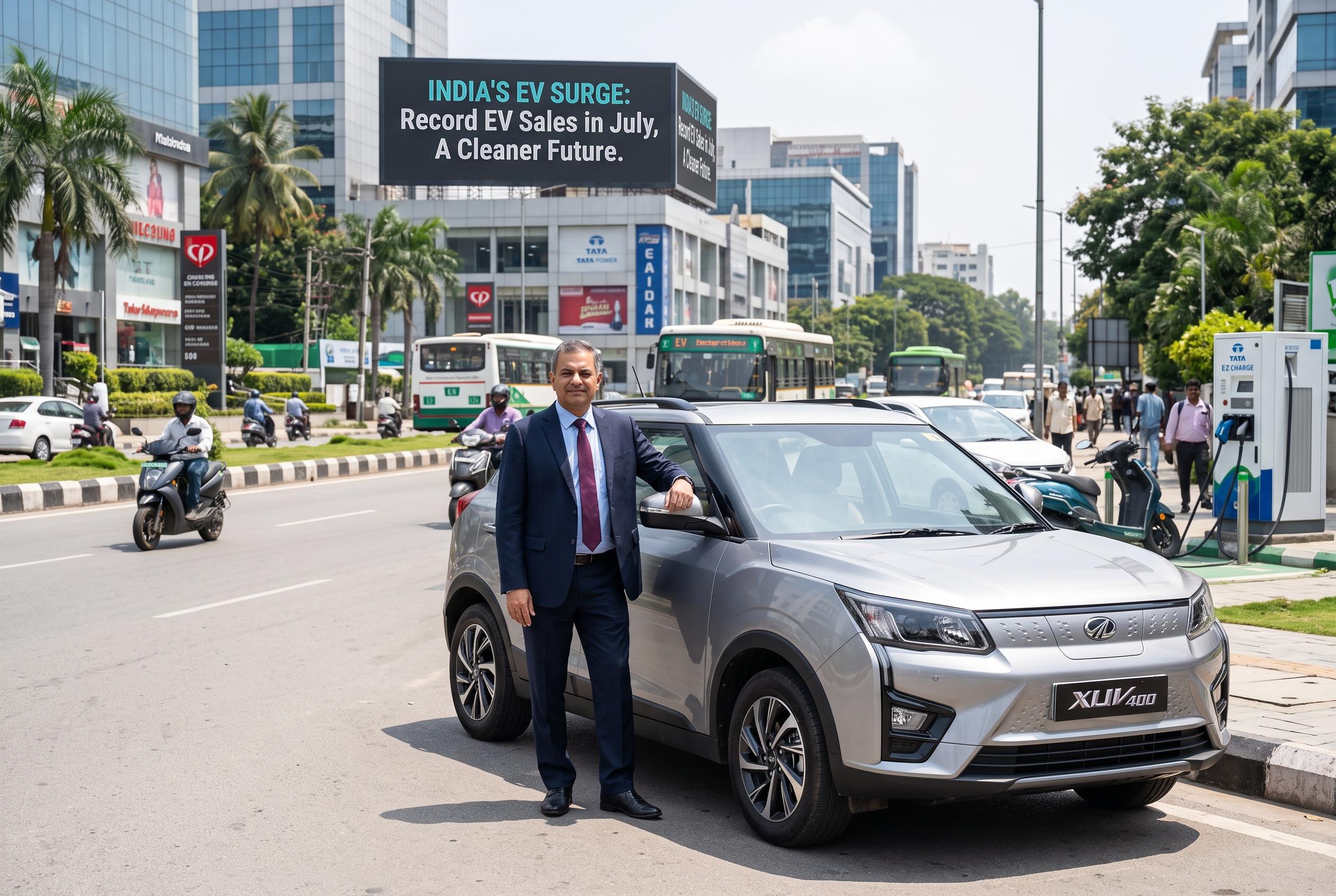

India’s EV market experienced its strongest monthly performance on record in July, with retail sales reaching over 327,000 units and marked by significant growth across all categories, signalling a rapid transition to mainstream electric mobility.
India’s electric vehicle market posted its strongest monthly performance on record in July, with retail sales reaching 327,901 units, according to data released by the Federation of Automobile Dealers Associations. The total marked a 66% increase from a year earlier and pushed electric vehicles to nearly one in every eight vehicles sold in the country during the month, up from roughly one in 10 a year ago. The figures also point to a broader shift in the market: every major category, from two-wheelers to commercial vehicles, recorded its best July on record.
The clearest sign of that change was in electric three-wheelers, where electrified models captured 65.1% of the market. That is a significant jump from the 61% share reported for FY2026 by Autocar Pro, and it reinforces how quickly the segment has moved from early adoption to mainstream use. The economics explain much of the momentum. Electric three-wheelers are cheaper to buy and far less expensive to run than petrol or CNG alternatives, making them especially attractive to drivers and fleet operators who depend on daily operating margins.
Two-wheelers also delivered a record month, with electric scooter and motorcycle sales passing 200,000 units for the first time and rising 88.3% year on year to 204,362. FADA said the sector benefited from buyers rushing to secure a government demand subsidy under the PM E-Drive scheme before it expired on July 31. That timing matters. The July figure may overstate the underlying run rate, and August will show whether demand holds once the incentive is removed. The broader trend, however, remains intact: electric two-wheelers are now a mass-market product rather than a niche category.
The competitive picture is changing as well. TVS Motor Company and Bajaj Auto continued to gain ground with sharply higher electric scooter sales, while Ather Energy and Hero MotoCorp also posted strong gains. Ola Electric, by contrast, reported a decline and has since said it will move away from a direct-to-consumer model towards a conventional dealership network. The shift underlines a practical reality in India’s two-wheeler market: after-sales support, spare parts and service reach are becoming as important as product design.
Passenger vehicles and commercial vehicles also added to the record. FADA said electric passenger vehicle registrations rose 83% from a year earlier, while electric commercial vehicle penetration climbed to 3.57% from 1.65% in July 2025. Industry data from June had already shown the market building strong momentum, with EV penetration crossing 12% in that month and electric passenger vehicles setting their own retail record. July therefore appears less like an isolated spike and more like a continuation of a wider transition, though the expiry of subsidies for two-wheelers means the next few months will be a key test of durability.
Disclaimer: This content is intended for informational purposes only. Readers are advised to exercise their own judgement, conduct due diligence, or consult a qualified expert before acting on any information provided.