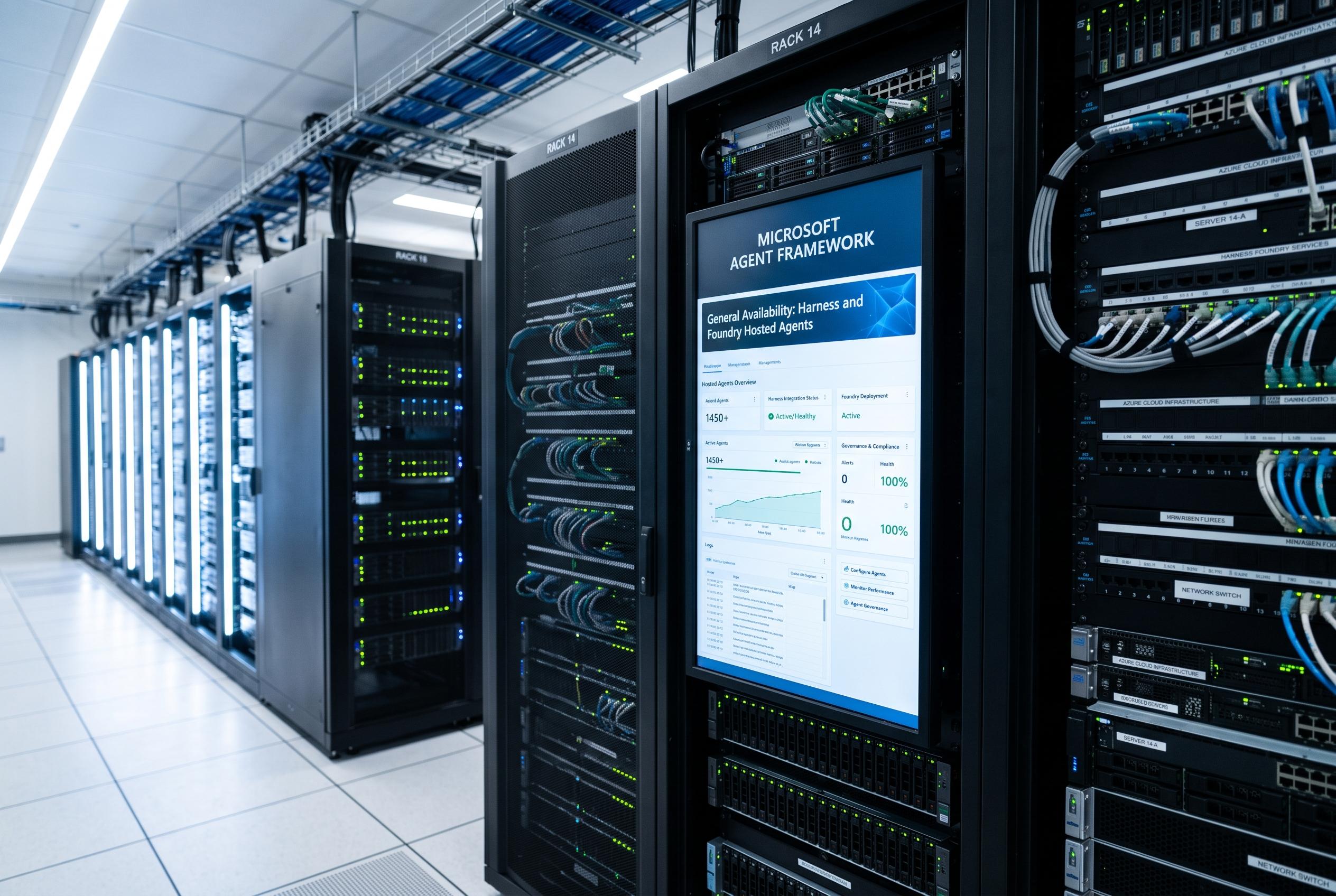

Microsoft’s Agent Framework Harness and Foundry Hosted Agents have reached general availability, transforming from experimental tools to a comprehensive platform for deploying, managing, and orchestrating AI agents in production environments, with enterprise-ready governance and cost structures.
Microsoft’s Agent Framework Harness and Foundry Hosted Agents reached general availability in early August, marking a more important change than a routine product update. The shift is from a toolkit for experimenting with agents to a managed platform for running them in production, with governance, observability and deployment controls built in. For enterprise teams, especially those moving from robotic process automation into agentic systems, the message is clear: Microsoft is now packaging the runtime as much as the model orchestration layer. According to Microsoft’s own developer blog and documentation, the framework combines agent abstractions, harness capabilities and workflow orchestration across Python and .NET.
The harness is the core of that change. Microsoft says it provides the execution loop that turns a language model into an agent, handling planning, memory, context management, approvals and telemetry without requiring teams to build those pieces themselves. Its documentation describes a broader platform that blends AutoGen’s lightweight agent style with Semantic Kernel’s enterprise features, while adding explicit graph-based workflows for multi-agent systems. That is a significant design choice: the harness is not an optional convenience layer, but the operational centre of the stack.
This matters because most of the work in production agent systems is not in model inference. It is in tool routing, state handling, retries, permissions and traceability. Microsoft’s release framing aligns with that reality by treating the harness as the default runtime for those concerns. The company says the harness supports planning, history, context handling and telemetry out of the box, which makes it easier for teams to move from prototype code to a repeatable service model.
Foundry Hosted Agents is the other half of the platform story. Microsoft positions it as the managed deployment target for Agent Framework agents, with containerised hosting, integrated identity, automatic scaling, managed session state, observability and versioning. The service uses secure per-session sandboxes and scale-to-zero behaviour, so idle agents can stop consuming compute while retaining state for later resumption. Microsoft’s guidance says this is intended to reduce the amount of infrastructure work needed to take an agent from local development into production.
That production model also brings a clearer cost structure. Microsoft’s hosted-agent guidance describes consumption-based pricing tied to compute and memory, with model inference billed separately through the underlying model provider. In practical terms, that makes the economics closer to cloud infrastructure than to traditional per-bot licensing in automation platforms. For teams evaluating scale, the important point is that session isolation, persistence and billing now sit inside one managed service rather than being stitched together manually.
Microsoft is also pushing multi-agent coordination into the same framework. The documentation lists several orchestration styles, including sequential, concurrent and handoff patterns, along with more advanced graph-based workflows. That gives architecture teams a single model for moving between simple pipelines and more complex specialist-agent systems, without changing the surrounding governance layer. In Microsoft’s own terms, the platform is designed for developers, machine-learning teams and platform administrators at the same time.
For enterprises already invested in Microsoft tooling, the appeal is obvious. The stack connects to Microsoft Foundry, Azure OpenAI and other model providers, while keeping identity, policy and observability inside the same operational framework. That makes it easier to treat agents as managed systems rather than isolated scripts. The broader implication is that Microsoft is now competing not just on model access, but on the control plane around it.
Disclaimer: This content is intended for informational purposes only. Readers are advised to exercise their own judgement, conduct due diligence, or consult a qualified expert before acting on any information provided.