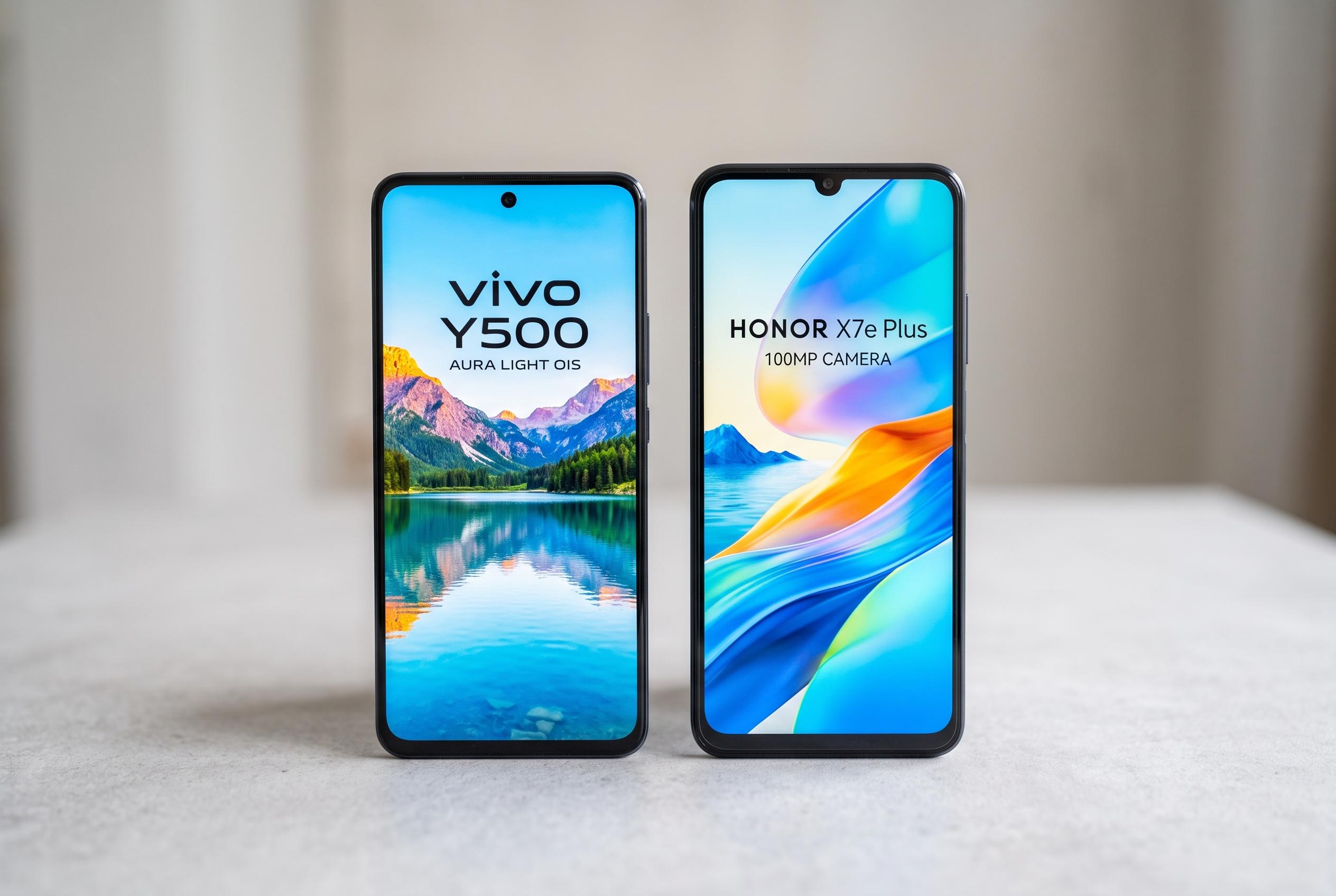

Vivo’s Y500 and Honor’s X7e Plus cater to budget-conscious consumers seeking long battery life and durability, but differ significantly in display quality, camera performance, and hardware features, offering distinct choices at similar price points.
Vivo’s Y500 and Honor’s X7e Plus are aimed at buyers who want long battery life, solid build quality and current Android software without paying flagship prices. In practice, they take different routes to get there. According to the comparison published by Gizmochina, Vivo leans harder on display quality and camera hardware, while Honor focuses on Qualcomm silicon, NFC support and tougher drop resistance.
On design, the two phones are closely matched. Both use a glass front with plastic sides and backs, and both carry IP68 and IP69 ratings for dust and water resistance. Vivo also adds MIL-STD-810H certification for military-grade durability, while Honor says the X7e Plus can survive drops from up to 2.5 metres. Display is where the split becomes clearer. Vivo’s Y500 uses an AMOLED panel with 1.5K-class resolution and a 120Hz refresh rate, which should make it sharper, brighter and more responsive than Honor’s 6.87-inch TFT LCD, even though the Honor screen is also rated at 120Hz. Retail listings and product databases do not agree on every panel dimension for the Vivo, but they consistently place it in the higher-end AMOLED category with far better brightness than the Honor.
Under the bonnet, the phones also appeal to different users. Vivo ships the Y500 with the Unisoc T7300, 8GB of RAM and UFS 2.2 storage. Honor uses the Snapdragon 4 Gen 4, which on paper brings slightly higher CPU clocks and a stronger Adreno graphics unit, making it the better pick for casual gaming and graphically heavier tasks. Both handsets use very large 8,100mAh batteries, which should comfortably stretch to two days for many users. Honor has a small edge in charging speed at 45W, compared with 44W on the Vivo, but Vivo counters with reverse wired charging and bypass charging, features that are more useful for frequent power users.
Camera hardware again favours Vivo overall. Both phones have 50-megapixel rear main cameras paired with an additional sensor and both can record 1080p video at 30 frames per second. Honor adds autofocus, which should help with consistency, but Vivo’s HDR support and image processing appear stronger in the comparison. The front camera is a more decisive win for Vivo: its 32-megapixel selfie camera is far more capable than Honor’s 5-megapixel unit. At the pricing level quoted by Focus, the Vivo Y500 costs $250, while the Honor X7e Plus is listed at $275. Taken together, Vivo looks like the more complete budget phone, while Honor makes more sense for buyers who value Qualcomm hardware, NFC and tougher drop protection.
Disclaimer: This content is intended for informational purposes only. Readers are advised to exercise their own judgement, conduct due diligence, or consult a qualified expert before acting on any information provided.