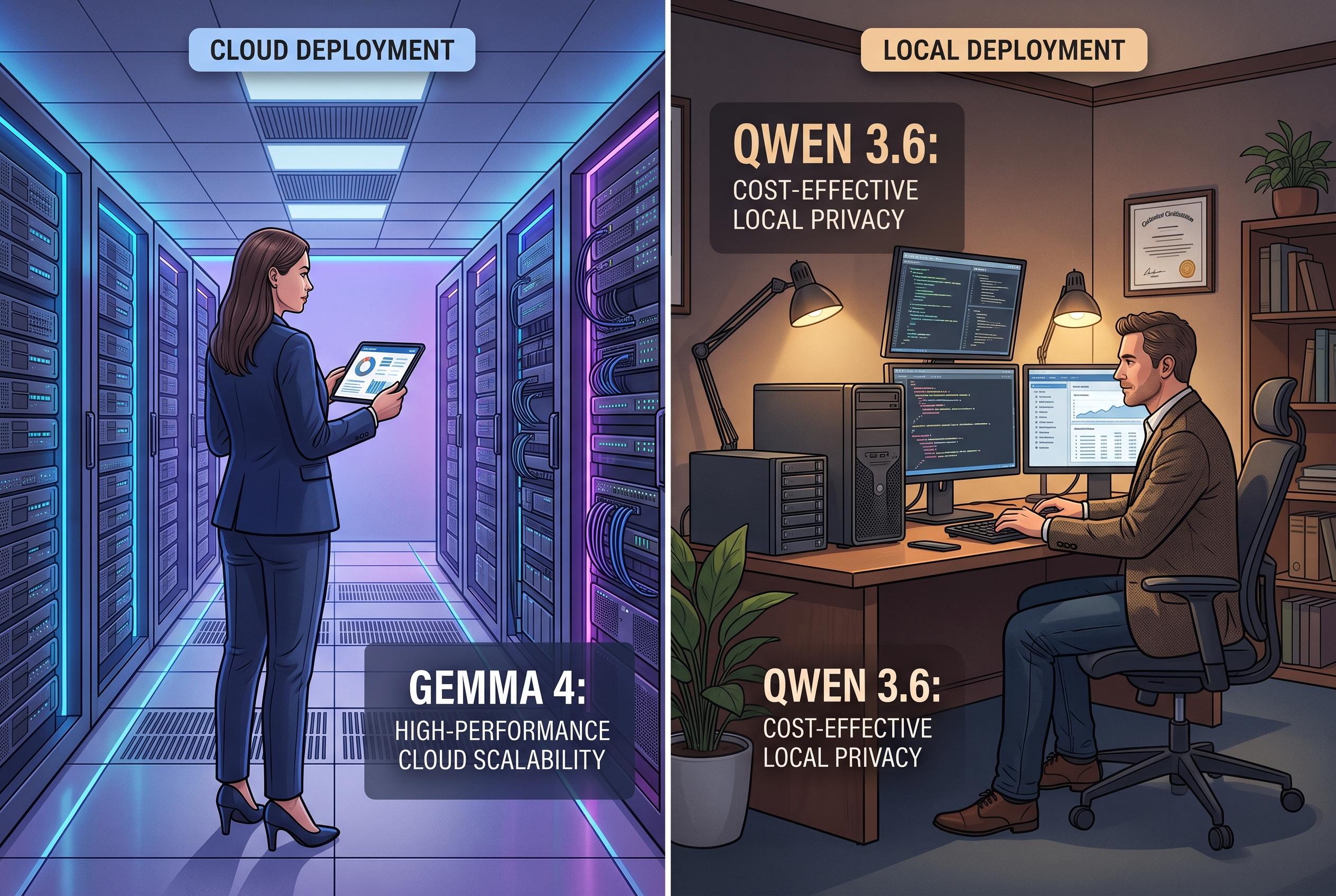

An in-depth comparison reveals that Gemma 4 and Qwen 3.6 serve markedly different needs, highlighting the importance of defining use cases before choosing an AI model, with implications for cost, privacy, and scalability.
The idea that every AI model competes on the same terms is misleading. As How-To Geek noted, Gemma 4 and Qwen 3.6 are designed for different environments, with one aimed at local use on personal hardware and the other built for large-scale cloud deployment. That distinction shapes everything from privacy to cost to the kind of work each model can handle well.
Gemma 4 is presented as the more compact and device-friendly option. The model is described as suitable for phones, laptops and desktop systems, with a 12B variant that can process audio and image inputs directly rather than relying on separate encoder models. For users who want an assistant that stays on their own machine, the appeal is clear: once installed, it does not depend on sending every prompt to an external server.
Qwen 3.6, by contrast, is framed as a cloud-first system designed for heavier analytical tasks. How-To Geek says the Plus version offers a one-million-token context window and a reasoning mode that stays active throughout a session. In practical terms, that makes it far better suited to long coding jobs, repository-wide debugging and other tasks where the model must keep track of large volumes of text without losing context. Related comparisons from Gemma4.wiki, Layer3 Labs and Qwen3lm also point to Qwen’s strength in agentic coding and large-scale context handling.
The trade-offs extend beyond performance. The article argues that licensing and deployment matter as much as benchmark numbers. According to the reporting, some Qwen 3.6 variants can be self-hosted under a permissive licence, while the higher-end cloud offering still depends on rented infrastructure. Gemma 4 is positioned as easier for small businesses and solo developers to adopt, especially now that the legal overhead around usage has been reduced. That makes it more accessible for people who want to experiment without building a cloud bill into every interaction.
Cost and privacy also separate the two. A cloud model can be efficient for organisations that already budget for infrastructure, but its usage grows more expensive as workloads increase. A local model carries more up-front setup effort, yet can avoid recurring compute charges and keep sensitive data on the device. In that sense, the choice is less about which model is “better” and more about whether the user needs portability and privacy or scale and endurance.
The broader point is that model comparison only works when the use case is defined first. A small on-device model can be the right tool for everyday assistance, while a cloud model may be the only sensible option for massive code analysis or long-running reasoning tasks. Treating them as interchangeable can lead to poor results and unnecessary frustration.
Disclaimer: This content is intended for informational purposes only. Readers are advised to exercise their own judgement, conduct due diligence, or consult a qualified expert before acting on any information provided.