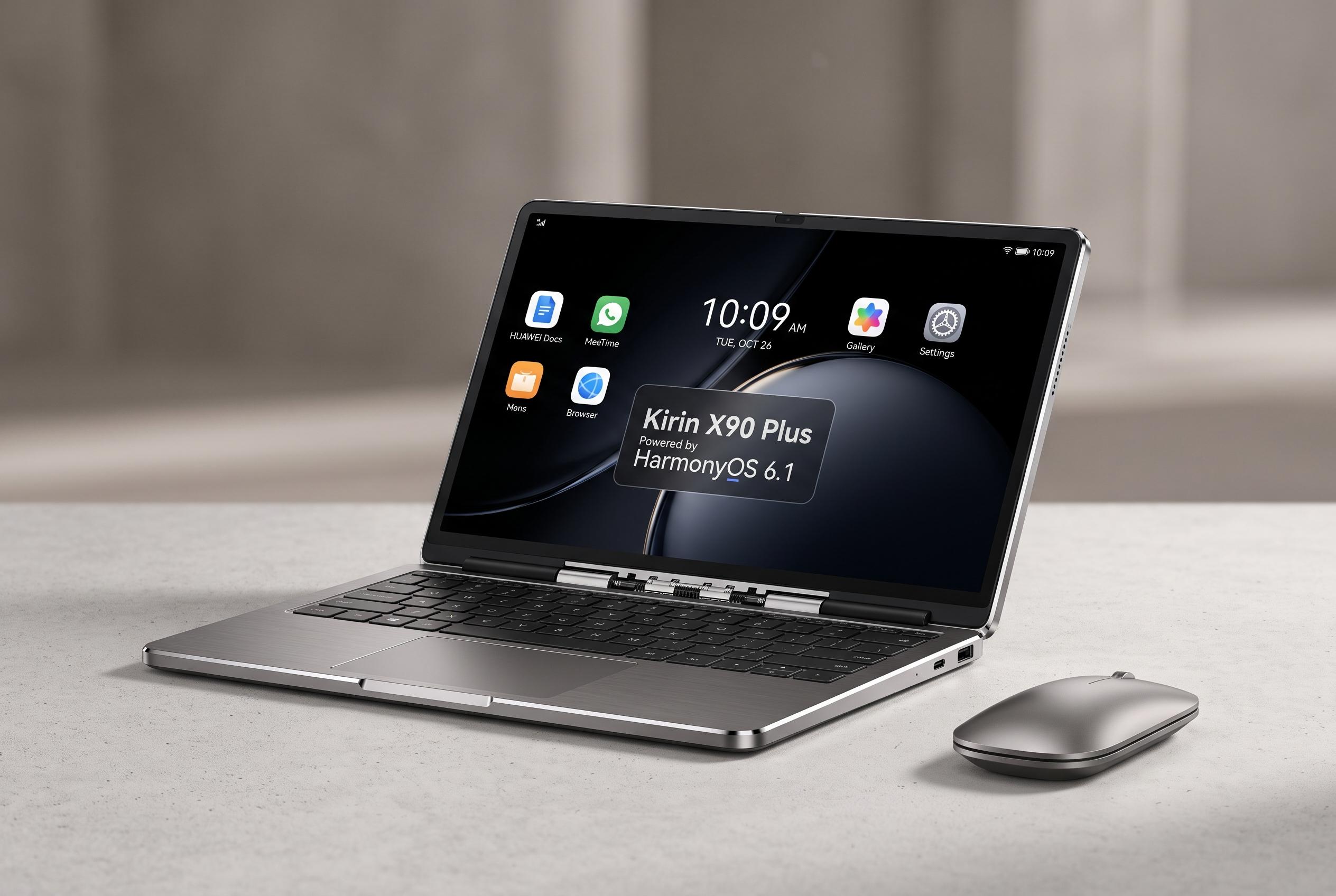

Huawei has introduced the MateBook Fold Ultimate Design 2026, a premium foldable laptop leveraging in-house Kirin X90 Plus chip and HarmonyOS 6.1, signalling a strategic shift in its computing ecosystem.
Huawei has unveiled a new foldable laptop aimed at buyers who want a premium device without the Windows ecosystem. The MateBook Fold Ultimate Design 2026 went on sale in China on August 5 and is due to ship on August 14, with Huawei positioning it as a showcase for its in-house silicon, software and hardware integration. According to Huawei’s own specifications, it keeps the 18-inch dual-layer OLED panel, 4:3 aspect ratio and 92% screen-to-body ratio of the earlier model while moving to HarmonyOS 6.1 and higher storage and memory options. HuaweiCentral reported that the company formally confirmed the Kirin X90 Plus chip at a HarmonyOS computer event.
The biggest change is the Kirin X90 Plus processor. Huawei says the new chip brings a performance lift and pairs with a vapour chamber cooling system to sustain efficiency in a thin chassis. The machine can be configured with up to 32GB of RAM and 2TB of storage, while Huawei’s pricing places it firmly in luxury territory. The top specification is listed at CNY 29,999, or about $4,445, with lower-tier versions available at CNY 24,999 and CNY 26,999.
The hardware remains unusual even by foldable standards. Huawei’s 18-inch panel collapses into a 13-inch-class footprint and the company says the device weighs 1.16kg. It has also updated the hinge with zirconium-based liquid metal and added support for the M-Pen 3 stylus, a pop-out kickstand and an 8MP camera. In practical terms, it is a large-screen computer that is trying to stay portable without giving up display area.
The software choice is more divisive. HarmonyOS 6.1 means the MateBook Fold does not natively run Windows or macOS applications, which sharply limits its appeal outside Huawei’s own ecosystem. Huawei says the wider platform now has more than 20,000 native apps, but the desktop catalogue still lags the software breadth buyers expect from mainstream PCs. That makes the device less of a conventional laptop rival and more of a controlled demonstration of Huawei’s independent computing stack.
That strategy reflects the company’s wider response to U.S. trade restrictions. Since Huawei was placed on the Entity List in 2019, it has had to work around limits on American suppliers and advanced semiconductor tools. The result is a product line built around in-house chips, proprietary software and tightly integrated services. Huawei’s recent claims about future transistor density and its LogicFolding architecture point to ambitions well beyond this one machine, even if those claims will ultimately need independent validation.
Disclaimer: This content is intended for informational purposes only. Readers are advised to exercise their own judgement, conduct due diligence, or consult a qualified expert before acting on any information provided.