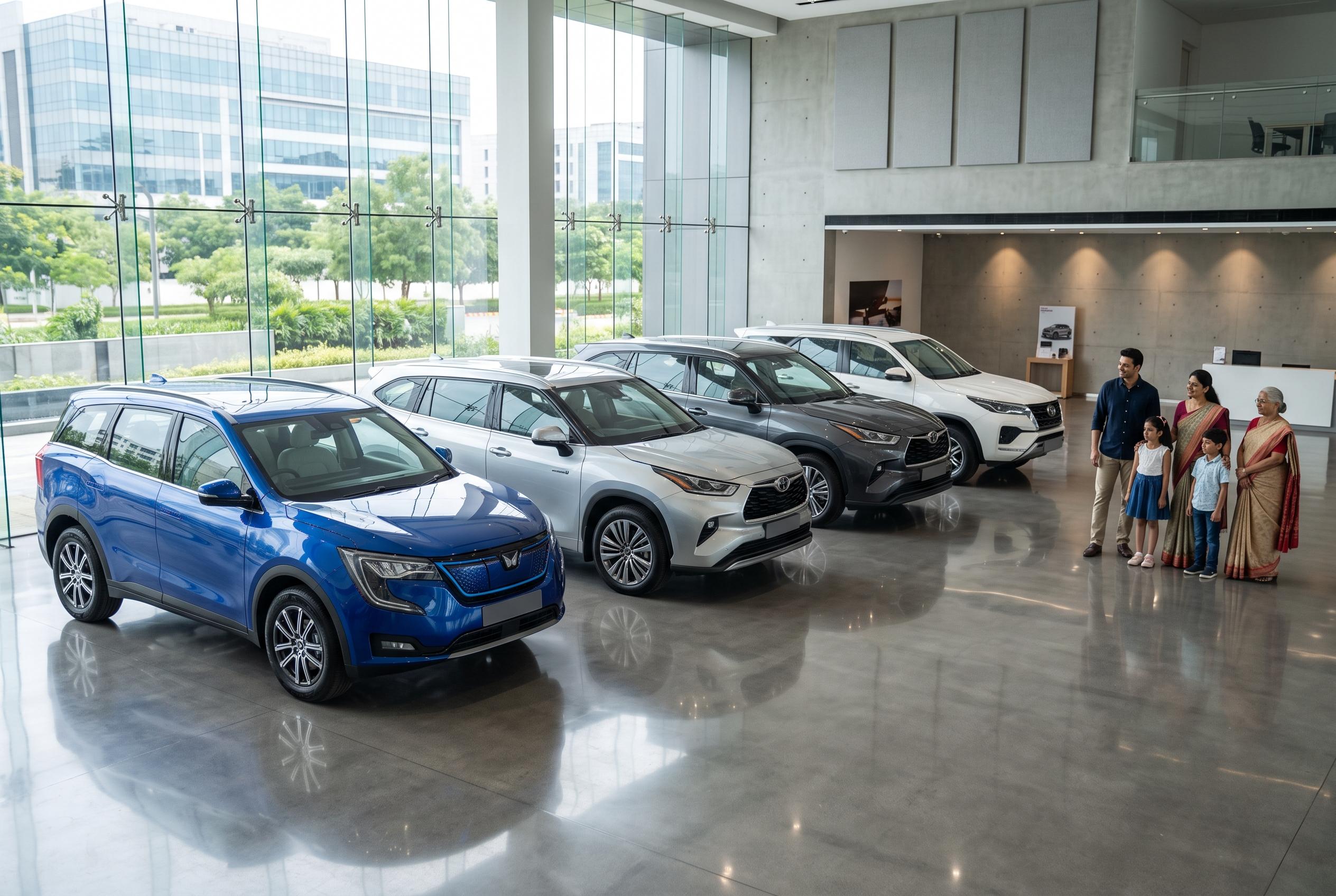

India’s seven-seat SUV market is entering a new phase with a wave of electric, hybrid, and conventional models aimed at larger families, signalling a rapid shift from niche to mainstream offerings.
India’s seven-seat SUV market is set for another busy cycle, with manufacturers preparing a mix of electric, hybrid and conventional models aimed at larger households that want more space than a standard five-seat mid-size SUV can offer. The next wave is expected to span premium nameplates, new-energy vehicles and more practical family-oriented offerings, reflecting how the segment has moved from niche to mainstream in a relatively short time.
Among the most closely watched launches is MG Motor India’s Hector Hawk, which CarToq says could arrive on August 26 in all-electric form, with a plug-in hybrid version to follow. MG has already unveiled its new ADAPT architecture for India, a multi-powertrain platform designed to support plug-in hybrid, range-extender EV, battery-electric and strong-hybrid systems. According to CarLelo, the electric Hector Hawk is tied to the Wuling Starlight 560 and is expected to be offered in five- and seven-seat layouts, with equipment such as a 12.8-inch infotainment screen, leatherette trim, wireless phone charging, cruise control, automatic climate control and a 360-degree camera. The international version uses a 69.2 kWh battery and a front-mounted motor, with output cited at 201 bhp and 310 Nm and a claimed range of 530 km.
Tata Motors is also preparing a three-row electric SUV in the form of the Safari EV. CarToq says it is likely to launch around the festive season, while CarLelo reports a 2026 debut and describes it as India’s first electric SUV with three rows. The electric Safari is expected to keep much of the current model’s profile while adopting EV-specific changes, including a closed front grille, revised lighting and aerodynamic wheels. Reported battery options are 65 kWh and 75 kWh, with the larger pack said to deliver a claimed range of about 622 km to 627 km and the smaller unit around 538 km. Premium features such as a panoramic sunroof, seat ventilation, memory seats and leatherette upholstery are also expected, with higher trims possibly getting all-wheel drive.
Kia’s Sorento Hybrid is scheduled for September 4, according to CarToq, and is expected to sit near the top of the brand’s India line-up. The SUV will reportedly be sold in the same shape as the global model and is likely to be positioned against established large SUVs such as the Skoda Kodiaq and Toyota Fortuner. CarToq says India could get both a 1.6-litre turbo-petrol strong-hybrid powertrain and a 2.2-litre turbo-diesel engine, while overseas hybrid variants can be had with all-wheel drive. Renault is meanwhile developing a seven-seat SUV based on its Bigster concept, sharing its platform with the next Duster but stretching it to suit a larger cabin. That model, expected to use 1.3-litre turbo-petrol and 1.8-litre strong-hybrid petrol powertrains, is not due until late 2026 or early 2027.
Disclaimer: This content is intended for informational purposes only. Readers are advised to exercise their own judgement, conduct due diligence, or consult a qualified expert before acting on any information provided.