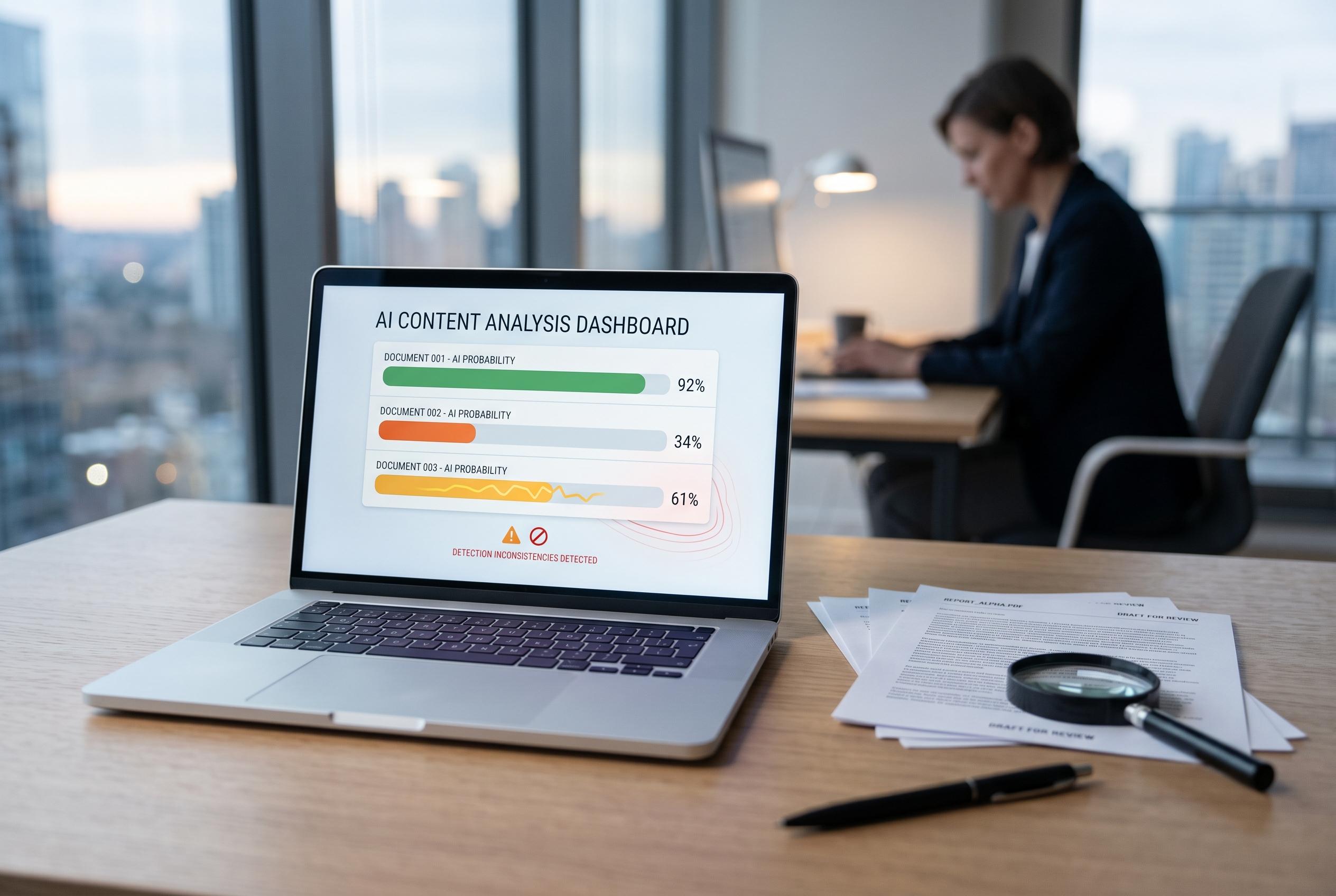

The effectiveness of AI content detection remains unreliable amid inconsistent results and growing sophistication in machine-generated prose, prompting calls for a shift towards manual content assessment over automated scores.
Artificial intelligence has become a routine part of content production, but the tools built to police its use remain far less convincing. A recent essay in Search Engine Journal described a simple test: one article, written without assistance, passed through several prominent AI detectors and produced wildly different verdicts. One labelled it entirely machine-generated, another put it at 78% AI, a third at 42%, while others said it was human or withheld the result behind a paywall. That inconsistency is the real issue, because if a single piece of original writing can trigger such contradictory scores, the numbers look less like verification and more like guesswork. Search Engine Journal argued that this has helped create a false economy around AI detection, one driven by anxiety rather than accuracy.
That concern is backed by broader evidence. Detectarena says false positives remain common across major tools, especially on formulaic writing, technical content, short passages and work by non-native English speakers. Leap AI makes a similar point, noting that detectors are largely pattern-matching systems: if human writing happens to resemble the statistical shape of machine text, it can be marked as AI-generated even when it is not. Those weaknesses matter because organisations often treat detector scores as if they were objective proof. In practice, they are only probabilistic signals.
The problem becomes clearer when older human writing is tested. Search Engine Journal described running work from 2014, 2019 and 2021 through AI detectors, despite those pieces being written before ChatGPT existed. The results still conflicted, with some tools calling the text human and others assigning significant AI probabilities or even attributing traces of systems that had not yet been released. That is a serious limitation, because historically human text should be the easiest possible benchmark for a detector. If the tools cannot reliably identify pre-ChatGPT writing, their usefulness in modern editorial workflows is difficult to defend.
Academic and independent research points in the same direction. A study hosted on PubMed Central found that AI detectors and humans could sometimes distinguish between forms of AI-generated writing, but reliability varied significantly and human scoring was low. A separate benchmark from Aidetectors.io reported false positive rates ranging from 3.1% to 14.2% across 10 detectors, with the weakest tools wrongly accusing about one in seven human texts. Scribbr’s review of detector performance also showed uneven results across products, even when the tools were tested on similar material. The broader message is consistent: performance varies too much for these systems to be treated as a dependable arbiter of authorship.
The risks are not evenly shared. Leap AI and Detectarena both note that non-native English speakers are disproportionately exposed to false positives, partly because detectors appear to confuse simpler or more standard sentence construction with machine output. That raises practical concerns for international teams, outsourced content operations and academic settings. A tool that is more likely to mistrust some writers than others is not simply imperfect; it is potentially discriminatory in how it is applied.
There is also a deeper irony. The same generation of models that made this debate urgent was trained to imitate natural writing so effectively that the boundary between human and machine output is now blurred. That is precisely why detectors struggle. The more closely AI resembles fluent human prose, the less reliable any system becomes that tries to separate the two by surface patterns alone. The resulting arms race benefits vendors more than readers, editors or writers.
Search Engine Journal’s wider argument is that the business around detection trades on fear. Writers worry that honest work will be flagged. Clients worry about reputational risk. Agencies worry about scores they cannot explain. Several detector companies also sell so-called humanisers, which promise to rewrite text so it can pass the same systems that first flagged it. That creates an obvious tension: the market both sells the alarm and the escape route. It is hard to see that as a trustworthy verification model.
A more durable approach is to judge content on substance. Accuracy, originality, usefulness and evidence of expertise tell readers far more than a percentage score. Where provenance really matters, editorial review, version history and documented workflow are more useful than automated suspicion. That is also closer to the view implied by the research: detector tools may have limited use as one signal among several, but they should not replace human judgement. The current market may profit from fear, yet the evidence suggests the wiser investment is better writing, not better guesswork.
Disclaimer: This content is intended for informational purposes only. Readers are advised to exercise their own judgement, conduct due diligence, or consult a qualified expert before acting on any information provided.