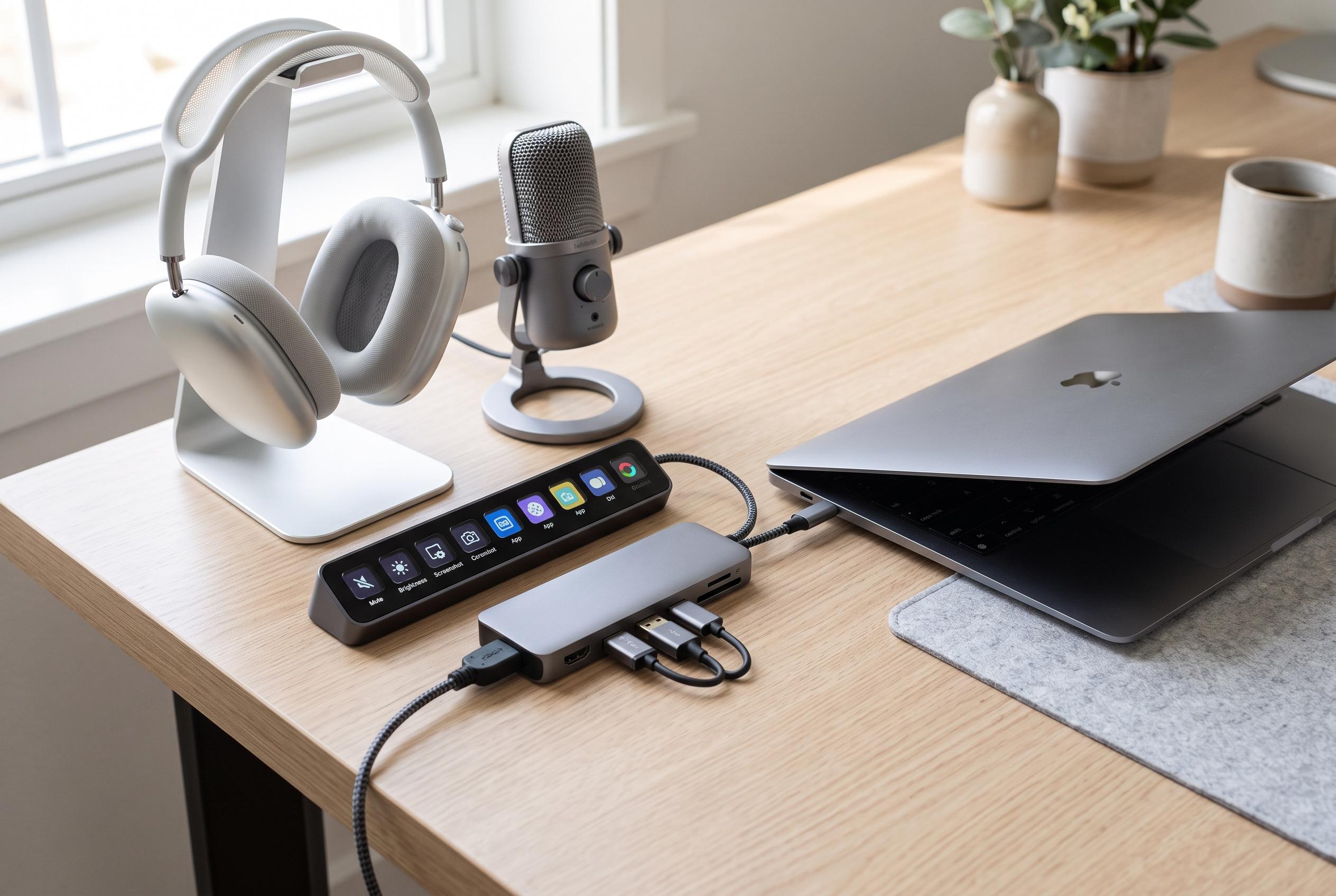

As Apple restores some ports and controls following user demand, innovative third-party gadgets offer practical solutions to fill the gaps left by recent MacBook redesigns, from programmable touch strips to versatile hubs and enhanced audio options.
Apple has spent years removing familiar ports and controls from the MacBook line, only to bring some of them back after users complained. For anyone who still wants the missing pieces, a wave of third-party accessories now recreates much of what disappeared from recent Mac laptops, from physical shortcut controls to older connectors and better portable charging.
The most direct example is Flexbar, a programmable touch strip that tries to recreate the old Touch Bar experience. According to Macworld, it connects by USB and lets users assign app-specific buttons, sliders and shortcuts on macOS, Windows and Linux. That makes it useful for editing, streaming or routine system controls, although the review also noted some reliability concerns and software that feels less polished than the hardware.
A more practical fix for Apple’s port reduction is the Vention 6-in-1 USB-C hub. It turns one USB-C port into HDMI output, Gigabit Ethernet, USB 3.0 ports and a card reader for SD and microSD cards. That matters for MacBook owners who still need wired networking, external displays or quick file transfer from cameras and drives without carrying several adapters.
For users who miss the old headphone jack on iPhone and iPad, a simple USB-C to 3.5mm adapter remains the cheapest answer. It restores support for wired headphones and works with any device that accepts USB-C, not just Apple products. The trade-off is sound quality: this kind of basic adapter is fine for everyday listening, but it is not a serious option for people who care about lossless audio.
Those who do care about sound have another choice in a USB-C digital-to-analogue converter with a built-in amplifier. This type of accessory does more than adapt the connector; it can drive demanding headphones and usually improves detail and bass response compared with a basic dongle. Compatibility is broad across Macs, iPads and Android phones, though some microphone functions may not work on every device.
Photography users may find the SD and USB-A gap on the MacBook Air especially frustrating. A compact card reader-hub solves both problems at once by combining SD and microSD slots with a USB-A port in a USB-C body. For transferring camera files, especially larger RAW images, that is a straightforward and useful replacement for what Apple left out.
The loss of the Touch Bar has also encouraged a market for mechanical macro pads. These devices give users between two and 24 programmable keys with RGB backlighting, acting as a hardware shortcut panel for creative work, livestreaming or repetitive tasks. Unlike the Touch Bar, they offer physical switches and can be configured with macros and hotkeys, which may suit power users better.
Battery accessories show the same pattern. A magnetic UGREEN power bank with 10,000mAh capacity gives iPhone users a way to charge on the move without cables, while an even thinner metal-cased MagSafe battery offers a more compact alternative with a built-in display. Both are aimed at travellers who want more capacity than Apple’s old MagSafe Battery Pack provided.
For users who want something beyond Apple’s own mini desktop, the Beelink Mini S12 Pro points to a different direction: a small Windows PC with room for upgrades. It can be configured with up to 16GB of RAM and 500GB of storage, and it includes extra expansion options inside the case. For some buyers, that makes it a more flexible and cheaper alternative to a Mac mini.
Disclaimer: This content is intended for informational purposes only. Readers are advised to exercise their own judgement, conduct due diligence, or consult a qualified expert before acting on any information provided.