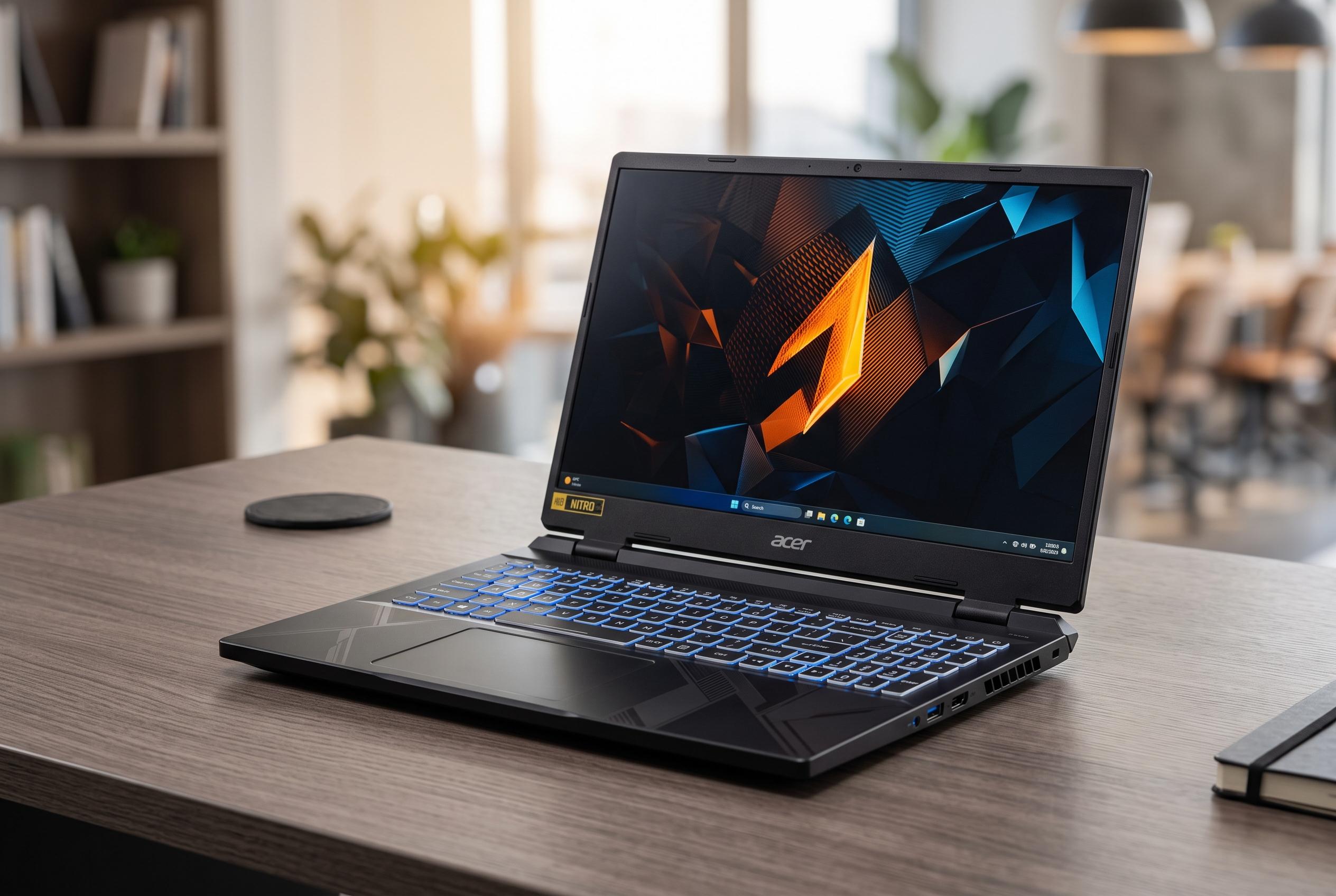

Acer’s Nitro V 15 showcases solid performance and thermal efficiency but struggles with pricing, competing in a crowded entry-level gaming market where hardware updates are incremental and affordability is at risk.
Acer’s Nitro V 15 sits in a crowded part of the gaming laptop market, where entry-level machines increasingly have to justify their price against both older RTX 2050 systems and newer RTX 5050 models. In the configuration reviewed by Canaltech, the laptop pairs an Intel Core i7-13620H with an RTX 4050, a combination that delivered broadly positive results in games, though the verdict depends heavily on what users expect to play and how demanding those titles are.
The chassis is functional rather than premium. Canaltech found a mostly plastic black design with a rigid feel, a weight of just over 2kg and a thickness of around 2.5mm, which is relatively restrained for a gaming notebook. The Brazilian ABNT2 keyboard, white backlighting and large touchpad make it practical for work as well as play. Other reviews reached similar conclusions about the hardware package: Tom’s Hardware praised the build quality and keyboard, while PCWorld also highlighted the sturdy construction and wide port selection.
The display is one of the model’s more convincing elements. Canaltech noted that the 15.6-inch IPS panel runs at 1,920 by 1,200 pixels with a 165Hz refresh rate and 300 nits of brightness, which is a strong fit for competitive games and does not overburden the RTX 4050. Tom’s Guide and PC Gamer were less enthusiastic about the screen on their units, describing it as merely average, which suggests Acer is still making compromises to keep the product in budget territory.
Thermals were another clear strength in Canaltech’s testing. During gaming, chip temperatures stayed below 71C, with the GPU generally around 65C and the CPU peaking at 71C in heavier moments. In synthetic workloads, the CPU reached 91C while the GPU hotspot remained below 80C. That is not class-leading, but it is controlled for a slim gaming machine. Battery life, however, was short, lasting 3 hours and 31 minutes in a Procyon work-style test, which is consistent with what most competitors in this segment deliver. Other reviewers also flagged noisy fans and modest webcam quality as trade-offs.
Performance is where the Nitro V 15 justifies itself. Canaltech’s testing focused on practical gaming rather than synthetic benchmarks, aiming for 60 frames a second at the panel’s native resolution and using DLSS quality mode where needed. Counter-Strike 2 did not need upscaling, while Cyberpunk 2077 was tested with ray tracing enabled at a low setting. Beyond gaming, Canaltech also found the machine capable enough for professional workloads and some AI tasks, and its PCIe 4.0 SSD reached almost 4,000MB/s in reads and 3,800MB/s in writes. That said, Tom’s Guide and Laptop Mag both warned that the laptop can feel less compelling in general-use performance and value once the rest of the market is considered.
Price is the biggest obstacle. Canaltech says the reviewed model is selling for about R$7,650, a level that no longer looks as appealing as it once did, especially given that the same Nitro V 15 can be found with an RTX 4060 for a similar sum if buyers accept Linux rather than Windows. Another alternative cited was the ASUS V16, which pairs an RTX 4050 with 24GB of RAM and a 16-inch 1,440 by 1,200 display for around R$7,100. On balance, the Nitro V 15 remains a sensible entry-level gaming laptop, but only if buyers prioritise 1080p gaming performance and can accept the compromises that come with a machine built to a price.
Disclaimer: This content is intended for informational purposes only. Readers are advised to exercise their own judgement, conduct due diligence, or consult a qualified expert before acting on any information provided.