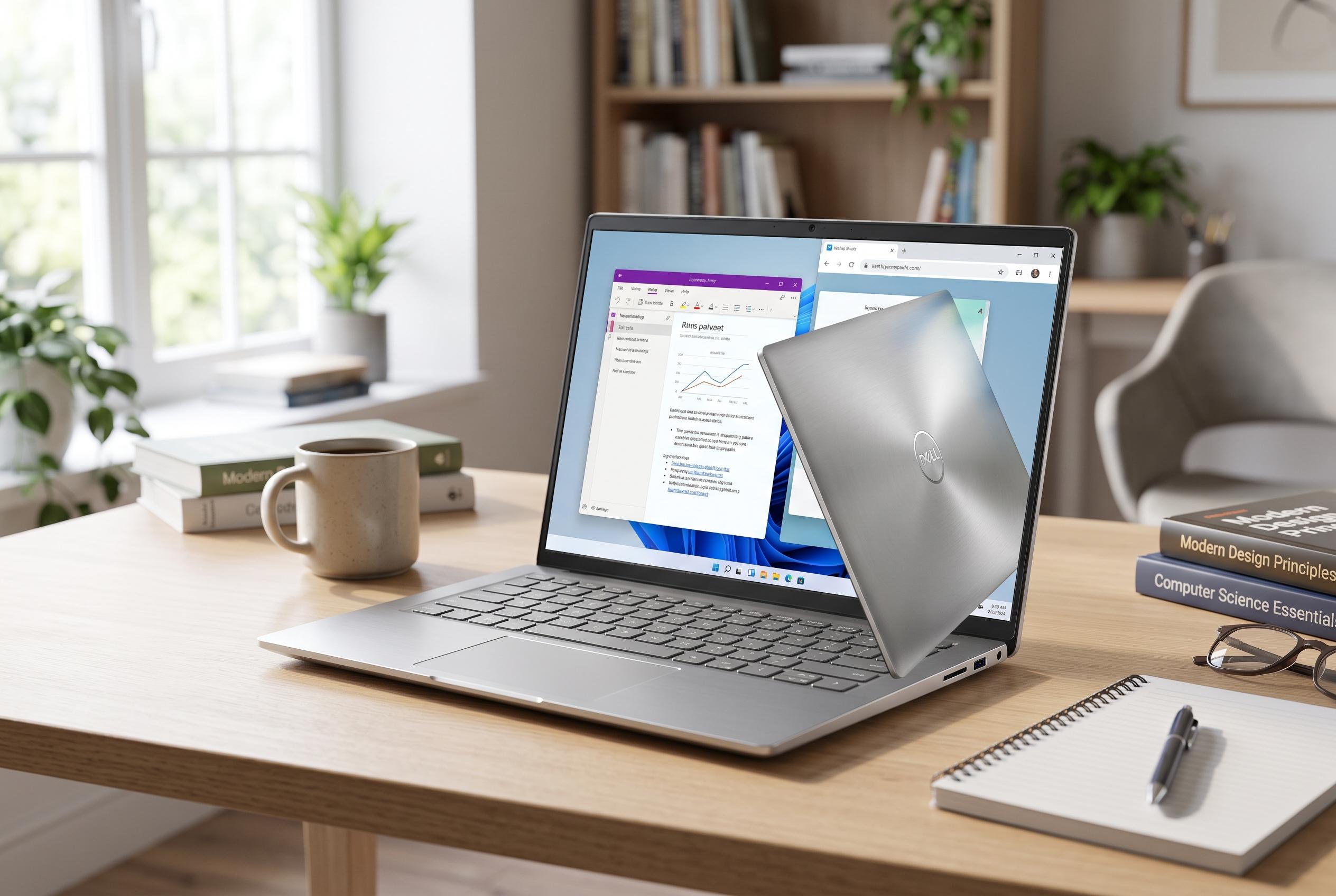

Dell’s 14S aims to combine premium design and impressive battery life at a budget-friendly price, nearing the quality of its XPS sibling while remaining accessible for students and mainstream users.
Dell’s 14S is trying to do something difficult: borrow enough from the XPS family to feel premium, while staying cheap enough to remain a sensible buy for students and mainstream users. On Tom’s Guide’s testing, it comes close. The laptop pairs an aluminium chassis with strong battery life, an OLED touch display on higher trims and enough everyday performance to handle web browsing, office work and light creative tasks with ease.
The strongest argument for the 14S is endurance. In Tom’s Guide’s web-surfing test at 150 nits, the laptop lasted 20 hours and 41 minutes, a result that places it among the longest-lasting Windows machines tested. That figure is especially notable because it was achieved on an OLED panel, which usually demands more power than a standard LCD. Tom’s Hardware also found the machine could exceed 20 hours, while PCWorld reported nearly 36 hours in offline 4K video playback, underlining how consistently efficient the system appears to be across different workloads.
Design is another clear step up from the short-lived Dell 14 Plus. Tom’s Guide said the 14S looks and feels much closer to the more expensive XPS 14, thanks to a cleaner hinge, a three-piece aluminium body and a sturdier overall build. The keyboard is described as comfortable for long typing sessions, while the trackpad feels closer to glass than to the cheaper, mushier pads found on many mid-range laptops. Dell has also kept the port selection practical, with Thunderbolt 4, USB-A, HDMI 2.1 and a headphone jack.
Performance is solid rather than exceptional. Tom’s Guide’s review unit, fitted with an Intel Core Ultra 7 355 and 16GB of memory, handled heavy browser use, streaming video and photo editing without trouble. But the benchmark results suggest it is not the best choice for sustained video work or other demanding creative tasks, especially in lower-end configurations. Tom’s Hardware reached a similar conclusion, noting that productivity performance lagged behind rivals and that the webcam was merely average.
The main weakness is the display’s brightness. Although the OLED panel is colourful and sharp, Tom’s Guide measured it at 269 nits in SDR mode, which is modest for a premium-leaning laptop and can make outdoor use difficult. PCWorld also flagged brightness as a concern. Dell’s own launch material points to higher brightness claims for some panel options, but the review evidence suggests the tested configuration falls short of the strongest displays in this class.
Pricing complicates the picture. Dell lists the 14S from $1,269, yet Tom’s Guide argues the real value depends heavily on promotions, with discounted configurations closer to $999 to $1,200 making far more sense. At those levels, the 14S becomes an appealing all-rounder. Push the price much higher, and buyers may be better served by Dell’s own XPS 14 or, for those who prioritise portability and battery life over Windows, a MacBook Air. For the right deal, though, the 14S looks like one of Dell’s more practical laptop options of the year.
Disclaimer: This content is intended for informational purposes only. Readers are advised to exercise their own judgement, conduct due diligence, or consult a qualified expert before acting on any information provided.