

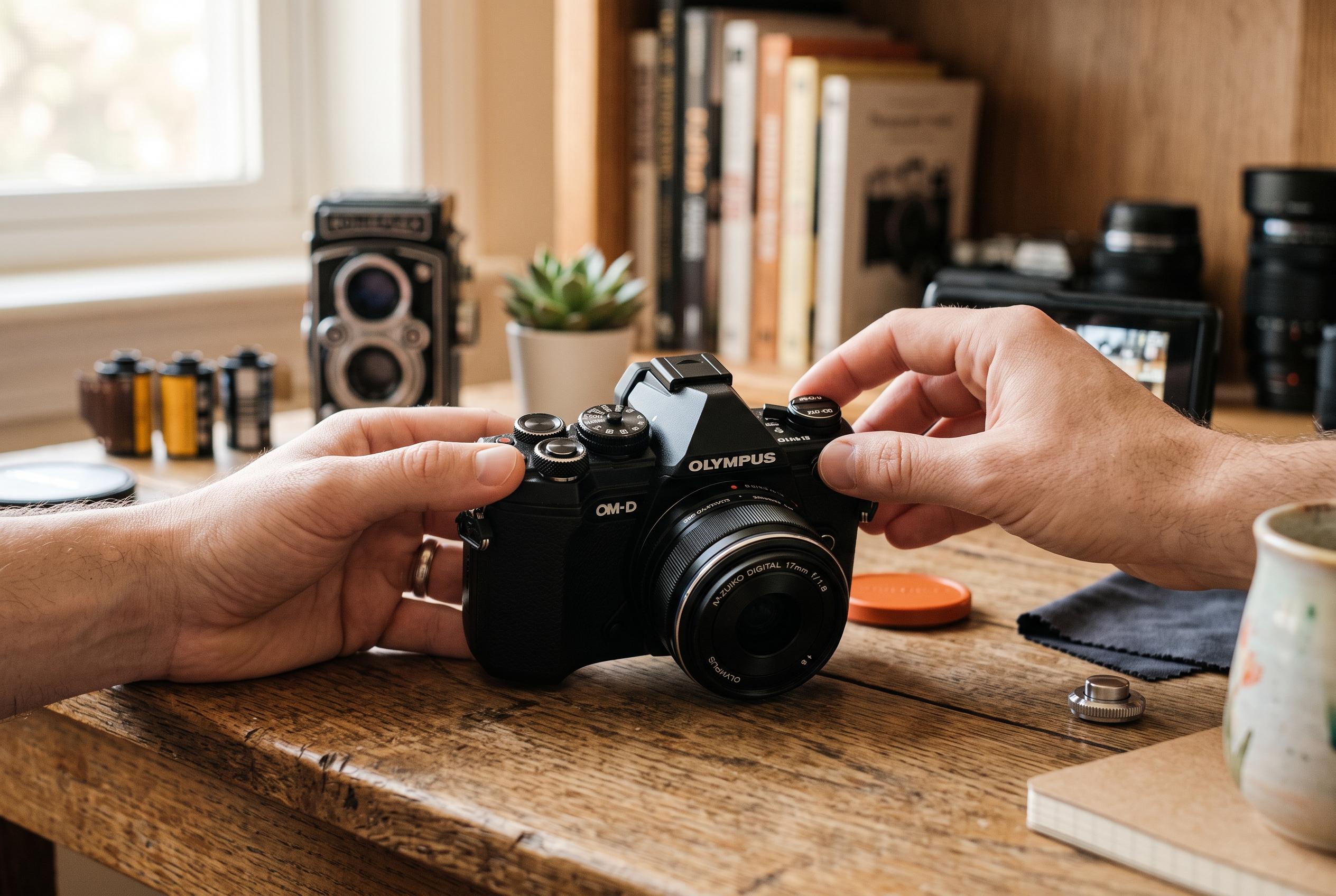

The compact Micro Four Thirds camera brings back the PEN name with an electronic viewfinder, AI autofocus, weather sealing and creative shooting modes, but its low-light performance and burst speeds remain modest.
OM System has revived the PEN line with a camera that leans heavily on portability and handling rather than raw novelty. In its test, CHIP found a compact, lightweight body with a polished retro look, weather sealing and Cinema 4K video capture, while also noting weaker sharpness in low light, no slow-motion option at higher resolutions and only a single memory card slot.
The PEN name carries a long history. The original Olympus PEN debuted in 1959, and the series was later revived in the digital era before Olympus exited the camera business in 2020. After OM Digital Solutions took over the imaging division in January 2021, the brand relaunched new models under OM System. This latest PEN continues that lineage, but aims at a different audience: users who want a small, adaptable camera for everyday use, travel and social content without moving up to a bulkier body.
That strategy is reflected in the hardware. The camera measures about 126 x 75 x 43 millimetres, making it smaller than other current OM System bodies such as the OM-1 Mark II, the OM-3 and the OM-5 Mark II. OM System has placed the electronic viewfinder on the left rear side instead of a central hump, echoing the older Olympus PEN F. The 2.36-million-dot EVF was welcomed as a useful addition, especially in bright light, although the design also means the built-in flash found on the PEN E-P7 is gone.
The display follows the same practical logic. The 3.0-inch panel has 1.04 million dots and can swing out to the side as well as tilt up and down, which makes it more flexible than the PEN E-P7’s earlier flip screen. It is also touch-enabled, so many settings can be changed directly on the screen. Inside, OM System uses a 20.2-megapixel Micro Four Thirds sensor and the TruePic IX processor. The camera records C4K at 24fps and 4K video at up to 30fps, while the image stabiliser is claimed to provide up to 5.5 stops of correction in the centre of the frame.
CHIP’s lab results suggest that the sensor and processor combination is solid rather than exceptional. Measured resolution reached up to 1,868 line pairs per picture height, with edge sharpness remaining strong through ISO 800 before visible losses set in at higher sensitivities as noise reduction became more aggressive. In practice, the in-body stabiliser proved valuable: CHIP reported sharp hand-held images at equivalent 84mm focal length with shutter speeds of 0.4 and 0.8 seconds.
Autofocus is another area where the PEN series has moved forward. This model is the first PEN camera with AI-based subject recognition, able to identify people, cats and dogs. It also uses a 121-point on-sensor phase-detection system with a cross-type sensor arrangement. CHIP said the recognition worked quickly and reliably in testing, even if the subject list is still narrower than on some rivals.
The camera also has a stronger appeal for users who want to shape the image in-camera. OM System includes colour and monochrome profile controls, 32 Art Filters, Live ND simulation, focus stacking, high-resolution stills up to 50 megapixels and long-exposure tools such as Live Bulb, Live Time and Live Composite. The CP function button provides quick access to several of these features, reinforcing the PEN’s role as a creative tool rather than a pure technical workhorse.
Speed is respectable, but not class-leading. OM System quotes up to five frames per second with continuous autofocus and a mechanical shutter, ten frames per second with electronic shutter and focus tracking, and up to 30 frames per second when focus is locked on the first frame. CHIP confirmed around five frames per second with the mechanical shutter, but did not reach the claimed top rate. In its standard settings, the test lab recorded roughly 19 JPEGs or six RAW files per second for a burst of 25 frames.
The camera is also designed with practical field use in mind. Its body is sealed to IPX1 standards against dust and splashes, and a new M.Zuiko Digital 14-42mm f/3.5-5.6 III kit lens is also weather-sealed. Battery life is rated at up to 590 stills or 135 minutes of video, and charging happens over USB-C. Connectivity includes microHDMI for video output and a 3.5mm microphone input, which should help buyers who want to use the camera for vlogging or small-scale production work.
Pricing is where OM System is likely to win attention. The body is offered at about €1,000, while the kit with the new lens costs around €1,099. CHIP notes that this is notably below the launch price of the original Olympus Pen F, which arrived at €1,199. That makes the new PEN a relatively accessible entry into a system that mixes retro styling, weather sealing and a broad set of computational photography tools, even if it stops short of being the most advanced camera in its class.
Disclaimer: This content is intended for informational purposes only. Readers are advised to exercise their own judgement, conduct due diligence, or consult a qualified expert before acting on any information provided.



