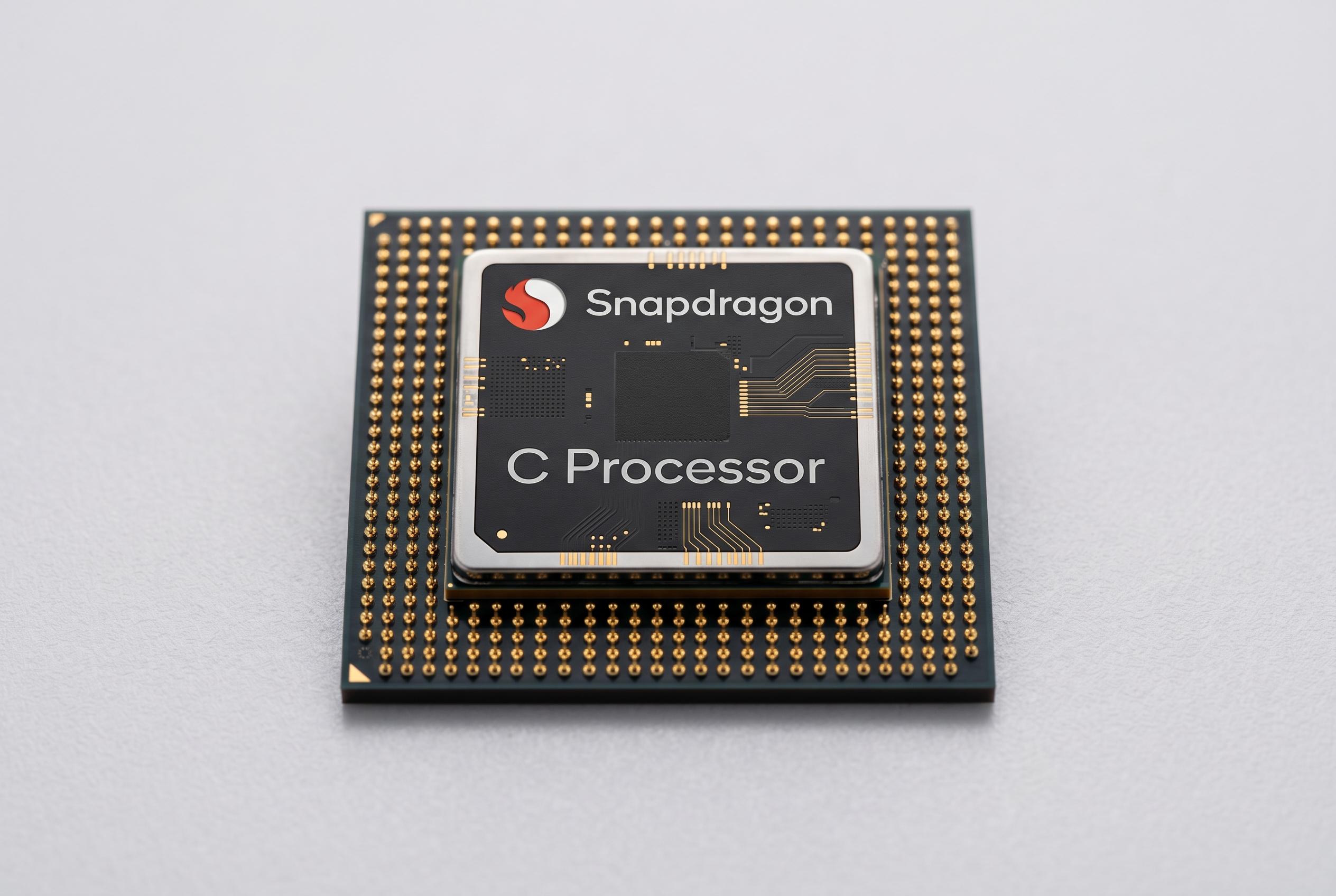

Qualcomm has revealed more details about its Snapdragon C processor, a cost-effective chip designed for budget Windows laptops starting at $300, aiming to bring all-day battery life and quiet operation to entry-level devices.
Qualcomm has filled in some of the gaps around the Snapdragon C, its smallest notebook processor, which is aimed at laptops starting at $300. The company first outlined the platform at Computex in May, pitching it as a low-cost chip for students, families and small businesses that would deliver responsive performance, quiet operation and all-day battery life. Devices based on the platform are expected to arrive later this year.
The new product brief shows that the Snapdragon C uses an 8-core Kryo CPU rather than Qualcomm’s newer Oryon design. It is built on a 6nm process and uses a three-tier clock configuration: one core can reach 3.0 GHz, three run at up to 2.6 GHz and four at up to 2.0 GHz. That places it firmly below Qualcomm’s Snapdragon X line, which is aimed at higher-end Windows on Arm notebooks.
Graphics and media support are modest but practical for the target segment. Qualcomm lists an Adreno A643 graphics unit with a top clock of 900 MHz and DirectX 12 support. The chip can drive an internal display at up to FHD+ and 120 Hz through eDP 1.4, while external displays can run at up to 4K60 over DisplayPort 1.4. Its video engine supports H.264 and H.265 encoding up to 4K30 and decoding of H.264, H.265 and VP9 at up to 4K60.
Memory and storage support are also designed for low-cost systems. Qualcomm says the Snapdragon C can work with LPDDR5X or LPDDR4X, with a maximum of 16 GB of RAM and bandwidth of up to 25.6 GB/s depending on the memory type. For storage, the platform offers either PCIe 3.0 x2 for NVMe drives or UFS 3.1 and 2.2, plus additional PCIe 3.0 lanes for components such as Wi-Fi, Bluetooth or mobile broadband. Qualcomm is recommending its FastConnect C6700 wireless platform, which supports Wi-Fi 6E and Bluetooth 6.0, and the chip can also provide two USB-C and two USB-A ports on a notebook design.
Microsoft’s Copilot+ PC requirements appear to be out of reach for the Snapdragon C, at least based on the information Qualcomm has shared so far. Copilot+ systems need a compatible SoC, 16 GB of DDR5 or LPDDR5 memory, 256 GB of storage and an NPU capable of at least 40 TOPS. Qualcomm says the Snapdragon C includes a Hexagon NPU, but it has not published a TOPS figure or linked the chip to Copilot+ certification. For the price band Qualcomm is targeting, that omission may not matter.
Acer, HP and Lenovo are among the first manufacturers working with Qualcomm on the platform’s launch. Acer has already shown the Aspire Go 15 in Taiwan, although pricing has not yet been disclosed. That points to a market push focused less on premium features and more on bringing Arm-based Windows laptops into the budget category.
Disclaimer: This content is intended for informational purposes only. Readers are advised to exercise their own judgement, conduct due diligence, or consult a qualified expert before acting on any information provided.