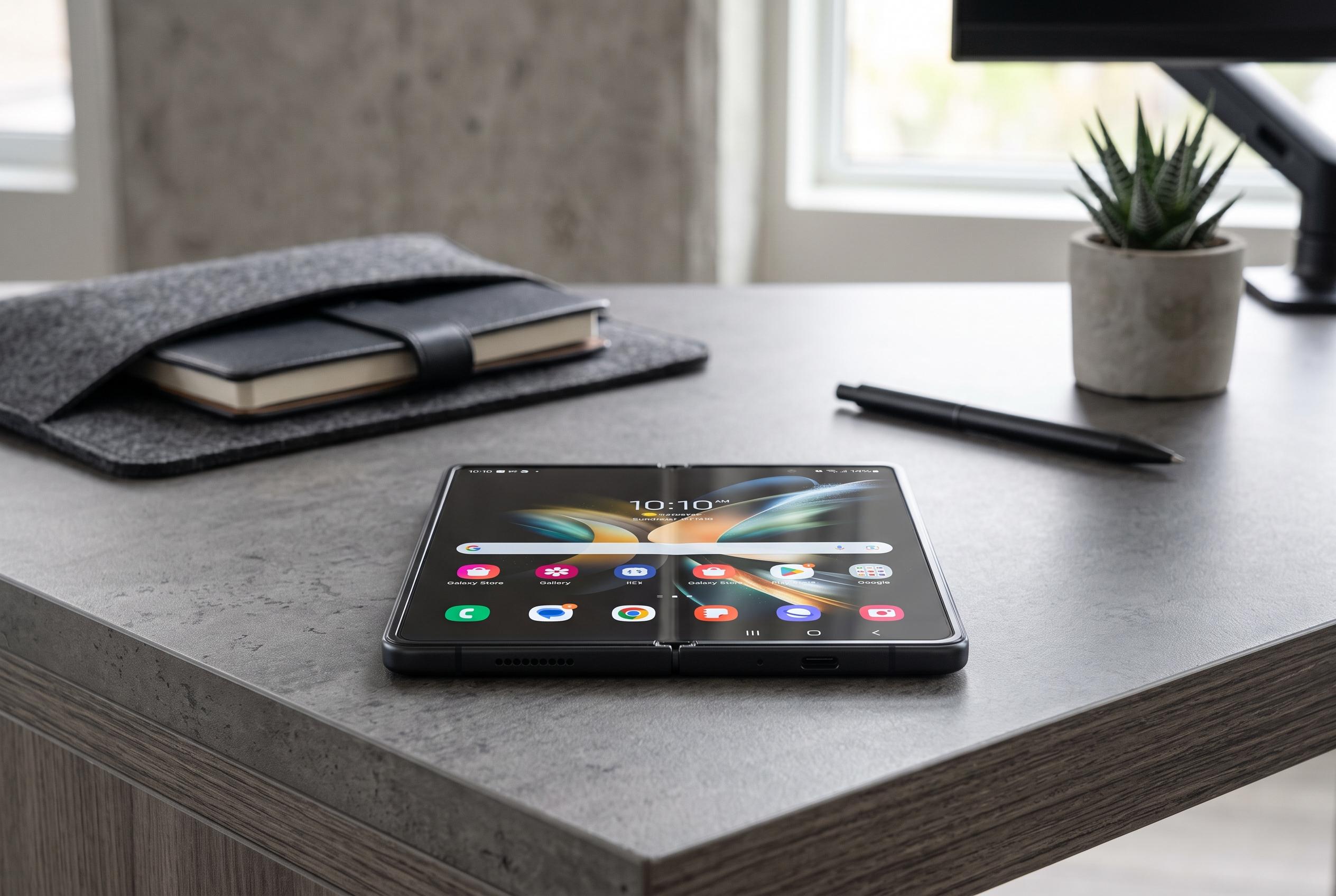

Samsung’s Galaxy Z Fold 8 is now available with full specs, offering a clear choice for buyers, while Google’s Pixel 11 Pro Fold remains unreleased, leaving consumers awaiting further details and pricing insights.
Samsung’s Galaxy Z Fold 8 is now a confirmed product, while Google’s Pixel 11 Pro Fold remains a work in progress built largely from leaks and official teasers. That makes the comparison useful but uneven: one handset is already shipping, with Samsung publishing full specifications for its new book-style foldable, while Google is still due to unveil its rival foldable at a later event. The practical result is that buyers can assess Samsung on firm ground, but must still treat Google’s device as provisional until launch. According to Samsung’s UK product page, the Galaxy Z Fold 8 uses a foldable design with a 5.5-inch cover display and a 7.6-inch inner screen, both at 120Hz.
On paper, the two phones are expected to be closely matched in format. Reports from Tom’s Guide and other leaks suggest the Pixel 11 Pro Fold will keep a 6.4-inch outer display and an 8-inch main panel, putting it in the same broad category as Samsung’s premium foldable line. The more interesting difference may be in pricing and positioning. Android Headlines has reported that Google’s foldable could start at $1,899, which would place it alongside Samsung’s standard Fold 8 and below the more expensive Fold 8 Ultra. If that pricing proves accurate, Google may be aiming to deliver near-Ultra display size without demanding Ultra-level money.
Performance is likely to be one of Samsung’s stronger cards. The Galaxy Z Fold 8 is expected to use Qualcomm’s Snapdragon 8 Elite Gen 5, a flagship chip aimed at sustained high-end work such as gaming, editing and multitasking. By contrast, leaked details on the Pixel 11 Pro Fold point to Google’s Tensor G6, with some reports indicating a trimmed core layout and an older PowerVR graphics architecture. That does not guarantee poor results, because Google has often relied on software tuning to compensate, but it does suggest Samsung may have the clearer advantage in raw speed and graphics headroom.
Battery and charging may widen that gap further. Samsung is said to have increased capacity to 5,000mAh, while leaks indicate Google’s battery could shrink to 4,658mAh. Samsung is also rumoured to support faster wired charging than previous Fold models, while the Pixel 11 Pro Fold is still expected to rely on 15W Qi2 wireless charging. Cameras, however, remain Google’s traditional strength. The Pixel 11 Pro Fold is said to feature a new 50-megapixel main sensor, alongside a 10.5-megapixel ultrawide camera and a 10.8-megapixel telephoto lens with 5x optical zoom. Samsung is expected to keep its 200-megapixel main sensor, with only modest changes to the secondary cameras. For now, though, the central fact remains that Samsung has launched a real product and Google has not. Anyone wanting to buy now has one clear option; anyone willing to wait may find the Pixel 11 Pro Fold worth watching closely once Google finally makes it official.
Disclaimer: This content is intended for informational purposes only. Readers are advised to exercise their own judgement, conduct due diligence, or consult a qualified expert before acting on any information provided.