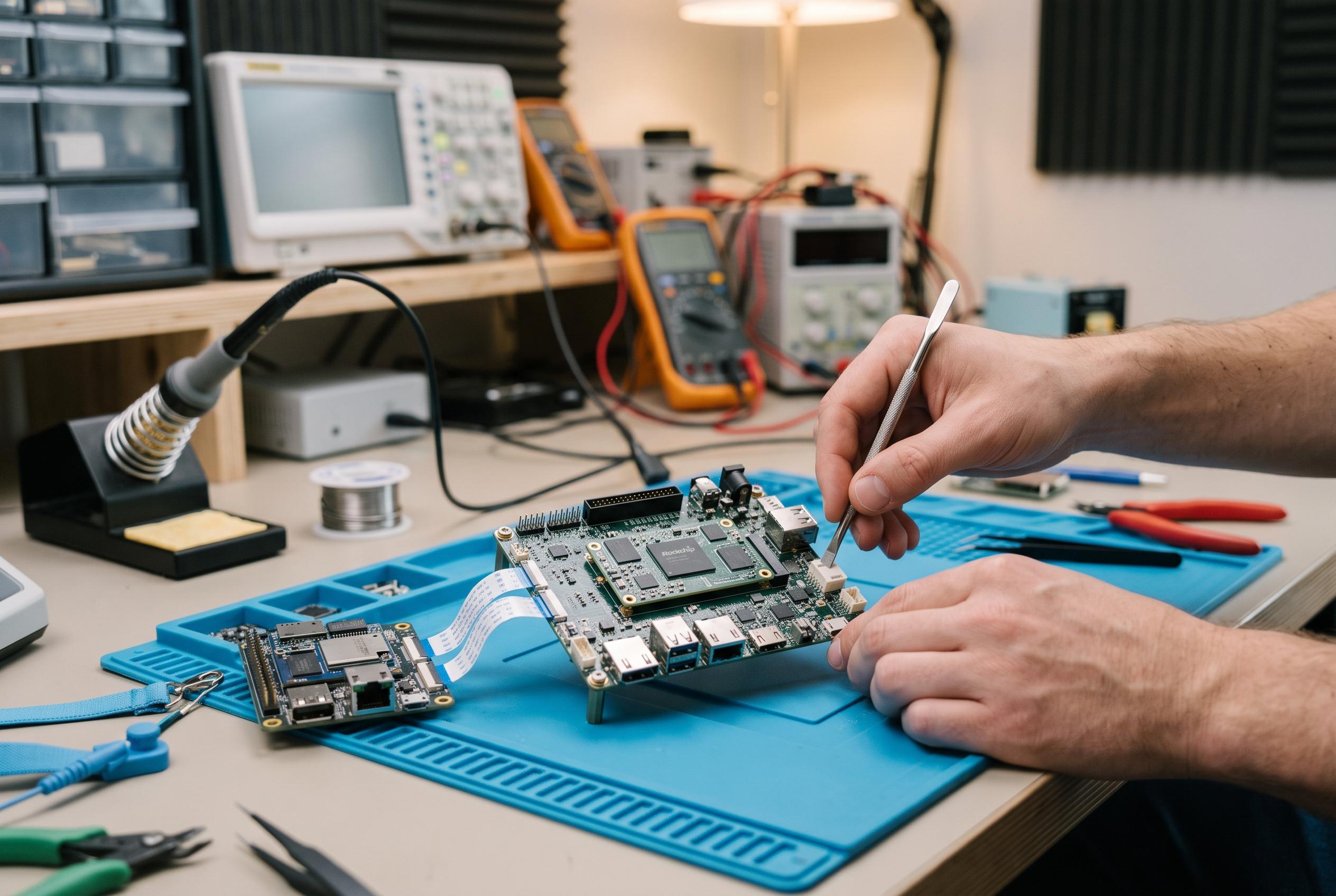

ELTAY’s RM66 with the BB CM4 carrier board and Rockchip’s RK3566 chip aims to challenge the Raspberry Pi Compute Module 4 by offering a flexible, industrial-grade embedded platform with competitive storage and connectivity features, though performance benchmarks reveal key differences.
ELTAY’s RM66 with the BB CM4 carrier board is a calculated attempt to treat the Compute Module idea as a serious embedded platform rather than a hobby board. Paired with Rockchip’s RK3566, it is aimed at developers who need a compact Linux system with eMMC storage, Gigabit Ethernet, USB, display outputs and expansion through a carrier rather than a fixed consumer-style layout. That makes it a more direct rival to Raspberry Pi Compute Module 4 than to a standard Raspberry Pi 4 board, even if the ecosystem around the latter remains far better established. According to ELTAY’s documentation, the RM66 uses a quad-core Cortex-A55 CPU at up to 1.8GHz, Mali-G52 graphics, a 0.8 TOPS NPU and configurations with up to 8GB of LPDDR4 and 64GB of eMMC 5.1. The module also exposes HDMI 2.0, eDP, MIPI DSI, MIPI CSI, SATA or PCIe 2.0 x1, USB 3.0 and Gigabit Ethernet.
The appeal of this class of hardware lies in flexibility. A Compute Module keeps the processing core separate from the rest of the system, allowing one module to be reused across multiple carrier boards and product designs. That matters in industrial controllers, terminals, gateways, embedded displays and other devices where the final port layout, power path and mechanical design differ from a ready-made board. In the RM66 package reviewed here, the BB CM4 carrier provides the practical interfaces: USB, Ethernet, HDMI, M.2, GPIO and display and camera connectors. The article’s hardware description also notes that ELTAY ships the module with a wireless module and external antenna arrangement, which is important because the RM66 does not rely on an internal antenna.
The comparison platform is a Raspberry Pi Compute Module 4 on a Waveshare adapter, which keeps the test closer to the same design philosophy. Raspberry Pi’s module is built around Broadcom’s BCM2711 and four Cortex-A72 cores at up to 1.5GHz. That platform remains better known, better documented and better supported by ready-made software images and community material, which is one reason it is still the default reference point for many embedded Linux builders. But it is also a useful benchmark because it is not a consumer Raspberry Pi 4 board dressed up as a module; it is another modular system with a carrier board.
In the tests described in the article, the Raspberry Pi CM4 was faster in raw CPU work. Sysbench favoured the Raspberry Pi by a wide margin in both single-thread and four-thread runs, and 7-Zip also gave the edge to the Cortex-A72 system. That result is a reminder that clock speed alone does not define performance: although the RM66’s Cortex-A55 cores can run at a higher frequency, they still lag behind the older but stronger A72 design in compute-heavy tasks. Memory behaviour was more mixed. Sysbench memory again favoured Raspberry Pi, but mbw showed the RM66 ahead in all three copy patterns, especially in its MCBLOCK run.
The RM66 did better on storage. With both test systems using roughly 32GB eMMC, sequential fio results showed the ELTAY module ahead on both read and write throughput. That matters more in embedded systems than headline CPU scores because boot time, log handling, package installs and application launches are often limited by flash performance rather than by arithmetic throughput. The USB and Ethernet tests were less conclusive: the same flash drive produced similar numbers on both boards, while the network benchmark was constrained by a roughly 100Mbit/s test setup, making it unsuitable for judging the full capacity of the Gigabit interfaces. Wi-Fi and Bluetooth worked on both systems, with the RM66 recording better transfer rates in the smartphone hotspot test used in the article, although that result should be treated as a practical check rather than a lab-grade maximum.
Thermals were broadly similar at the end of a five-minute all-core stress run, with both systems finishing at about 82C. The article is careful not to overstate that comparison because the boards began the test at different temperatures. That caution is sensible, and it reflects the broader point of the evaluation: a Compute Module is judged less by one benchmark than by the balance of CPU performance, storage speed, interface availability, software maturity and integration effort. On that basis, the RM66 looks credible as an ARM64 Linux module with useful embedded features and solid eMMC performance. The Raspberry Pi CM4 remains the more capable choice for compute-heavy workloads and for users who value software maturity and documentation above all else.
Disclaimer: This content is intended for informational purposes only. Readers are advised to exercise their own judgement, conduct due diligence, or consult a qualified expert before acting on any information provided.