

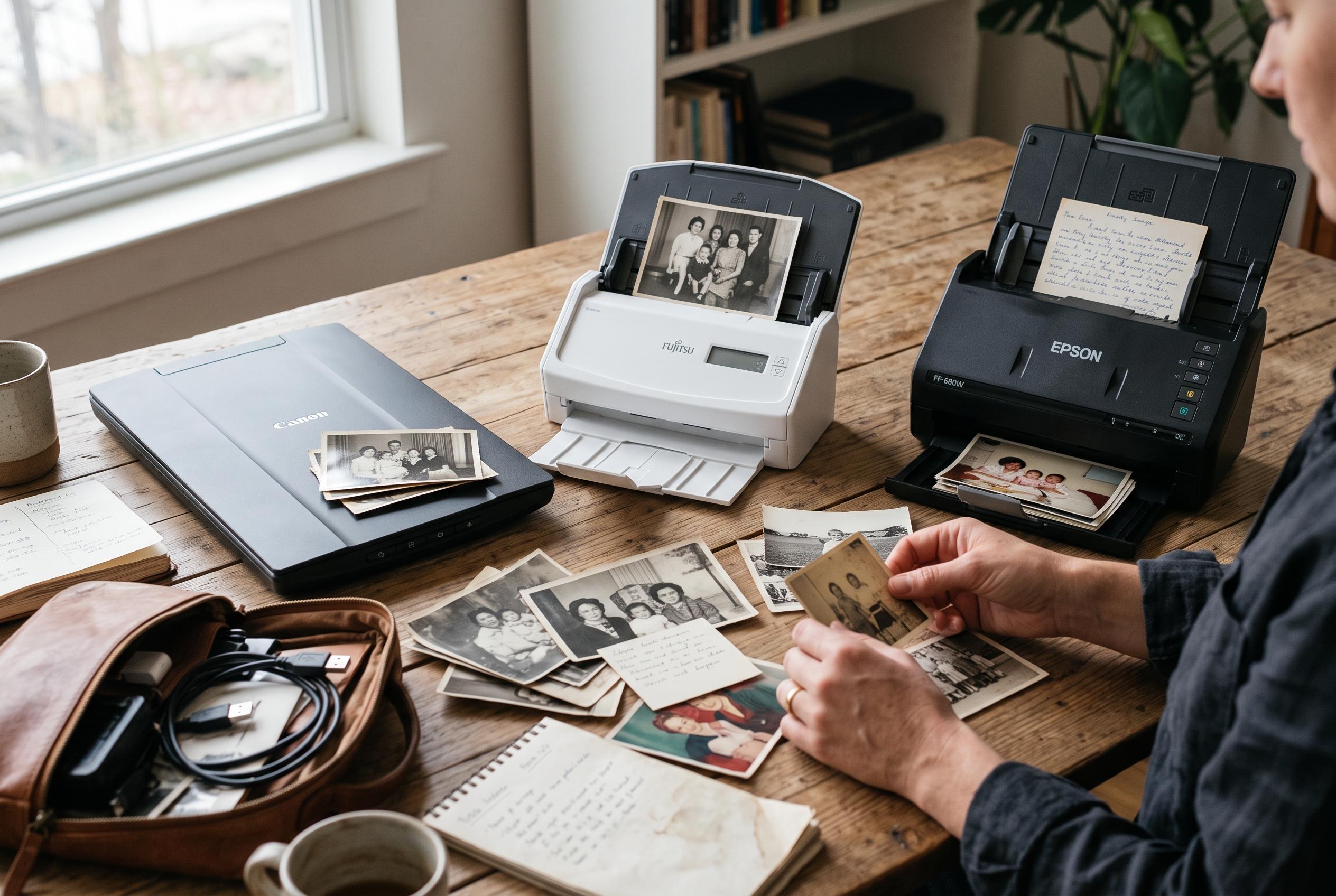

Portable scanners now range from high-speed photo feeders that capture handwritten backs to slim flatbeds and battery-free travel models, with each type making a different trade-off between image quality, speed and convenience.
Portable photo scanners now cover a wider range of uses than simple photo archiving. The best models can preserve family prints, capture handwritten notes on the reverse side, and also handle receipts, forms and business cards without demanding a full-sized office setup. The result is a market that splits broadly between fast feeder-based scanners for bulk work, compact flatbeds for image quality, and ultra-light mobile units for travel.
For large photo collections, the Epson FastFoto FF-680W remains the most capable choice among the scanners reviewed here. TechGearLab says it can process up to 36 photos at a time, scan a print in about a second at 300 dpi, and capture both the front and handwritten back in a single pass. Digital Camera World adds that it also handles instant film such as Polaroid and Instax, while iTechGuides notes its 600 dpi optical resolution, wireless connection and cloud-back-up features. Its chief limitation is obvious: at 8.2 pounds, it is compact for a photo feeder but still better suited to a desk than a suitcase.
For occasional scanning where detail matters, the Canon CanoScan LiDE 300 offers a simpler route. Canon says the slim flatbed delivers 2400 x 2400 dpi optical resolution and uses Auto Scan Mode to identify the original on the glass and set the scan accordingly. That makes it suitable for single photos, receipts, business cards and paperwork. The trade-off is speed, since flatbeds process one item at a time, and the USB-only design gives less flexibility in placement.
At the other end of the size scale, the HP HPPS100 and Brother DS-640 are built around mobility rather than archiving. The HP model weighs about 3 ounces and scans up to 15 pages per minute, while Brother’s unit is roughly 1 pound and less than a foot long, with a quoted speed of up to 16 pages per minute. Both are aimed at travellers and remote workers who need to capture documents, cards and the occasional photo without carrying a larger machine. Their strength is convenience; their weakness is that they are single-sheet devices with lower image ambition than the better flatbeds.
The Epson WorkForce ES-50 sits in a practical middle ground for mobile paperwork. Epson says it can scan a page in as little as 5.5 seconds, runs from USB power without batteries, and handles receipts, IDs and long documents up to 8.5 by 72 inches. That makes it well suited to business trips and day-to-day administration. It is less appropriate for people trying to digitise a substantial photo archive, where feeder speed and back-side capture matter more.
For users who want one compact device that can also manage documents efficiently, the ScanSnap iX1300 is the most versatile of the bunch. Its duplex scanning, USB and Wi-Fi connectivity, and automatic de-skew and blank-page removal make it better suited to mixed workloads than to photo-only use. By contrast, the Canon imageFORMULA R10 focuses on organised document batches, with a 20-sheet feeder, duplex scanning and a 12-page-per-minute rating, but it is not intended for photo paper or photographic media. Those two models underline a useful distinction: not every portable scanner that can scan a photo is truly a photo scanner.
For buyers whose priority is image fidelity, Epson’s Perfection V19 II and Canon’s CanoScan LiDE 400 are the stronger flatbed picks. Epson’s model offers 4800 dpi optical resolution, a removable high-rise lid for books and albums, and colour-restoration tools aimed at faded prints. Canon’s LiDE 400 matches that emphasis on quality with 4800 x 4800 dpi resolution, USB Type-C power and data, and built-in enhancement features for dust removal and colour correction. Both are better for careful preservation than for speed, and both favour people who scan individual images rather than piles of paper.
A handheld option completes the picture. The AOZBZ 900DPI scanning wand stores files directly to a Micro SD card and offers 300, 600 and 900 dpi settings, which gives it a level of independence missing from most of the other machines in this category. It is useful when space is scarce or when users want a scanner that works without immediate software setup. But handheld scanning demands a steady hand and does not match the consistency of a feeder or flatbed, especially for anyone seeking repeatable quality across a larger set of prints.
The selection as a whole shows that “portable” can mean very different things. A high-volume household will value the FastFoto’s feeder and back-side capture. Someone preserving family albums may prefer the care and resolution of a flatbed. Travellers and office workers are better served by a lightweight sheet-fed model with USB power. The right answer depends less on the label on the box than on the kind of originals being scanned, how often they will be scanned, and how much control the user wants over image quality, speed and workflow.
Disclaimer: This content is intended for informational purposes only. Readers are advised to exercise their own judgement, conduct due diligence, or consult a qualified expert before acting on any information provided.



