

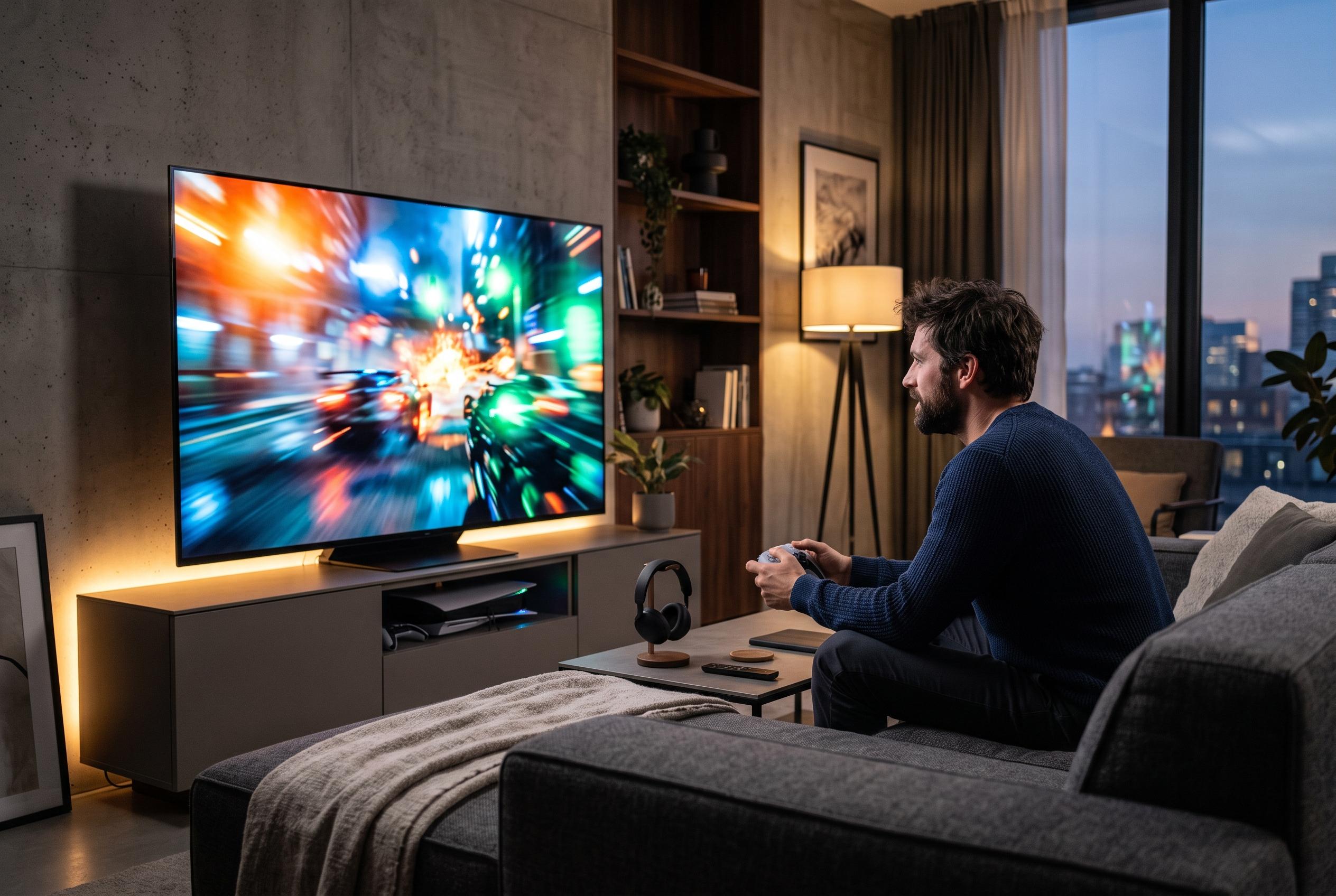

A 2026 feature-led comparison puts the Hisense U8 ahead on refresh rate and brightness, while Sony’s BRAVIA 3 II offers the clearest HDMI 2.1 match for PS5 owners.
At 75 inches, a gaming television only earns its place if it can keep pace with current hardware. That means more than a marketing label: buyers should look for a native refresh rate of at least 120Hz, variable refresh rate support, auto low latency mode and, where possible, HDMI 2.1 inputs. Smart Home Perfected’s 2026 round-up focuses on five models whose Amazon listings explicitly name at least one of those gaming features, giving console and PC owners a clearer basis for comparison.
The strongest all-round choice in that guide is the Hisense U8. Its listing names a native 165Hz panel, a VRR range from 48Hz to 165Hz, ALLM and AMD FreeSync Premium Pro, which places it ahead on raw gaming specifications. The same listing also points to a Mini LED backlight with QLED colour, up to 5,600 local dimming zones and peak brightness of up to 5,000 nits, making it the brightest and most finely segmented panel among the five models discussed. For buyers who care as much about image impact in a bright room as they do about responsiveness, that combination is difficult to ignore.
For PlayStation 5 owners, the Sony BRAVIA 3 II is the clearest match. Smart Home Perfected says its title names four HDMI 2.1 ports, while the feature line states 4K at 120Hz, VRR and ALLM together. Sony also lists PS5-specific functions such as Auto HDR Tone Mapping, Auto Genre Picture Mode and a Game Menu, which should make setup easier and ensure the television is tuned for console use rather than general entertainment. It is not a Mini LED or OLED set, so it is not the most advanced panel in the group, but it is the most explicit about HDMI 2.1 support.
The TCL QM7L occupies a useful middle ground for buyers who want strong gaming performance without stretching to the top-priced option. Its listing states 144Hz, Game Accelerator 288 VRR and AMD FreeSync Premium Pro, while the panel is described as SQD Mini LED QLED with an anti-reflective coating and up to 2,100 local dimming zones. That gives it a clear advantage over standard LED sets for contrast and daytime viewing, although Smart Home Perfected notes that ALLM and HDMI 2.1 are not called out in the listing. For many PC gamers, though, the combination of 144Hz and VRR is sufficient and the panel specification is a sensible compromise.
Samsung’s M80H and Roku’s Pro Series round out the list with different strengths. The Samsung model is the simpler proposition: Motion Xcelerator 144Hz, VRR, Mini LED backlighting and AI processing are stated, but the listing does not name ALLM, HDMI 2.1 or a FreeSync variant. The Roku Pro Series is the most straightforwardly described gaming package, with 120Hz, ALLM, VRR and FreeSync Premium Pro appearing together in the same sentence, plus Dolby Vision IQ and Bluetooth Headphone Mode for late-night use. It does not match the Hisense or TCL on peak refresh, but its feature list is unusually direct for shoppers who want to see the gaming credentials spelled out.
Taken together, the guide reinforces a point echoed by broader TV buying advice from TechRadar and Tom’s Guide: for gaming, panel type matters, but connectivity and refresh rate matter just as much. Their 2026 round-ups also favour sets with strong brightness, low input lag and full HDMI 2.1 support, particularly for PS5 and Xbox Series X owners. In that context, the Smart Home Perfected list is best read as a feature-led shortlist rather than a pure picture-quality ranking. If a buyer wants the most complete gaming specification on the page, the Hisense U8 stands out. If the priority is explicit HDMI 2.1 support for a current console, the Sony BRAVIA 3 II is the clearest fit.
Disclaimer: This content is intended for informational purposes only. Readers are advised to exercise their own judgement, conduct due diligence, or consult a qualified expert before acting on any information provided.



