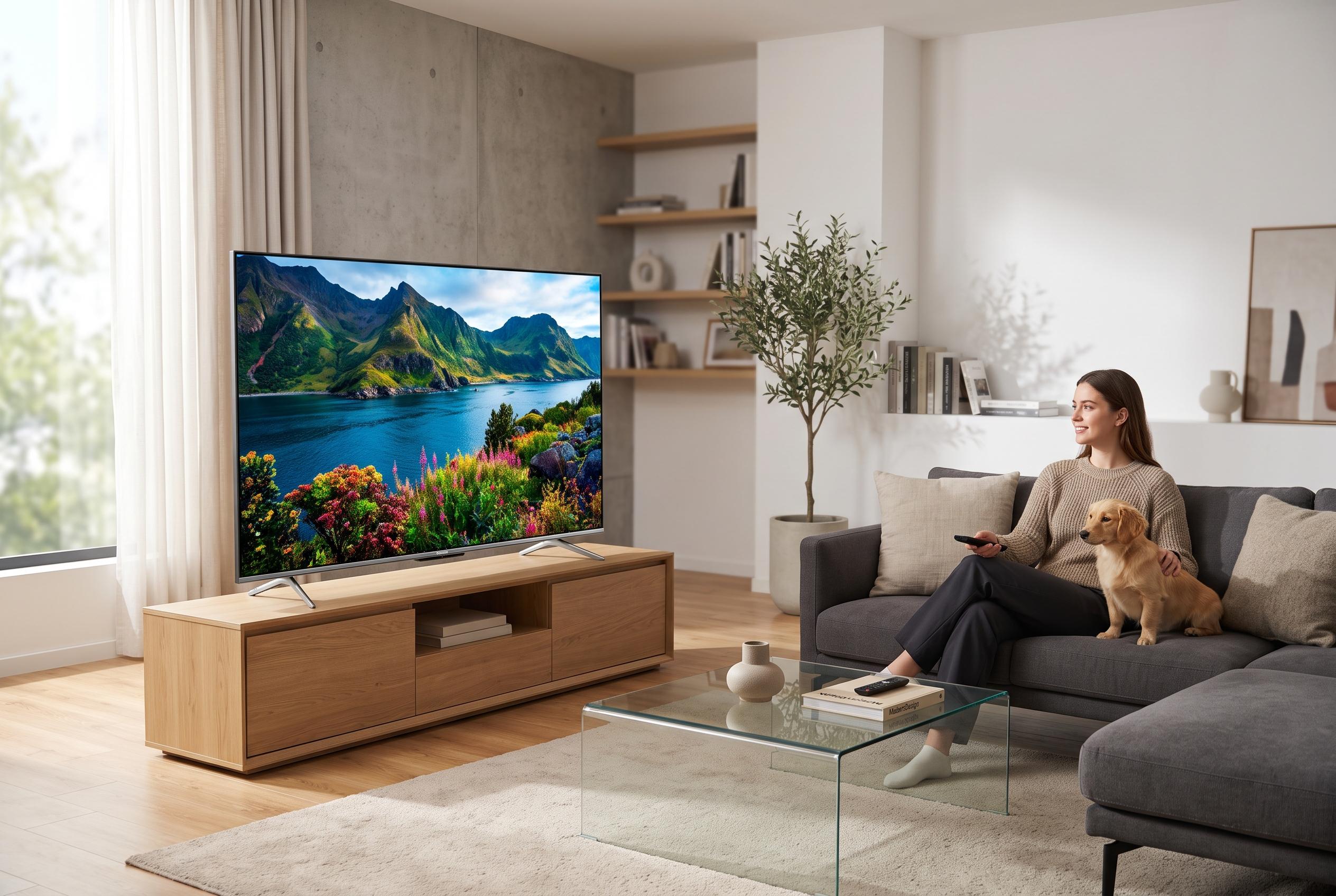

Hisense’s latest UR8 model introduces more affordable RGB mini-LED technology, offering notable features but falling short of redefining the premium TV hierarchy, as critics point to contrasts in colour performance and black levels.
TechRadar’s assessment of the Hisense UR8 suggests that RGB mini-LED is arriving in a more affordable form, but not yet in a way that dislodges OLED. The review says the set combines strong backlight control, capable sports handling and a wide gaming feature set, yet the colour performance that should define the category does not fully deliver the expected leap. In other words, the UR8 looks like an important step for the technology, but not a breakthrough that changes the hierarchy of premium TV panels.
Hisense has placed the UR8 below the flagship UR9 in its RGB mini-LED line-up, with sizes from 55 inches to 85 inches and a 100-inch model in some markets. TechRadar noted launch pricing of $1,999 in the US, £2,299 in the UK and AU$2,495 in Australia for the 65-inch version, although US prices have already fallen sharply. That regional spread matters: the review argues the model is competitive in the US and Australia, but in the UK it is priced close to, and sometimes above, OLED rivals such as the LG C6, weakening the case for buying it on value alone.
The appeal of the UR8 is not hard to understand. Hisense says the set uses an RGB mini-LED backlight, an anti-glare panel, a Hi-View AI Engine RGB processor and a 2.1.2-channel sound system tuned by Devialet. The company also claims wide colour coverage, including 100% of the BT.2020 gamut, while the TV supports Dolby Vision, HDR10+ and four HDMI 2.1 ports with refresh rates of up to 180Hz. What Hi-Fi? similarly described the UR8 as a feature-rich package, while Notebookcheck positioned it as the more affordable entry in Hisense’s new RGB mini-LED range.
Independent testing, however, shows a more complicated picture. RTINGS said the UR8SG delivers high peak brightness, strong gaming support and low input lag, but still leaves room for improvement in black levels, contrast and sound. TechRadar’s own measurements were striking: the UR8 posted very high colour gamut figures and strong brightness numbers, yet the reviewer still found the picture less vivid than expected, particularly when compared side by side with Samsung’s QN80H. The result was natural and detailed rather than dramatically bold.
That tension runs through the entire review. The UR8 performs well in motion, handles bright-room viewing effectively and offers a useful spread of gaming and smart TV features, with Google TV in the US and VIDAA in the UK and Australia. But the set’s biggest promise, according to TechRadar, remains only partly fulfilled. RGB mini-LED is clearly advancing, and the UR8 is a credible mainstream product, but it still does not have the colour impact, black-level depth or overall consistency needed to be called an OLED challenger.
Disclaimer: This content is intended for informational purposes only. Readers are advised to exercise their own judgement, conduct due diligence, or consult a qualified expert before acting on any information provided.