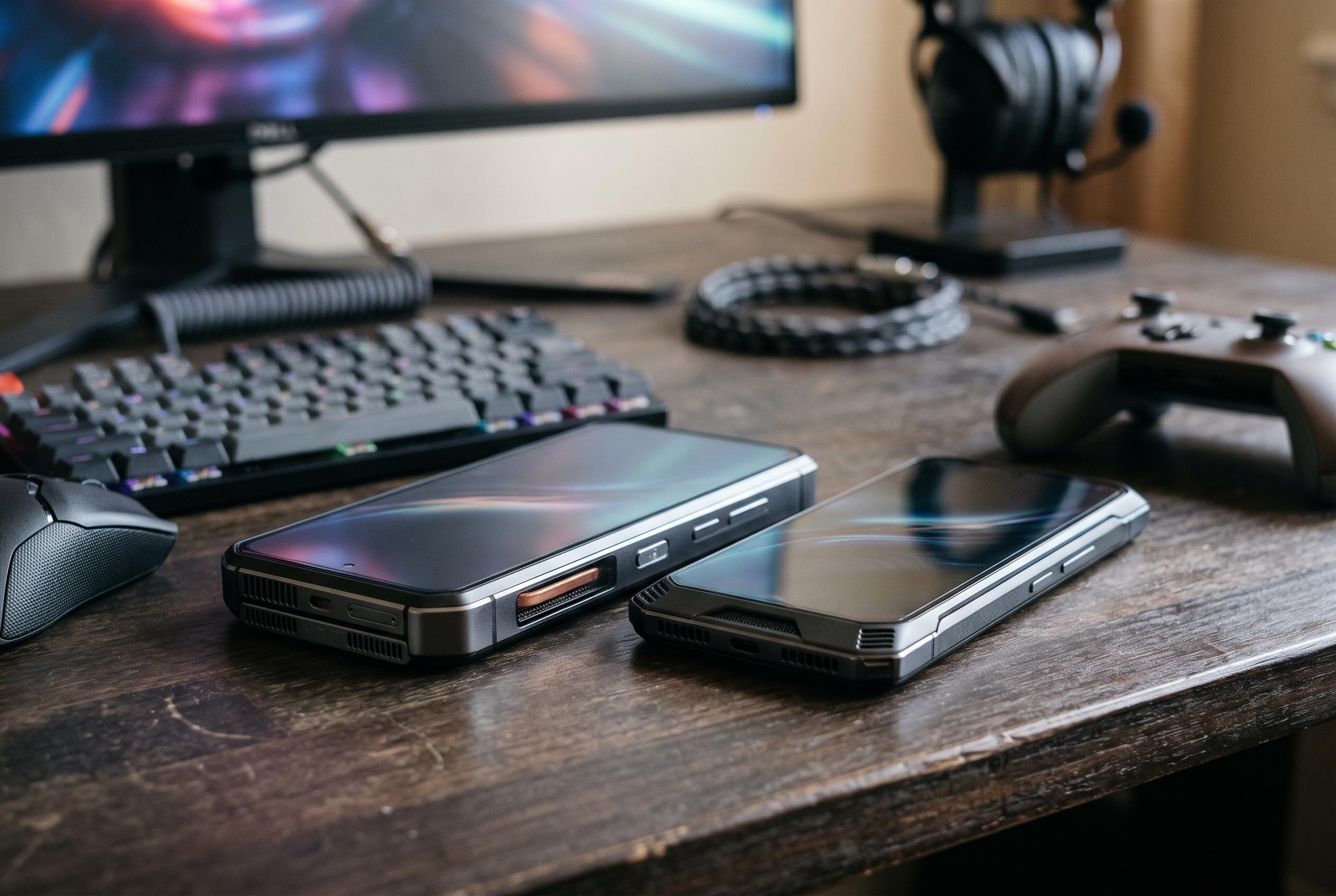

Both phones pair Qualcomm’s Snapdragon 8 Elite Gen 5 with 185Hz displays and active cooling, but Honor undercuts iQOO on price and adds a much larger battery and stronger cameras.
iQOO’s Neo 12 and Honor’s WIN RT 2 have turned Chinese gaming phones into a closer contest than their price tags suggest. Both models are built around Qualcomm’s Snapdragon 8 Elite Gen 5, both use 2K displays with a 185Hz refresh rate, and both include active cooling fans intended to reduce throttling during long gaming sessions. iQOO put the Neo 12 on sale in China on 28 October 2026, one week after Honor launched the WIN RT 2, making this a direct clash between two performance-focused handsets rather than a simple generational upgrade. According to the product pages from Vivo and Honor, the real differences lie in the supporting hardware, not the headline chip.
On price, Honor has the edge across every matching memory and storage tier. Honor’s launch materials and independent launch coverage put the WIN RT 2 at CNY 4,199 for the 12GB/256GB model, while iQOO’s Neo 12 starts at CNY 4,399 for the same configuration. That gap remains as the storage increases, though iQOO alone offers a 1TB version. The wider point is that both phones have become substantially more expensive than their predecessors, reflecting the sharp rise in memory costs and the pressure created by demand from AI data centres. In practical terms, neither device is cheap by the standards of previous gaming phones, but Honor is the less expensive entry point.
The design and durability figures favour Honor, albeit by a narrow margin. Vivo lists the Neo 12 at 225g to 229g, depending on the back material, while Honor’s WIN RT 2 is heavier at 238g. Both phones carry IP68 and IP69 protection, but Honor adds IP69K, a stricter water-jet rating that gives it an extra durability claim on paper. Honor also leans harder into gaming aesthetics, with a rear light ring and more than 40 lighting effects, while iQOO takes a more restrained approach. Vivo’s own product information also emphasises dust screens around the fan intake, which is a useful detail for long-term reliability in a phone that still has moving parts inside.
Display specification is more evenly matched. Both devices use 2K OLED panels and support 185Hz in compatible games, so motion smoothness should be broadly similar. Honor’s promotional figure of 10,000 nits is a peak HDR number, not the brightness most users will see in daily use; its more relevant high-brightness figure is 2,000 nits. iQOO quotes 2,200 nits, which gives it a slight advantage for direct sunlight use if the claims are measured in the same way. Honor counters with a much higher PWM dimming frequency, which should reduce visible flicker for sensitive users, while iQOO adds DC dimming as an alternative. On paper, that makes this round close to a draw, with each phone offering a different answer to eye comfort.
Performance is where iQOO becomes more specialised. The Neo 12 pairs the Snapdragon 8 Elite Gen 5 with its Q3 gaming chip, which Vivo says enables upscaling, frame generation and ray tracing in supported games. Honor also uses in-house gaming and display hardware, but its published material is less explicit about a comparable game-by-game feature list. Benchmarks reported ahead of launch suggested the Neo 12 had a small lead, although such figures can vary with firmware and test conditions. The more important distinction is that iQOO is clearly targeting players who want the most aggressive gaming enhancements, while Honor is presenting a more balanced high-performance package.
Battery life is where Honor makes its strongest case. The WIN RT 2’s 12,070mAh silicon-carbon battery is unusually large for a mainstream handset, and it is paired with 90W wired charging and 27W wired reverse charging. iQOO’s 9,000mAh battery is still large, but it is notably smaller, even though it supports 100W charging. That means the Neo 12 should refill faster, while the Honor should last longer between charges. For most buyers, the larger battery is likely the more valuable advantage, because it affects daily use rather than just top-up speed. The camera system also tilts clearly towards Honor, which uses a 200-megapixel main sensor, a 12-megapixel ultrawide and a 50-megapixel front camera, compared with iQOO’s 50-megapixel main camera, 8-megapixel ultrawide and 16-megapixel selfie camera.
Taken together, the WIN RT 2 looks like the better all-round phone, while the Neo 12 is the more focused gaming device. Honor offers the lower starting price, the bigger battery, the stronger camera array and the additional IP69K rating. iQOO answers with a dedicated gaming chip, faster charging and a 1TB option that Honor does not match. For buyers who care most about sustained gaming features and storage capacity, the Neo 12 remains the more specialised choice. For everyone else, Honor’s cheaper and more complete package is easier to recommend.
Disclaimer: This content is intended for informational purposes only. Readers are advised to exercise their own judgement, conduct due diligence, or consult a qualified expert before acting on any information provided.