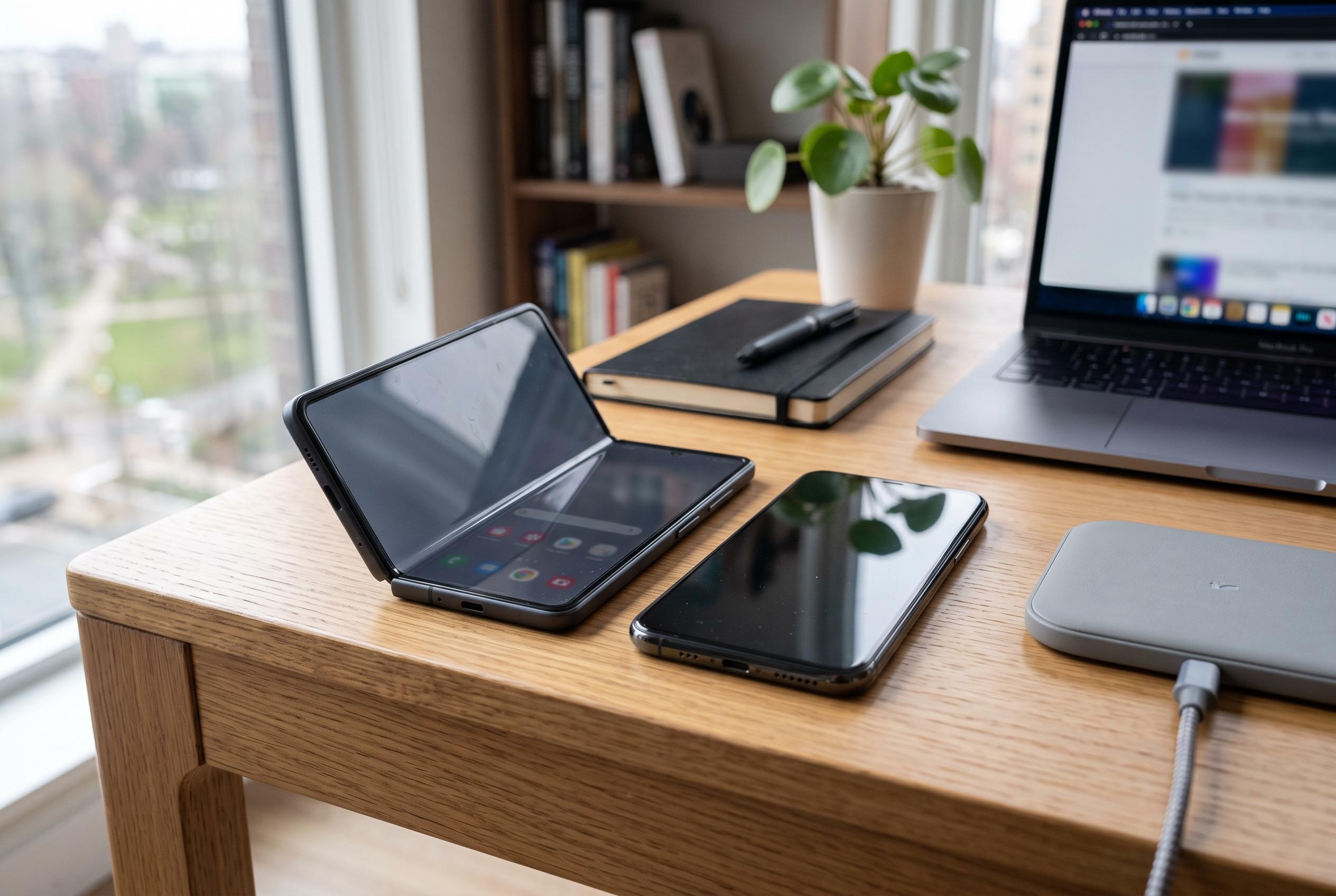

Samsung’s latest comparison between the Galaxy Z Fold8 Ultra and the Galaxy S26 Ultra highlights the evolving debate between versatile foldables and traditional flagships, with each device appealing to different user needs.
Samsung’s latest head-to-head between its foldable and conventional Ultra models comes down to a simple question: whether the added versatility of a large folding screen justifies the extra cost and the compromises that still come with a bendable device. The Galaxy Z Fold8 Ultra and the Galaxy S26 Ultra are closer in size, weight and everyday handling than their different designs suggest, but their priorities remain sharply distinct. According to GSM Arena’s comparison, the Fold is the more ambitious device, while the S26 Ultra is the more conventional flagship that is easier to recommend on practical grounds.
On paper, the Z Fold8 Ultra is the more unusual achievement. It packages a 6.5-inch outer screen and an 8-inch inner panel into a body that weighs almost exactly the same as the S26 Ultra, which has a 6.9-inch display. Samsung has also worked to reduce the usual foldable penalties. The company says the new hinge is designed to open more smoothly, and it has added a revised display structure it calls “Flex Titanium” to improve durability and reduce crease visibility. Even so, Samsung’s own design comparison material still places the foldable in a different category from the slab-style S-series, and the S26 Ultra retains the more straightforward build, with stronger dust protection and a full IP68 rating.
Display quality is a clear strength for both phones, but for different reasons. The S26 Ultra has the sharper single screen and adds S Pen support as well as Samsung’s Privacy Display feature. The Z Fold8 Ultra, however, gives users two very different viewing experiences, and that is the real attraction. As What Hi-Fi reported, Samsung positions the Fold8 Ultra as its brightest Galaxy phone yet, and GSM Arena’s measurements suggest both devices are more than bright enough for outdoor use. In practice, the foldable’s cover screen is suited to quick tasks, while the internal display is the one that changes how the phone is used, especially for reading, multitasking and tablet-style apps.
Battery life and charging are still areas where the traditional Ultra has the edge. Both devices use 5,000mAh batteries, but GSM Arena found the S26 Ultra to last longer in real-world testing, particularly when the Fold8 Ultra’s larger internal panel is in use. Charging is faster than on previous Samsung foldables, yet the S26 Ultra still charges more quickly at 60W wired and 25W wireless, compared with 45W and 20W on the Fold. That is consistent with AT&T’s comparison, which also places the conventional Ultra ahead on endurance and charging speed.
Performance is more evenly matched than the battery results might suggest. Both phones use Qualcomm’s Snapdragon 8 Elite Gen 5 for Galaxy, with 12GB of RAM on base versions and up to 16GB on higher trims. GSM Arena found the S26 Ultra a little quicker in short bursts, but the gap narrows under sustained load, where both phones throttle. Samsung says the Fold8 Ultra uses an expanded graphite cooling structure to help with heat dissipation, and while that does not make it class-leading under heavy stress, it does keep the device usable without becoming uncomfortable.
The biggest practical separation comes from cameras. The Fold8 Ultra essentially mirrors the S26 Ultra’s imaging setup, but without the 5x telephoto lens. Main camera quality is broadly similar in daylight, and the ultrawide and 3x zoom outputs are close enough that most users would struggle to tell them apart at a glance. The S26 Ultra pulls ahead more clearly at longer zoom ranges and in low light, where its brighter main lens and dedicated 5x camera give it more flexibility and cleaner results. PhoneArena and Tom’s Guide have both highlighted that same pattern: the foldable’s camera system is capable, but the conventional Ultra is still the more complete imaging phone.
Selfies are one of the few areas where the Fold8 Ultra has a genuine advantage. It offers front cameras on both displays, but more importantly it can use its rear cameras for self-portraits, giving it a level of flexibility the S26 Ultra cannot match. Video features are closely aligned, with both phones supporting Samsung’s newer recording options, including Log capture and APV support, although again the S26 Ultra benefits from the extra 5x camera when zoomed footage matters.
The result is a choice defined less by raw specification and more by use case. The Galaxy S26 Ultra is the safer recommendation: tougher, longer lasting, faster to charge, better at long-range zoom and cheaper. The Galaxy Z Fold8 Ultra is the more compelling device for anyone who will actually make use of its folding design. It is not just a phone with a gimmick attached; it is a pocketable dual-screen product that changes how the device can be used. Samsung’s own support material frames the two product lines in exactly those terms: one is the familiar Ultra flagship, the other is the more experimental device built for users who want a larger, more adaptable mobile workspace.
Disclaimer: This content is intended for informational purposes only. Readers are advised to exercise their own judgement, conduct due diligence, or consult a qualified expert before acting on any information provided.