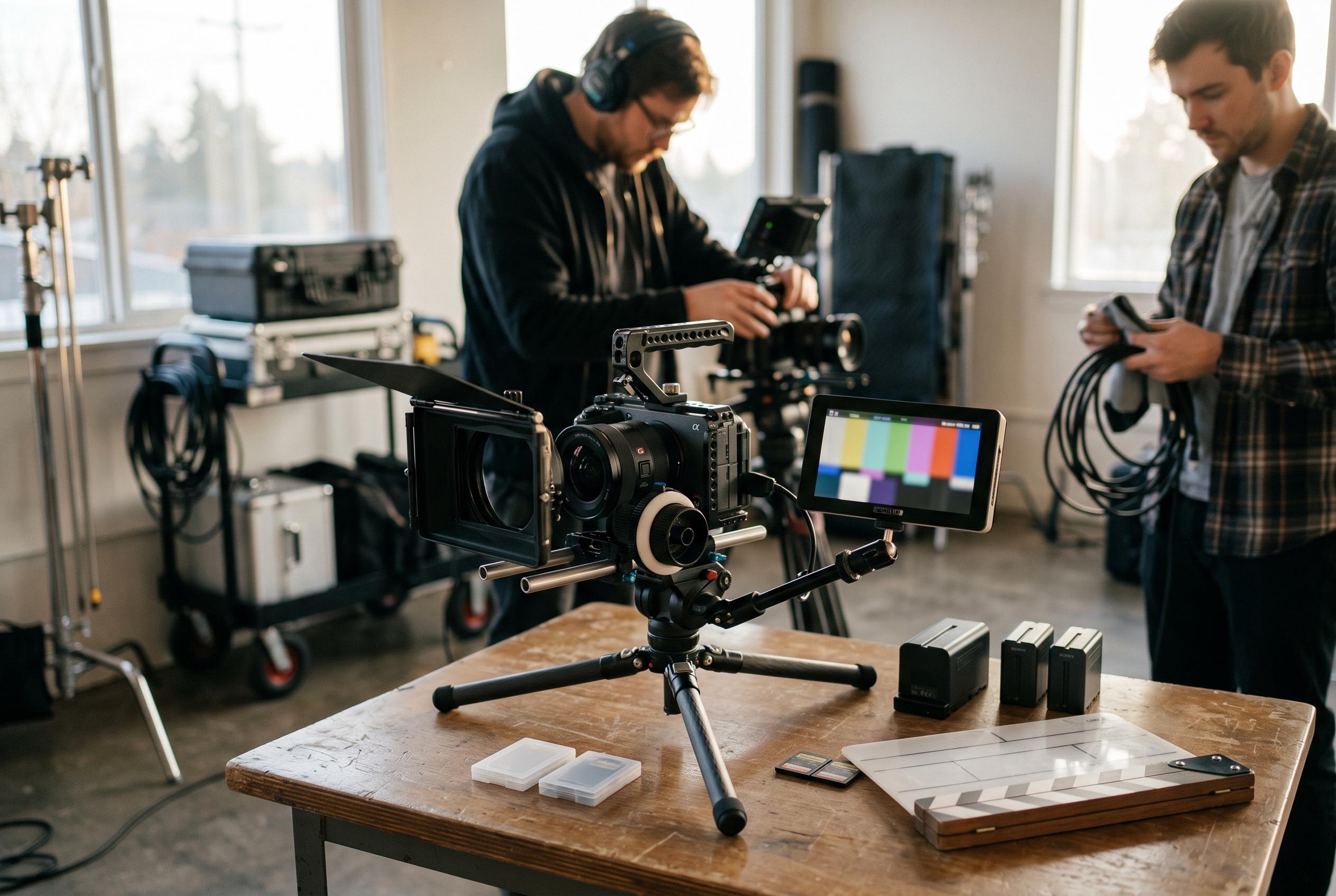

Short Film Central’s latest guide highlights the continued relevance of Super 35 format in 2026, praising the Sony FX30 as the top all-round camera in a competitive field that balances image quality, affordability, and versatility for diverse production needs.
Short Film Central’s latest guide treats Super 35 as the practical centre of indie cinema in 2026, arguing that the format still offers the best balance of image quality, lens choice and total system cost for narrative filmmakers, documentary crews and short-form creators. The article frames the format as a modern continuation of 35mm motion picture traditions, and says its appeal remains tied to a familiar mix of cinematic depth of field, broad lens compatibility and manageable budgets. It also positions the roundup as a hands-on comparison rather than a spec sheet exercise, with the publication saying it tested cameras across short film scenes, interviews and run-and-gun shoots before ranking them.
At the top of the list is the Sony FX30, which the guide presents as the strongest all-round choice for solo shooters and low-budget indie productions. Short Film Central says the camera’s appeal rests on its compact body, strong autofocus, dual base ISO and Sony’s S-Cinetone colour profile, which the site describes as giving footage a polished look with minimal grading. That emphasis on portability and reliable tracking is consistent with independent review coverage of Sony’s current cinema line, which has generally praised the FX30’s small form factor and practical workflow for gimbal, documentary and one-person crews.
The Blackmagic Pocket Cinema Camera 6K Pro is positioned as the best value option, particularly for filmmakers who want built-in neutral density filters and Blackmagic RAW recording without moving into a far more expensive cinema body. TechRadar’s review noted the camera’s 5-inch HDR touchscreen, mini XLR inputs and USB-C recording support, while other assessments highlighted its thermal behaviour, RAW workflow and battery limitations under sustained 6K recording. Taken together, those observations support Short Film Central’s view that the 6K Pro is strongest when image quality and grading latitude matter more than battery endurance or autofocus.
For higher-end narrative work, the guide singles out the Blackmagic URSA Mini Pro 4.6K G2 as the most serious cinema tool in the roundup. Short Film Central points to its high dynamic range, interchangeable mount system and integrated ND filters as reasons it suits controlled productions with a dedicated crew. That recommendation fits the camera’s design intent: a heavier, more fully featured body aimed at set-based work rather than lightweight solo operation. The same logic also explains why the site treats the URSA Mini Pro 12K as a specialist machine rather than a default choice, since its ultra-high-resolution workflow is best suited to VFX-heavy jobs and productions with substantial storage and post-production capacity.
Canon’s EOS C70 is presented as the documentary favourite, largely because of its Dual Pixel autofocus, built-in ND system and compact cinema body. Short Film Central argues that those features make it particularly useful for solo operators who need dependable focus during interviews, walk-and-talks and fast-changing locations. The company’s own positioning of the C70 as a professional 4K production camera is broadly in line with that assessment, and it helps explain why the model is framed as the strongest option for crews that prioritise speed and accuracy over a larger raw-recording workflow.
The Canon EOS C200 and EOS C100 Mark II fill narrower but still relevant roles. Short Film Central describes the C200 as a workhorse for filmmakers who want internal Cinema RAW Light recording and Canon colour in a robust body, while the C100 Mark II is cast as an entry-level, lightweight choice for students, first-time documentary shooters and event videographers who do not need 4K. That split reflects a clear workflow distinction: the C200 is aimed at production value and grading flexibility, whereas the C100 Mark II is valued for simplicity, endurance and approachable handling.
Panasonic’s AU-EVA1 rounds out the list as the high-frame-rate specialist. The guide says its 5.7K sensor, dual native ISO and ability to record 4K at 60fps and 2K at 240fps make it useful for music videos and slow-motion-heavy narrative work. In the context of the wider roundup, that places the EVA1 as a more specific tool than the Sony or Canon bodies, but one that remains attractive where speed, motion options and low-light performance must coexist in a single camera package.
What gives the guide its practical value is not just the ranking, but the way it narrows the decision to a few production realities: autofocus, built-in ND filters, codec choice, lens mount and total rig cost. Short Film Central argues that these factors matter more than headline resolution alone, and that remains a useful way to judge Super 35 cameras in 2026. The site’s broader message is clear: for most indie filmmakers, the right camera is the one that fits the shoot style, the lens kit and the post-production pipeline, not simply the one with the biggest sensor or the most pixels.
Disclaimer: This content is intended for informational purposes only. Readers are advised to exercise their own judgement, conduct due diligence, or consult a qualified expert before acting on any information provided.